In 2011, former NFL quarterback and current analyst Ron Jaworski wrote The Games That Changed the Game. He examines transformative offensive and defensive innovation in pro football. Why should we care? Our thinking, literally our brain structure and chemistry, changes according to inputs like diet, exercise, sleep, and stimulation. Learning changes our thinking by changing our brains.
In the final chapter, "Jaws" analyzes the Patriots' 2002 Super Bowl game plan against the Rams' "Greatest Show on Turf". He breaks down key moments and how innovation and departure from conventional wisdom brought victory.
He begins with a digression to the 1976 season, where lowly Detroit assistant Bill Belichick helps inspire a game plan to defeat the 1976 Patriots, a team that defeated both Pittsburgh's "Steel Curtain" and the eventual Super Bowl titlest Raiders. The Lions used a two-tight end, two wide offense that stymied the Patriots 30-10, the week after the Pats beat the Raiders 48-16.
Jaworski indulges readers in an understanding of the chimeric Belichick, who stresses forward thinking, not dwelling on last week's results. His primary intent is to neutralize what you do well, seemingly impossible while outmanned and outgunned against future Hall of Famers Kurt Warner and Marshall Faulk.
For example, on Ty Law's interception (above), Richard Seymour (93) lines up over center and rushes to attack the right tackle (in twist action), resulting in confusion and pressure from outside linebacker Mike Vrabel.
Belichick commits to hitting Faulk on every play, pressing the wide receivers while playing extra DBs, and severely limiting blitzing, the opposite of what Belichick orchestrated in a 24-17 regular season loss to the Rams.
The overarching themes of the "Bull's-Eye Game Plan" were change and creativity. Belichick feels unfettered by convention. Rams' coach Mike Martz wanted to win "his way", with an explosive passing attack, reminiscent of the Falcons' 2017 offense, whose pass-happiness eventually led to unhappiness.
None of this entitles us to believe we belong in Belichick's class. But it suggests that when facing unfavorable size and skill matchups, that we embrace curiosity and creativity. Developing solutions requires openness and willingness to change.
Basketball matchups seldom allow as much tactical change. Nobody in the NBA can handle LeBron one-on-one.
The Celtics tried to give Jae Crowder (x3) 'extreme help' choosing their poison...a hail of three-pointers from Cavalier perimeter shooters like Kevin Love (5) or Kyrie Irving (1).
The Celtics chose this strategy because James torched them in Game 1 getting to the rim relentlessly regardless of his defender.
(48 + (0.5 x 19))/85 = 57.5/85 yields a blistering 67.6 effective field goal percentage for Cleveland in Game 2.
The more we learn, the better our chance to compete, providing that we can execute competently.
Total Pageviews
Sunday, May 21, 2017
Fast Five Plus: Core Principles for Players or Coaches
Successful coaches add value to their situation and team. General Ray Odierno's statement that leadership reflects character, commitment, and competence resonates. Success demands great character and process.
A couple of diagrams apply.
"Never give in; never give in, never, never, never. In nothing great or small, large or petty, never give in." Persistence can overcome and outlast adversity.
4. Perspiration. "The magic is in the work." We choose whether to invest or to spend our time and our energy. "Don't cheat the drill" means don't cheat your teammates.
5. Performance-focused. Ohio State football Coach Urban Meyer reminds, "A to B, 4 to 6." On a given play, a player goes from point A to point B, for 4 to 6 seconds." Then, they do it over. Aristotle said it differently, "Excellence then, is not an act, but a habit." Compete to your fullest this possession...and again.
6. Positivity. Positive people believe in themselves, live and play purposefully. We choose whether to be positive and spread positive thoughts and behaviors. Remind players "you can do this" and "I believe in you."
A couple of diagrams apply.
The first is from Brett Ledbetter, who wrote What Drives Winning. With young players in development, I emphasize the process needed for success, not outcomes. Who we are defines us, not our record, although we want to become our "better version."
The second is from Stephen M.R. Covey and The Speed of Trust. Here's an excellent book summary. What people see is 'above ground'. What we are forms the base. Some powerful and influential people lack integrity and positive intent, like dictators, career criminals, and some professionals. Warren Buffett said, "Success demands intelligence, energy, and integrity. But the first two without the latter are dangerous."
Young people need positive role models. When they see selfishness, disrespect, and unfairness, they either quit or are influenced by that dark side.
We create the "workplace culture' consistent with our attitude, beliefs, and values.
1. Punctuality. I believe in "Dean Smith Time". Show up ready to go before 'official' practice time. A former player who got accepted to the US Naval Academy immediately comes to mind. Young players depend on others for transportation, so there's no consequence.
2. Preparedness. We had evening practice. Prepared players completed other obligations (chores, schoolwork), and were physically (rested, stretched) and mentally (engaged) ready to go. Coaches are prepared via our practice schedule, reflecting process clarity and simplicity.
3. Persistence. Coolidge summarized.
As does Churchill's "Harrow Hall" address:
"Never give in; never give in, never, never, never. In nothing great or small, large or petty, never give in." Persistence can overcome and outlast adversity.
4. Perspiration. "The magic is in the work." We choose whether to invest or to spend our time and our energy. "Don't cheat the drill" means don't cheat your teammates.
5. Performance-focused. Ohio State football Coach Urban Meyer reminds, "A to B, 4 to 6." On a given play, a player goes from point A to point B, for 4 to 6 seconds." Then, they do it over. Aristotle said it differently, "Excellence then, is not an act, but a habit." Compete to your fullest this possession...and again.
6. Positivity. Positive people believe in themselves, live and play purposefully. We choose whether to be positive and spread positive thoughts and behaviors. Remind players "you can do this" and "I believe in you."
Saturday, May 20, 2017
Fast Five: Man-to-Man Defense: Why or Why Not?
Heredity or environment? Task-oriented or relationship-oriented coach? Size or speed?
"Do more of what is working and less of what is not." We work in a bottom-line, results-oriented world. Whatever it takes.
There's room for both man-to-man (in Pete Newell terms, individual assignment) and zone defense. Let's discuss advantages and limitations.
I. Advantages:
1. We set the matchups we like.
2. Responsibility is clear. Your primary responsibility is your assignment. (Corollary: if you do not know your assignment, then you can't be on the floor)
3. The defense directly accounts for everyone.
4. The defense maintains flexibility. We can play tight with full denial, sag and protect the paint, help off weak players, et cetera.
5. We can 'sag' off weak offensive players, allowing additional help.
6. In developmental (youth) settings, practice builds fundamentals.
II. Disadvantages:
1. High fundamental skill is required at every matchup.
2. Defense is vulnerable to screens and back cuts.
3. The primary responsibility is each assignment instead of the ball.
4. Defense may be susceptible to fouling.
5. Transition offense is more difficult.
6. Not designed to cope with 'star' player mismatch.
7. Has potential weakness against pick-and-roll.
Comments and priorities:
III. Whether on or off the ball, every player must have proper stance and positioning.
IV. No easy shots is first priority. That means limiting penetration and challenging shots without fouling.
V. Great 'man' defense pressures the ball but resembles zone away from the ball. Great zone defense still provides pressure on the ball and has some man features away from the ball (communication, especially coping with cutters).
"The help cannot get beat."
We need a 'system' of help, communication, and movement on the pass.
Sophisticated defenses "tag" the cutter. "No free passes."
Players must understand the assignments. Does x2 slide down to 'bother' the cut? Does x4 "lock and trail" or go over? Is there an automatic situational switch- late in shot clock or the period? Players don't know without instruction, repetition, and feedback.
"Do more of what is working and less of what is not." We work in a bottom-line, results-oriented world. Whatever it takes.
There's room for both man-to-man (in Pete Newell terms, individual assignment) and zone defense. Let's discuss advantages and limitations.
I. Advantages:
1. We set the matchups we like.
2. Responsibility is clear. Your primary responsibility is your assignment. (Corollary: if you do not know your assignment, then you can't be on the floor)
3. The defense directly accounts for everyone.
4. The defense maintains flexibility. We can play tight with full denial, sag and protect the paint, help off weak players, et cetera.
5. We can 'sag' off weak offensive players, allowing additional help.
6. In developmental (youth) settings, practice builds fundamentals.
II. Disadvantages:
1. High fundamental skill is required at every matchup.
2. Defense is vulnerable to screens and back cuts.
3. The primary responsibility is each assignment instead of the ball.
4. Defense may be susceptible to fouling.
5. Transition offense is more difficult.
6. Not designed to cope with 'star' player mismatch.
7. Has potential weakness against pick-and-roll.
Comments and priorities:
III. Whether on or off the ball, every player must have proper stance and positioning.
IV. No easy shots is first priority. That means limiting penetration and challenging shots without fouling.
V. Great 'man' defense pressures the ball but resembles zone away from the ball. Great zone defense still provides pressure on the ball and has some man features away from the ball (communication, especially coping with cutters).
"The help cannot get beat."
We need a 'system' of help, communication, and movement on the pass.
Sophisticated defenses "tag" the cutter. "No free passes."
Players must understand the assignments. Does x2 slide down to 'bother' the cut? Does x4 "lock and trail" or go over? Is there an automatic situational switch- late in shot clock or the period? Players don't know without instruction, repetition, and feedback.
Friday, May 19, 2017
Fast Five: Iconic Basketball Photographs
"A picture is worth a thousand words."
James Naismith, founder of basketball...with his peach basket...Naismith was a physician, chaplain, coached at Kansas, and one of his players was the legendary Phog Allen. Naismith's coaching record at Kansas was under .500, so there's hope for all of us.
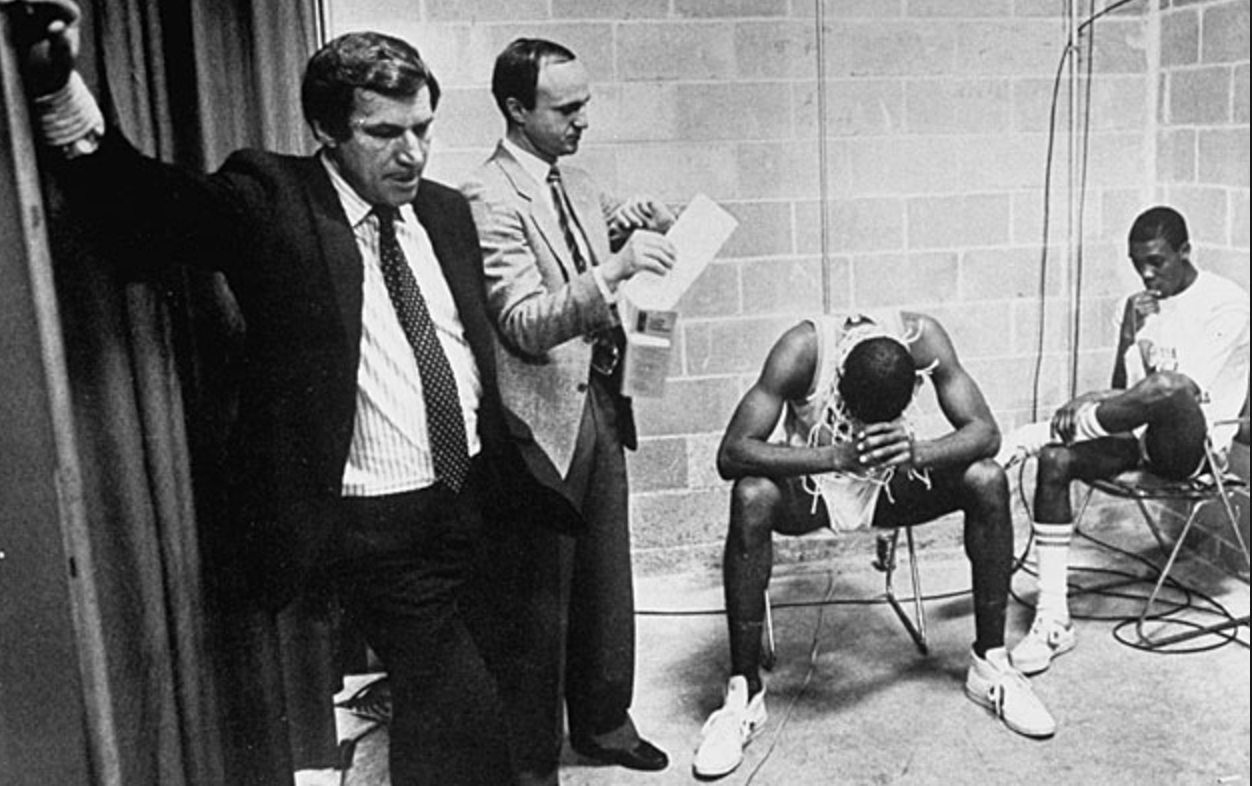
How draining is an NCAA title run? This classic 1982 image shows Dean Smith after winning...
The greatest one-on-one matchup in NBA history, Bill Russell and Wilt Chamberlain.
"The Logo."
1972 Olympics. USA Men's Basketball boycotts the medal ceremony after officiating malfeasance gives Russia the gold.
James Naismith, founder of basketball...with his peach basket...Naismith was a physician, chaplain, coached at Kansas, and one of his players was the legendary Phog Allen. Naismith's coaching record at Kansas was under .500, so there's hope for all of us.
How draining is an NCAA title run? This classic 1982 image shows Dean Smith after winning...
The greatest one-on-one matchup in NBA history, Bill Russell and Wilt Chamberlain.
"The Logo."
1972 Olympics. USA Men's Basketball boycotts the medal ceremony after officiating malfeasance gives Russia the gold.
Better Advice
“Once a president gets to the White House, the only audience that is left that really matters is history.”
― Doris Kearns Goodwin
Coaches dispense advice. Listening and experience inform good advice. If we don't listen, we can't know our players and their strengths, weaknesses, goals, and dreams. Sometimes coaches kill dreams. I knew someone in training to be a Navy pilot. He crashed during a carrier landing and was advised to quit...ten of the hundred pilots in his class died.
Key advice rules:
1. "Never give advice that you couldn't take."
2. "Consider the source." - Jim Bouton, Ball Four
3. "There is nothing cheaper than free advice."
What's the best advice you ever got? As a third year medical student at Boston City Hospital, I got great advice from intern Anne Knowlton, "If you don't speak up, then nobody knows what you know."
The best advice is timely, insightful, and given with good intent. We can share general or specific advice. General wisdom is widely distributed.
Tailor your advice to the person, the time, and the situation.
Dean Smith is known for supporting Michael Jordan's decision to leave Carolina early for the NBA. What was good for Jordan clearly wasn't best interest for Coach Smith or the Tarheels.
In How to Win at the Game of Life, Christian Klemash explains how John Chaney emphasizes the difference between the MEANING of advice and the EFFECT. We can't know what advice Duke's Coach Krzyzewski gave to Grayson Allen last season. But Allen cleaned up his act after the advice...and one game suspension.
Never underestimate the value of good advice. During World War II, President Roosevelt relied so heavily upon General George C. Marshall that he selected General Eisenhower to command US forces in Europe. Roosevelt wanted to keep Marshall in Washington for advice and logistical support.
Doris Kearns Goodwin wrote Team of Rivals: The Political Genius of Abraham Lincoln. He selected multiple political rivals for his Cabinet. He benefited from their political wisdom but also kept enemies close. Some have spoken (coarsely) that it is better to have enemies "inside the tent pissing out than outside the tent pissing in."
The twenty-four hour rule often applies. When we want to respond harshly, it's usually better to cool off for twenty-four hours. Stay positive. Remember Jon Gordon's The Positive Dog. We control our happiness with our thoughts and actions. Shawn Achor reminds us to finish each day with gratitude. Read. Kevin Eastman's two hours of reading a day affords 180 hours a quarter of extra knowledge.
Dispensing better advice begins with taking our own.
Coaches dispense advice. Listening and experience inform good advice. If we don't listen, we can't know our players and their strengths, weaknesses, goals, and dreams. Sometimes coaches kill dreams. I knew someone in training to be a Navy pilot. He crashed during a carrier landing and was advised to quit...ten of the hundred pilots in his class died.
Key advice rules:
1. "Never give advice that you couldn't take."
2. "Consider the source." - Jim Bouton, Ball Four
3. "There is nothing cheaper than free advice."
What's the best advice you ever got? As a third year medical student at Boston City Hospital, I got great advice from intern Anne Knowlton, "If you don't speak up, then nobody knows what you know."
The best advice is timely, insightful, and given with good intent. We can share general or specific advice. General wisdom is widely distributed.
Dean Smith is known for supporting Michael Jordan's decision to leave Carolina early for the NBA. What was good for Jordan clearly wasn't best interest for Coach Smith or the Tarheels.
In How to Win at the Game of Life, Christian Klemash explains how John Chaney emphasizes the difference between the MEANING of advice and the EFFECT. We can't know what advice Duke's Coach Krzyzewski gave to Grayson Allen last season. But Allen cleaned up his act after the advice...and one game suspension.
Never underestimate the value of good advice. During World War II, President Roosevelt relied so heavily upon General George C. Marshall that he selected General Eisenhower to command US forces in Europe. Roosevelt wanted to keep Marshall in Washington for advice and logistical support.
Doris Kearns Goodwin wrote Team of Rivals: The Political Genius of Abraham Lincoln. He selected multiple political rivals for his Cabinet. He benefited from their political wisdom but also kept enemies close. Some have spoken (coarsely) that it is better to have enemies "inside the tent pissing out than outside the tent pissing in."
The twenty-four hour rule often applies. When we want to respond harshly, it's usually better to cool off for twenty-four hours. Stay positive. Remember Jon Gordon's The Positive Dog. We control our happiness with our thoughts and actions. Shawn Achor reminds us to finish each day with gratitude. Read. Kevin Eastman's two hours of reading a day affords 180 hours a quarter of extra knowledge.
Dispensing better advice begins with taking our own.
Thursday, May 18, 2017
Fast Five: The Mental Game
The high schooler makes a brilliant steal and dunks. The next time down, he buries a three. The third time, he commits a charge and immediately "doubles down" with a reach-in foul. He picks up the ball and tosses it to the distant referee, instead of handing it to the adjacent official. You've seen it; what do you do about it?
What are we doing for the players' 'mental game'? Players develop skill, athleticism, and knowledge but not always discipline, emotional control, and psychological fitness. What resources should they engage to inform the head game?
The excellence domains include character, commitment, and competence.
We want to transfer simple, practical, applicable lesson to our players. Here are a few 'easy' shares for players:
Amy Cuddy discusses "power positions" in her well-received TED talk. Assuming expansive positions before job interviews or games can raise testosterone and loser cortisol, a stress hormone.
Pressure degrades performance. Weisinger and Pawliw-Fry share over twenty methods to handle pressure, from putting events into perspective, process thinking, stress balls, to breaking tasks into smaller ones, and listening to music to optimize activation.
Jason Selk suggests breathing exercises, mental highlight reels, and personal statements on identity and performance in 10-Minute Toughness. You are who you believe you are.
Harvey Dorfman practiced tough love for ball players. He confronted players. “What are you going to do about it? What are you going to do to make the appropriate adjustments?” I think his Coaching the Mental Game is a classic.
There is no 'one size fits all' approach. But we choose to train people to handle adversity or allow them to shrink from it. Don't give players unwanted emotional crutches or sponsor temper tantrums preventing a mature game.
"Self-discipline is a form of freedom. Freedom from laziness and lethargy, freedom from the expectations and demands of others, freedom from weakness and fear-and doubt. Self-discipline allows a pitcher to feel his individuality, his inner strength, his talent. He is master of, rather than a slave to, his thoughts and emotions." - Harvey Dorfman
What are we doing for the players' 'mental game'? Players develop skill, athleticism, and knowledge but not always discipline, emotional control, and psychological fitness. What resources should they engage to inform the head game?
The excellence domains include character, commitment, and competence.
We want to transfer simple, practical, applicable lesson to our players. Here are a few 'easy' shares for players:
Amy Cuddy discusses "power positions" in her well-received TED talk. Assuming expansive positions before job interviews or games can raise testosterone and loser cortisol, a stress hormone.
Pressure degrades performance. Weisinger and Pawliw-Fry share over twenty methods to handle pressure, from putting events into perspective, process thinking, stress balls, to breaking tasks into smaller ones, and listening to music to optimize activation.
Jason Selk suggests breathing exercises, mental highlight reels, and personal statements on identity and performance in 10-Minute Toughness. You are who you believe you are.
Harvey Dorfman practiced tough love for ball players. He confronted players. “What are you going to do about it? What are you going to do to make the appropriate adjustments?” I think his Coaching the Mental Game is a classic.
There is no 'one size fits all' approach. But we choose to train people to handle adversity or allow them to shrink from it. Don't give players unwanted emotional crutches or sponsor temper tantrums preventing a mature game.
"Self-discipline is a form of freedom. Freedom from laziness and lethargy, freedom from the expectations and demands of others, freedom from weakness and fear-and doubt. Self-discipline allows a pitcher to feel his individuality, his inner strength, his talent. He is master of, rather than a slave to, his thoughts and emotions." - Harvey Dorfman
Wednesday, May 17, 2017
Practice Without the Ball
The average player spends ninety percent of a game without the ball. What activities can we practice without a basketball? Footwork and conditioning...everyone has to decide how much demonstration is necessary for those players motivated enough to work out on their own.
The "core" blocks of Coach Wooden's "Pyramid of Success"
1) Stance (teaching balance, defensive technique) common to many sports
2) Pivoting - some say it is the least taught skill
3) Jump stops (start without the ball, then add back). Key is to drop the butt a couple of inches to lower the center of gravity and prevent falling forward.
4) Jumping drills - jumping rope, line jumps (front/back), mixed jumping drills (below)
Excellent video with dynamic stretching warmup exercise and then kneeling tuck jumps and broad jumps.
Split lunge jumps
Core strengthening - "dead bug"
Alternate Superman
"Box jumps". For girls, I suggest starting with newspapers (or magazines) bundled with duct tape because they initially can't jump as high as boys (fact).
Body weight drills (squats, lunges, step ups)
5) Hip turns (for defense)
6) Blocking out
Defenders can't see where the coach points.
Tuesday, May 16, 2017
What Makes Success?
Christian Klemash wrote How to Succeed in the Game of Life: 34 Interviews with the World's Greatest Coaches. He believed that great coaches would share unique insights about success. The first question he raised was 'what is success'?
Fittingly, John Wooden was the first coach to agree to an interview with Klemash.
We should provide our interpretation without expecting consensus. Success might be emotion: happiness, satisfaction, or pride, or external like renown, influence, money, or transformation of others. "Are we building a program or a statue?"
But we can ask whether success means winning, maximizing our potential, or sometimes just surviving. And we should acknowledge that ideas flourish in differing environments. Success for Mother Teresa has different meaning than for a CEO of a Fortune 500 company.
After discussing Michael Jordan's mega-contract, an interviewer asked Bob Cousy if he were born too soon, Cousy answered something like this, "I had a wonderful career at Holy Cross and enjoyed my time there. I was fortunate to have played on some great teams with the Celtics. After that, I was lucky to have coached at Boston College and in professional basketball with the Royals. I've had a wonderful broadcasting career with the Celtics and really enjoy working for the Celtics in the community. My health has been very good and I have a wonderful family. I am truly blessed." Success was not about money.
The answers top coaches provide might surprise us.
John Chaney: "The most important day of your life is today...you must win this minute. You must win this day. And tomorrow will take care of itself."
Bela Karolyi: "Success is an attitude...an attitude working day in and day out that you are sharing and influencing with your partner or student."
Herman Edwards: "I think for me, success...has nothing to do with what you gain and accomplish for yourself, it's really what you do for others that matters."
Whitey Herzog: "I think that having your health, having your friends- that's success. Success is having a wonderful family."
Bill Cowher: "I think it's finding happiness, and how many people you touch along the way."
Brad Gilbert: "Trying to get better everyday."
Dan Gable: "I look at what impact you as a person have in society."
Klemash shared Coach Wooden's poem:
At God's footstool to confess
A poor soul knelt and bowed his head
"I failed," he cried
The Master said, "Thou didst thy best
That is success."
I believe that success is about making a difference every day, about becoming our better version, and helping those around us to do the same.
Preparing Your Best Five Situations
"The game isn't about running plays, it's about making plays." - Mike Krzyzewski
No, I'm not talking about your best five players or situational players (e.g. press group, delay team). Every coach needs some 'reliable' actions for "must score" times. That doesn't devalue the need to "compete every possession." Those actions depend on your players' abilities, the presence or absence of a closer, and the strength of the opposition.
Best Five:
Half-court set play
Half-court zone play
Baseline out of bounds (BOB)
Sideline out of bounds (SLOB)
After timeout (ATO)
These include "bread-and-butter" actions, getting the ball to your playmakers, and challenging the defense with spacing, screening, player and ball movement. Simple is better. They demand regular practice to minimize "brain lock," the moments when players lose focus. Under the the best case, we have multiple. We also need to know how good teams are going to respond (switch everything late in quarter or in the shot clock).
Half court set play
Horns double downscreens. We want action to the basket, whether with our best scorer (3) or hard to defend actions (off ball screens). Sometimes it helps to set the posts low and break them high, either directly or crossing. Remind players to finish cuts through.
Box set zipper into pinch post action...with off ball screen if nothing materializes.
Half court zone
Easiest. Simple corner pass with two cuts through to pressure the middle.
Harder. Wing entry into screen both tops into overload weak.
Ball screen into reversal with x5 Thunder screen. I believe that screening zones creates openings and annoys defenders. It would help to have more physical players.
BOB
We see almost exclusively zones on BOBs.
A lot of coaches like to screen the middle of the zone...for good reason. x3 has to choose whom to leave open.
Against man-to-man, this confuses defenses who have seen backscreens during the game.
SLOB
Warriors. 3 sets sequential screens (cross into diagonal) to set up the 5 for a layup. 4 should work to get open and consider the 1 on a dribble handoff if the 2 isn't open. The 2 has initial iso option.
Winner. Worst case scenario you get a switch (big on small) against your best one-on-one player. 5 doesn't have to pass over the inbounds defender.
ATO
UCONN triple action. Blind pig, staggered screen, into pick-and-roll.
Horns 'away' into cross-screen.
No, I'm not talking about your best five players or situational players (e.g. press group, delay team). Every coach needs some 'reliable' actions for "must score" times. That doesn't devalue the need to "compete every possession." Those actions depend on your players' abilities, the presence or absence of a closer, and the strength of the opposition.
Best Five:
Half-court set play
Half-court zone play
Baseline out of bounds (BOB)
Sideline out of bounds (SLOB)
After timeout (ATO)
These include "bread-and-butter" actions, getting the ball to your playmakers, and challenging the defense with spacing, screening, player and ball movement. Simple is better. They demand regular practice to minimize "brain lock," the moments when players lose focus. Under the the best case, we have multiple. We also need to know how good teams are going to respond (switch everything late in quarter or in the shot clock).
Half court set play
Horns double downscreens. We want action to the basket, whether with our best scorer (3) or hard to defend actions (off ball screens). Sometimes it helps to set the posts low and break them high, either directly or crossing. Remind players to finish cuts through.
Box set zipper into pinch post action...with off ball screen if nothing materializes.
Half court zone
Easiest. Simple corner pass with two cuts through to pressure the middle.
Harder. Wing entry into screen both tops into overload weak.
Ball screen into reversal with x5 Thunder screen. I believe that screening zones creates openings and annoys defenders. It would help to have more physical players.
BOB
We see almost exclusively zones on BOBs.
A lot of coaches like to screen the middle of the zone...for good reason. x3 has to choose whom to leave open.
Against man-to-man, this confuses defenses who have seen backscreens during the game.
SLOB
Warriors. 3 sets sequential screens (cross into diagonal) to set up the 5 for a layup. 4 should work to get open and consider the 1 on a dribble handoff if the 2 isn't open. The 2 has initial iso option.
Winner. Worst case scenario you get a switch (big on small) against your best one-on-one player. 5 doesn't have to pass over the inbounds defender.
ATO
UCONN triple action. Blind pig, staggered screen, into pick-and-roll.
Horns 'away' into cross-screen.
Monday, May 15, 2017
Coaching Profile: Lenny Wilkens
Lenny Wilkens is one of the few enshrined in the Basketball Hall of Fame as both player and coach. What made Wilkens a special coach? ESPN noted, "Wilkens is the all-time coaching wins leader without ever coaching a Hall of Fame player in his prime or at his best."
A two-time All-American at Providence College, Wilkens coached the Seattle Supersonics to an NBA Championship in 1979, was an assistant coach for the US Olympic Dream Team I and head coach for the Olympic Dream Team 2.
Four men are in the Hall of Fame as both players and coaches, John Wooden, Bill Sharman, Lenny Wilkens, and Tom Heinsohn. Wilkens also has membership for his participation on the Dream Team.
Coaching Philosophy/Style:
Wilkens preached team basketball. He had to. Another ESPN quote, "His Seattle champions were the most starless in NBA history. In fact, when they went to the Finals in 1978, it was without a player on the All-Star team that season."
He cultivated the Socratic Method, "what is your responsibility?" Craig Ehlo said of Wilkens, "It's the person who he is, the standards he sets--the values, the morals, the way you conduct yourself."
Some say he was a "coach's coach," and he authored the Wilkens Legacy Basketball Clinic Series. He preached simplicity and clarity.
Lenny Wilkens Quotes:
"If you can't go through it, find a way around it. Don't spend all your time banging your head."
"The most important quality I look for in a player is accountability. You've got to be accountable for who you are. It's too easy to blame things on someone else."
"Show people how to have success and then you can push their expectations up."
"I let them know that I believe that they can succeed, and I'm going to be there to help them."
“If you want it, you've got to give it.”
Coaching Notes:
The indefatigable Wes Kosel shares some Wilkens plays. We see these types of actions today...
Eric Musselman shared some great thoughts:
Lenny Wilkens: "If you help people to be better, to accomplish something, to succeed at something, then I think you see some success, and that's not easy to do."
Video:
About Jackie Robinson, "He was a man on the field and off the field."
"My family has always been a part of every decision I've made."
History matters.
A two-time All-American at Providence College, Wilkens coached the Seattle Supersonics to an NBA Championship in 1979, was an assistant coach for the US Olympic Dream Team I and head coach for the Olympic Dream Team 2.
Four men are in the Hall of Fame as both players and coaches, John Wooden, Bill Sharman, Lenny Wilkens, and Tom Heinsohn. Wilkens also has membership for his participation on the Dream Team.
Coaching Philosophy/Style:
Wilkens preached team basketball. He had to. Another ESPN quote, "His Seattle champions were the most starless in NBA history. In fact, when they went to the Finals in 1978, it was without a player on the All-Star team that season."
He cultivated the Socratic Method, "what is your responsibility?" Craig Ehlo said of Wilkens, "It's the person who he is, the standards he sets--the values, the morals, the way you conduct yourself."
Some say he was a "coach's coach," and he authored the Wilkens Legacy Basketball Clinic Series. He preached simplicity and clarity.
Lenny Wilkens Quotes:
"If you can't go through it, find a way around it. Don't spend all your time banging your head."
"The most important quality I look for in a player is accountability. You've got to be accountable for who you are. It's too easy to blame things on someone else."
"Show people how to have success and then you can push their expectations up."
"I let them know that I believe that they can succeed, and I'm going to be there to help them."
“If you want it, you've got to give it.”
Coaching Notes:
The indefatigable Wes Kosel shares some Wilkens plays. We see these types of actions today...
Eric Musselman shared some great thoughts:
Lenny Wilkens: "If you help people to be better, to accomplish something, to succeed at something, then I think you see some success, and that's not easy to do."
Video:
About Jackie Robinson, "He was a man on the field and off the field."
"My family has always been a part of every decision I've made."
History matters.
Sunday, May 14, 2017
Too Much Dribbling
"Basketball is a game of cutting and passing." Unless you're the point guard, ninety percent of the time, you won't have the ball. Elite players function at high levels without the ball and without over dribbling. "Good players need two dribbles, excellent players need one, elite players don't have to."
Watch. Jordan doesn't "dribble the air out of the ball."
A fun little video for young players learning the fundamentals.
Listen to your parents, "don't play in the traffic." Great players excel "in space."
Excellent defenders CARE: concentrate, anticipate, react, execute. I tell players to crossover on their shoelaces...don't expose the ball to alert defenders. The video shows Kawhi stealing as the ball leaves the hand. I always found it easier to poke at the ball as it returned to the hand.
Solid ball handlers protect the ball, attack the defense, get separation, and make good decisions. What gets dribblers into trouble (been there, done that)?
Excellent defenses "know their nos." They want NO easy baskets, NO middle, NO dribble or pass penetration, NO postups, NO transition hoops, NO open threes, NO uncontested shots, NO second shots, NO fouling perimeter shots.
1) Dribbling without purpose (out of control)
2) Stationary dribbling (inviting defensive attack)
3) Exposing the ball
4) Poor technique (fumbles, traveling)
5) Weak nondominant hand
6) Dribbling into traffic
7) Dribbling into "trap zones"
8) Picking up the dribble (triggering denial)
9) Turning the back triggering doubles/"two-timing"
10)Jumping in the air with the dribble (getting hung up)
11)Habitually running offense from the sideline
Primary trap zones (intersecting boundary lines)
Watch. Jordan doesn't "dribble the air out of the ball."
A fun little video for young players learning the fundamentals.
Listen to your parents, "don't play in the traffic." Great players excel "in space."
Excellent defenders CARE: concentrate, anticipate, react, execute. I tell players to crossover on their shoelaces...don't expose the ball to alert defenders. The video shows Kawhi stealing as the ball leaves the hand. I always found it easier to poke at the ball as it returned to the hand.
Solid ball handlers protect the ball, attack the defense, get separation, and make good decisions. What gets dribblers into trouble (been there, done that)?
Excellent defenses "know their nos." They want NO easy baskets, NO middle, NO dribble or pass penetration, NO postups, NO transition hoops, NO open threes, NO uncontested shots, NO second shots, NO fouling perimeter shots.
1) Dribbling without purpose (out of control)
2) Stationary dribbling (inviting defensive attack)
3) Exposing the ball
4) Poor technique (fumbles, traveling)
5) Weak nondominant hand
6) Dribbling into traffic
7) Dribbling into "trap zones"
8) Picking up the dribble (triggering denial)
9) Turning the back triggering doubles/"two-timing"
10)Jumping in the air with the dribble (getting hung up)
11)Habitually running offense from the sideline
Primary trap zones (intersecting boundary lines)
Conceptually poor, suboptimal spacing, allows defense to play 5 against 3.
Dean Smith Twenty Principles
We are fortunate to have the lessons from great coaches, like Dean Smith.
Why were Smith's teams so successful?
Source: Basketball's Best
1."We rewarded unselfish acts that helped the team: good defense, setting effective screens, diving on the floor in pursuit of the ball, assists, blocked shots, deflected passes."
2."Treat each possession as if it were the only one in the game."
3."A leader can be tough, and still show respect."
4."I believed that if we got the little things right, it would help us get the big things right."
Hoop Thoughts
5."Building a team takes patience. There are no shortcuts."
6."Play hard, play together, play smart."
7."Reward unselfish behavior."
8."Team success makes each individual stronger."
Investors.com
9."We prepared for … pressure by the way we practiced."
10."Concentrate on the process rather than the result."
11."An annual goal was to disguise our team’s weaknesses and accentuate its strengths."
12."A leader should take the blame for losses and give the players credit for victories."
AJC.com
13."Smith was an innovator: The run-and-jump defense, the two-platoon system, the strategic saving of timeouts, the Four Corners."
A Game Plan for Effective Leadership
14."Love is the most effective motivator in sports."
CoachCal.com
15."Dean Smith was the original players-first coach. He was the original coach who developed players, yet built a team and let those players drag the program."
ChampionshipCoachesNotes
16."Coach Smith: A leader's job is to develop committed followers. Bad leaders destroy their followers' sense of commitment."
17."At the top of the practice day was an offensive and defensive Emphasis of the Day and the players had to learn the Emphasis of the Day and the Thought for the Day."
18."The coach's job is to be part servant in helping each player reach his goals within the team concept."
19."Getting your athletes to accept their roles is one of the biggest challenges of coaching."
20."Winning was very important at Carolina, and there was much pressure to win, but Coach cared more about our getting a sound education and turning into good citizens than he did about winning."
Smith exemplified modeling excellence. He never acted as "the smartest guy in the room," he just was. He lived a principled life and even in death shared with his players.
Saturday, May 13, 2017
What Is Your Talent?
“If you set a goal of becoming an expert in your business, you would immediately start doing all kinds of things you don't do now.” - Geoff Colvin, Talent Is Overrated
Charles Barkley commented that former coach Paul Silas would ask, "What is your NBA talent?" We can ask, "what is your talent?" This rekindles the infamous questions, "why do you want to be President" or "what qualifies you for this job?"
Tryouts inform a player's size, athleticism, skill, and game understanding. Some coaches record players' strength (e.g. bench press reps at a given weight, vertical jump, and running time). When parents ask why their child didn't make the team, the coach can provide both OBJECTIVE and SUBJECTIVE information. "Susie scored 30th of thirty-one players in strength, jumping, and running testing. Her effort was good, but she needs to improve her athleticism to compete at this level."
After each practice and game, I suggest that players record in their notebook three items they did well, one they struggled in, and what specific change they will make to improve. A few players actually do...and they generally are the 'serious' players. They control what they can control.
Players must develop an improvement PROCESS. During your offseason, catalog your strengths and 'need areas'.
Charles Barkley commented that former coach Paul Silas would ask, "What is your NBA talent?" We can ask, "what is your talent?" This rekindles the infamous questions, "why do you want to be President" or "what qualifies you for this job?"
Tryouts inform a player's size, athleticism, skill, and game understanding. Some coaches record players' strength (e.g. bench press reps at a given weight, vertical jump, and running time). When parents ask why their child didn't make the team, the coach can provide both OBJECTIVE and SUBJECTIVE information. "Susie scored 30th of thirty-one players in strength, jumping, and running testing. Her effort was good, but she needs to improve her athleticism to compete at this level."
After each practice and game, I suggest that players record in their notebook three items they did well, one they struggled in, and what specific change they will make to improve. A few players actually do...and they generally are the 'serious' players. They control what they can control.
Players must develop an improvement PROCESS. During your offseason, catalog your strengths and 'need areas'.
Directions: complete the self-assessment and also CIRCLE the area where you feel is your biggest need for offensive and defensive improvement. The slashes allow the player options to grade within the category or get independent assessment (e.g. coach score as well as personal grade).
Write three SPECIFIC drills you will practice to improve. If you don't know how, ask the coaches for suggestions.
Coaches provide opportunity. You must find reasons to force them to play you. As a young player, I needed more quickness, better ball-handling, and improved shooting to get minutes. My sense is that most players lack self-assessment skills.
Geoff Colvin also writes, “The best performers set goals that are not about the outcome but about the process of reaching the outcome.”
Subscribe to:
Posts (Atom)