Prepping for a new coaching job? Have a LOOKBOOK, a short, emotional vision of coaching process.
Don't detail the entire program. Create a preview in 10-12 pages.
1. We make leaders. Our graduates go places.
Victoria will become Dr. Victoria to our animal friends.
2. We have our priorities straight.
FAMILY
ACADEMICS
EXTRACURRICULARS
3. We develop players.
Above: 5 future All-League players, 2 League MVPs, 1 WNBA player from Melrose 2006 team.
4. We teach players to SEE THE GAME.
5. We keep our philosophy simple.
TEAMWORK, IMPROVEMENT, ACCOUNTABILITY
"Basketball is sharing." - Phil Jackson
"Happiness begins where selfishness ends." - John Wooden
"Get more and better shots than opponents." - Pete Newell
"Get over yourself." - Gregg Popovich
6. We understand tension between individual excellence and team play. We don't preach OLD SCHOOL or NEW AGE. "You earn your paycheck" through your commitment and investment.
MINUTES, ROLE, RECOGNITION
ACHIEVEMENT = PERFORMANCE x TIME
7. We don't go back to basics. We never leave.
"Every day is player development day."
8. We care about INTANGIBLES.
9. We don't make promises.
Seniority isn't a rule. "This is not a union job."
Sport is a meritocracy.
"Repetitions make reputations."
"Excellence is our only agenda." - Anson Dorrance
Do UNREQUIRED WORK to get DESIRED minutes.
10. We impact winning.
Make the team and teammates better.
Being a great teammate is a choice.
Toughness is a skill.
Hard work is a skill.
Positive energy is a skill.
Lagniappe (something extra). Development moment...extended layups.
Lagniappe 2. I teach, "Bigs away come back into play."
Amos Tversky told a Nobel Laureate pontificating about everything at a party, “there’s nobody in the world as smart as you think you are.” - from The Undoing Project, by Michael Lewis
having the ability to process information at game speed
reading the flow of the game and determine if it needs to be changed
the understanding of the importance of time and score
the understanding of shot selection
the understanding of his teammates strength’s and weaknesses
knowing and developing an understanding of the scouting report/game plan
developing a relationship with the coaching staff so to better understand the system
knowing your opponents
watching tapes of your team, of yourself, of the opposing team and the person you will defend
listening to knowledgeable people, reading about the game, studying the game.
having the ability to understand what was drawn/discussed in the timeout, execute it on the floor and being able to make the proper “basketball reads” if the play isn’t there. This is especially important in late game situations.
That's better than, "doing the right things at the right time."
Book smarts and street smarts aren't court coequal. Know how beats know that. What matters is being effective.
Apply IQ lessons from every domain.
Einstein, “insanity is doing the same thing over and over and expecting a different result.”
Edison preached, "imagination, persistence, and analogies."
Use dissent. CEO Alfred Sloan didn't trust consensus.
Emotional intelligence helps people “read the room.”
From Psychology Today, "We are naturally drawn to a person with high EQ. We are comfortable and at ease with their easy rapport. It feels as though they can read social cues with superhuman ability. Perhaps they can even mind-read how other people feel to some extent. This effortlessness is welcome in all domains of life—at home, in social settings, and at work."
Specifically how might we train players?
Situational practice includes time and score (e.g. tie score, ten seconds to go with possession, what's the plan?)
Three-possession games (O-D-O offense-defense-offense) beginning with BOB, SLOB, free throw, or ATO
Small-sided games (e.g. three-on-three inside the split)
Video study. What did you see and what choice did you make?
Train focus. How many games are lost because of a costly turnover, a blown assignment, bad shot, or bad transition defense? As mindfulness was good enough for Jordan, Kobe, LeBron, and young stars, is it not good enough for us?
Discuss situations every practice.
Up one with the ball, 20 seconds left, what will opponents do?
Up one without the ball, 8 seconds left, what's our strategy?
Up three without the ball, 9 seconds left, to foul or not?
Down 3, SLOB, 4 seconds left, what's our action?
Excellent teams win close games (e.g. two possessions and fewer) through skill, will, and focus, the ability to avoid critical mistakes.
Lagniappe. Need a three. SLOB, Zipper entry, horns into double stagger.
Lagniappe 2. Make the things we measure matter to outcomes.
Lagniappe 3. Development moment.
2 foot finishing
Most players think of only jump stops when a coach emphasizes two foot finishes.. but you have way more options than just the jump stop!
It's not a coin flip. Choose whom you want to become. Coaching and life share ups and downs. When Bill Belichick hears, "Belichick the genius," he replies "I've heard Belichick the idiot a lot."
Players make memories, the yin and the yang. Here are some vivid ones:
Be "That Girl." A player wanted to take responsibility for a loss. Bella hugged her, saying, "We win as a team and we lose as a team." Be the kind of person everyone values.
How did it make you feel? A bullying episode occurred. An assistant coach quoted Maya Angelou to the players:
Remember, these are children.
Be worthy of the foxhole. Shannon was slight and probably 90 pounds soaking wet. There was a loose ball and she dived into the scrum near midcourt. She's the person I want in my foxhole.
Be fierce. Victoria, now in veterinary school, was friendly, tough, and ferocious. "You can call me Victoria or Vic but not Vickie." She earned the name, V-Rex.
Flash athleticism. As an assistant, I made the last pick for our team. At tryouts, Sydney wasn't the tallest or the most skilled but the most athletic. She became one of our top two players, a scoring machine with defensive anticipation. She also played on a State Championship volleyball team.
Be excited. I never coached Naomi. Just before tryouts began, she came up to me saying, "Hi, my name is Naomi, and I'm REALLY excited to be here." Dang, girls, be excited to be here.
Speak with nonverbals. Zoe made great eye contact. Stand tall, have a firm handshake, and swagger to show your best self, skills that follow you off the court.
"Friends stab you in the front." - Oscar Wilde Someone shares that a parent strongly disliked my coaching. I'd rather hear it directly with suggestions on how to improve. Years ago a mother approached me saying a parent complained her daughter wasn't learning anything. She said, "I go to all the practices and I learn a lot."
Be memorable. I told a player she was great and I had nothing left to teach her, another coach could bring her forward. She answered, "You are a great coach."
Key points:
Be "That Girl."
How did it make you feel?
Be worthy of the foxhole.
Be fierce.
Be excited.
Be memorable.
Lagniappe (something extra). Triple threat versus rapid decision-making.
Stephen Curry telling players at Curry Camp about making decisions in .5 seconds: pic.twitter.com/OnDCKULMo0
"The difference between who we are now and whom we become in five years is the people we meet and the books we read."
Learn across domains. You may have read 'classic' basketball books such as Dean Smith's "Basketball: Multiple Offense and Defense" and John Wooden's "Practical Modern Basketball."
Recently, I mentioned a few outstanding non-basketball books:
"Legacy" by James Kerr - building character organizations
"The Score Takes Care of Itself" by Bill Walsh - attention to detail
"Game Changer" - Dr. Fergus Connolly - impacting winning
What about other resources for athletes and coaches? Here are a few:
"In These Girls Hope Is a Muscle" UMASS Journalism professor Madeleine Blais shares the story of a divided girls high school basketball team, loaded with talent...and drama. It's beautifully written and named one of the top 100 sports books by Sports Illustrated. Blais inspires better writing.
"The Boys in the Boat" Daniel Brown weaves a tapestry of history and sport amidst the Great Depression, the rise of Nazi Germany, and the emergence of the US Olympic crew team. Aside from its historical relevance, Brown's prose is pristine. "It is hard to make that boat go as fast as you want to. The enemy, of course, is resistance of the water, as you have to displace the amount of water equal to the weight of men and equipment, but that very water is what supports you and that very enemy is your friend. So is life: the very problems you must overcome also support you and make you stronger in overcoming them. —George Yeoman Pocock”
"Coaching the Mental Game" H.A. Dorfman shares leadership concepts and stories in bite-sized chunks. "By 'leaving it in the locker room' -or his office- the coach gives himself an opportunity to regenerate his vitality, enthusiasm, brain cells." Some might call it the perfect bathroom book.
"The Russell Rules" Bill Russell (with David Falkner) sees sport through a different lens. About Oscar Robertson he writes, "For a while, I thought he had 360-degree vision. He seemed to know where everyone on the court was at all times; he could thread a pass through the eye of a needle...but he didn't really have 360-degree vision at all; he had this peculiar ability great athletes had to focus."
"Search Inside Yourself" People regard "soft skills" with varying degrees of skepticism and credence. Mindfulness is a skill, enhancing focus, raising grades and test scores, improving sleep, reducing anxiety, lowering blood pressure. Here is one of many excellent summaries.
Here is my Google Drive Presentations mindfulness slideshow
"Between stimulus and response, there is a space. In that space lies our freedom and our power to choose our response. In our response lies our growth and our happiness. — Viktor Frankl We all have things that trigger us to react emotionally. I know I do — I can be a very action-oriented person and can sometimes act on impulse, so this was a particularly big learning for me."
Lagniappe. A different look at the roll and kick, vis-a-vis the short roll and kick off the trap.
Either way you need the playmaker and the shooter.
I love Scrabble. It’s like basketball - competitive with elements of math, its own vocabulary, offense, and defense. Playing the fully-committed defender frustrates high-scoring players.
Strong players average over thirty points per turn. Like basketball it’s about quality possessions. And knowing two-letter words like KA, KI, KY, JA, JO, QI, XI, XU, ZA, and ZO separate 500 point games from losses.
Basketball has valuable two-letter words, too. Make them your players'.
WE
The African proverb says, "Alone, we go faster but together we go further."
Prioritize WE. Make the TEAM better.
GO
Score in transition before defenses are set.
Basketball symmetry says to take away opponent transition. Set a goal such as allow no more than three transition hoops/game.
DO
Sport rewards aggressiveness.
DO is the equivalent of Bob Woodward's FAA - "focus, act aggressively"
"DO more to become more; become more to DO more." You define your minutes, role, and recognition.
BE
BE more by making those around you better.
UP
UP equals extending the defense.
UP raises the intensity level.
NO (What are our absolutes?)
"Know your NOs."
NO middle
NO direct drives
NO second shots
NO unchallenged shots
NO bad fouls
Lagniappe (something extra). Focus on teaching.
Lagniappe 2. I'm not looking for a basketball job. But if I were, I'd be revising my "lookbook"
What is our coaching going to look like. It contains an introduction, core values and philosophy, drill book, my Google Presentations video teaching links, playbook elements, and "tone and style." The Duffer Brothers, writers/directors of Stranger Things recommend a "sizzle reel" or "fake trailer."
I've shown mine before. It's cheesy and not so slick but "for gawd's sake Jim, I'm a doctor not a film editor."
"My wife always tells me if you are talking about what you did yesterday, you have not done much today." - Dr. James Andrews
Player and ball movement inform basketball beauty. "Movement kills defense." Simplicity makes beauty.
Coach Gordon Kaplan generously posts an example.
Learn to use and reject ball screens (below).
The "suddenness" of the back door cut marries urgency and beauty.
There's something magical about the backscreen lob.
Players get lost on the weak side/help side. You say, "that's bad defense." That's often basketball. Urgent cutting creates opportunity and makes defenders look bad.
"Corner rip" got us opportunity but not always hoops.
We called it Golden State with a cross screen to enter the ball and the diagonal screen to free a scorer.
Well-designed actions are helpful but not sufficient. What works?
Urgent cutting...be 'sudden'. Reminder, away from the ball, "the screener is the second cutter."
Finish on the move with a variety of finishes...either hand from either side off either or both feet. For example, if you practice 'box drills' learn a portfolio of finishes including wrong foot, extended arm.
Score in isolation or two-on-two settings (e.g. PnR)
Work one-dribble moves off the catch including "stampede" (on the move).
Lagniappe. "Every day is player development day."
Rip through without lifting the pivot foot. Jab, jab and rip, and rip moves are core moves off the catch.
Lagniappe 2. H.A. Dorfman (Coaching the Mental Game) shares a demonstration he taught a psychology class. He took an empty linseed oil can and inserted a rubber stopper. As he pumped air from the can, it buckled and made noise. The analogy was between pressure and resilience. When psychological reserves fail (loss of resilience), people buckle.
Every story informs "someone searching for something." Coaches face the same problems and frustrations. "Everyone" sees a player with size, athleticism, and skill and wonders how to unlock production from talent.
Get more yield. You've all used this without even knowing its name. Great cooks get up to 30 percent higher yield with an 'econome' peeler than with knives. Seek efficiency in practice and games...arising from better organization, tempo, focus, effort, and decision-making.
Get more flavor with unexpected blends. Mayo, mustard, ketchup, and Old Bay seasoning make an amazing burger topping. Maybe a three-guard offense is right for you.
Inspire more. Influence more with better stories, better content, better writing.
Make it personal. Ask players what they want from the basketball experience and what they're prepared to do. Exceptional players separate themselves through will and skill.
Make it emotional. Connect within the team and community. In our small city, a handful of men, "The Back Row Boys" came to watch both boys and girls play. "Old guys" and young people came together over basketball. Everybody won...a lot.
Make ordinary extraordinary. That's an underlying theme from Stranger Things. Ordinary people can play harder, better, and more unselfishly as worthy groups. That doesn't guarantee championships but earns respect.
Plan the arc of your narrative.
Have a philosophy to share and teach well. Be you.
Communicate to build trust and get buy-in. Be you if it works.
Player development, player development, player development
Set the bar high on some metrics - improved FG%, fewer turnovers, number of times defense gets three consecutive stops (aim for 3 x 7 per half x both halves = 372).
Track the Performance Ratings System (modified from Lee Rose) to get a better measure of individual performance. Challenge players to improve efficiency (better shots, fewer turnovers, more rebounds and assists).
Key takeaways:
Seek efficiency for productivity
Experiment
Make it personal and emotional
Ordinary to extraordinary
Set the metrics bar higher
Track "Performance Ratings System" - raw box scores can mislead
Lagniappe (something extra). The "Coleman Play." There's no video only an impossible block by Bill Russell.
Lagniappe 2. There's not only one way but Russell had reasons for his way (and a career average of over 22 rebounds/game).
Lagniappe 3. What non-basketball coaching books should every basketball coach read?
- "Legacy" by James Kerr - building character organizations
- "The Score Takes Care of Itself" by Bill Walsh - attention to detail
- "Game Changer" - Dr. Fergus Connolly - make all impact winning
Lagniappe 4. "I believe in discipline. You can forgive incompetence. You can forgive lack of ability. But one thing you cannot ever forgive is lack of discipline." - Forrest Gregg, former NFL player and coach in Coaching the Mental Game, by H.A. Dorfman
Horns is versatile, has solid spacing, and no 'natural' weak side. Here's an introduction from Lason Perkins.
I grew up in a "1-4 High" offense which I see as the horns precursor. Without a shot clock or three point shots, we still averaged 65 points a game by creating quality shots.
And coaching "limited" middle school players, underdogs won a playoff game with horns, scoring seven points in five possessions (above) with "down."
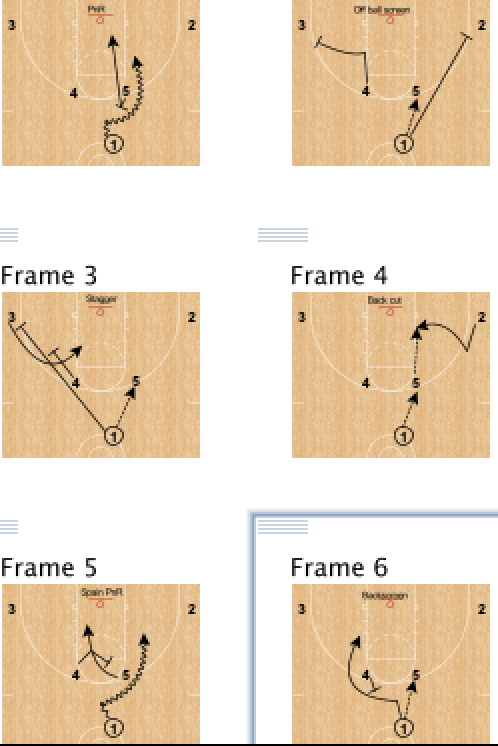
Horns offers on and off-ball screens, staggers, and advanced cutting. In the bottom left frame, Spain pick-and-roll is illustrated.
The challenge isn't finding ideas, it's developing players to execute with urgent cutting, crisp passing, and capable finishing.
It offers potential for early offense with:
1) high ball screen
2) filled corner with open 3 off help
3) weak side pindown (or backscreen 'hammer' action)
Horns versus zone. Screening works well, forcing remaining defenders to choose.
Mom preached that using four-letter words reflect limited vocabulary. In basketball, four-letter words separate wins from losses.
TALK. Communication - especially on defense - alerts, energizes, and intimidates. "Silent teams lose." You know the term "ELO" - early, loud, and often. Call "help right" and that guy ain't driving there.
Don't take my word for it. Listen to Jay Bilas.
EYES. Eyes impact many actions.
"Eyes make layups." Pick your spot on the glass.
Eyes move defense on shot fakes and passes looking off defenders.
As a cutter, the passer's eyes have to see you to deliver on the cut.
Remember "the ball is a camera." Does it see you open?
"PASS." Basketball is a game of cutting and passing.
Pete Carril said, "the quality of the shot reflects the quality of the pass."
Pass willingly.
PASS "on target and on time."
PASS because the ball has energy.
NBAMath published data on the relationship between quality passes and wins. "We can see a positive correlation between ball movement and on-court success does exist, even if the cause of such success is still evasive." Yes, shooters matter as GSW shows.
These relationships may not apply at lower levels with less skilled passers, cutters, catchers, and finishers.
MOVE. Cutting is the other shoe to fit.
Cutters have to time cuts and read screens - to curl, cut backdoor, or bump off.
Cut urgently. Many actions fail without URGENT CUTTING.
Moving can establish, maintain, or destroy spacing.
This Bob Knight video has value for cutters and passers.
SHOT.
"Think shot first." -Don Kelbick
"Be shot ready" on the catch.
Defensively, allow "one bad shot."
Call "shot" on the release alerting defensive rebounders.
Four-letter words aren't dirty, they're triggers to do the right things.
Lagniappe. Study elite players. How does Jokic get space?
Lagniappe 2. "Play of the week" Ram screen fake handoff...
Be effective, efficient, and consistent. I have no idea of our middle school record (1967-1969). It's not recorded. What mattered was learning the game and building skill.
But I remember the sectional title game in Boston Garden (March, 1973).
Do whatever you want; I wish I had known more, sooner.
1. Skill wins. Study how to build skill, especially offensive fundamentals - shooting, passing, dribbling, cutting, pivoting, rebounding. Skill translates to Pete Newell's first commandment, "get more and better shots than your opponents." Skill translates at every level, including the NBA Finals.
2. Reduce turnovers. Turnovers nullify skill. Turnovers zero out possessions. Worse yet, live ball turnovers help opponents turn into opponent scores. "Turnovers bleed into defense" as "the ball is gold."
3. "Possession and possessions." We need ball possession to score and good possessions to win. Find possession enders, players who get stops and scores.
4. "Be good at what we do a lot." There's offense, defense, and conversion between the two. Conversion is 50% of the possession equation. Conversion leads to transition and early offense and stopping opponent transition.
Continuous 4 x 4 x 4.
5. "Contain the ball." If we can't contain the ball, we allow layups, fouls, and drive and kick off help. Cultivate defenders and defensive will. Practice minutes make will; will gets minutes.
6. "Handle pressure." What happens in youth basketball? Pressure and zone defense, because young players struggle with both. Practice applying and defeating pressure. My favorite drill is 5 versus 7 full court, no dribbling. The ball hits the floor and it's a turnover. It forces vision, cutting, passing, and relocating.
7. "Make every practice action impact results." Practice time is a vital resource. Condition within drills or scrimmage. As we say about the last cookie, "don't waste it."
Change passers every minute with "racehorse." Basketball is not a running game, it's a sprinting game. Pass, cut, receive, finish.
8. "Increase practice tempo." That doesn't exclude breaks. But it reflects Brian McCormick's, "no lines, laps, or lectures." Brad Stevens said watching the Patriots practice changed Celtics practice. Watching Geno Auriemma practice impacted ours. Bring a sense of urgency daily.
9. "Reduce fouling." Fouls reflect bad technique, lack of effort, lack of focus, and poor judgment. Don't foul jump shots and especially not three pointers. Most youth teams shoot UNDER 20 percent on threes. Why bail them out with free throws? "Show your hands. Move your feet. Don't slap down." If it looks like a foul, officials will call it. Stop frustration fouls. Don't "double down" making on bad play into two. You see it almost every game.
10. Be a tracker. Track team statistics like shooting percentage, turnovers, and hustle plays. Tracking improves shot quality and lowers turnovers. Tracking impacts accountability.
The box score doesn't show everything. It doesn't track deflections, block outs, tie ups, charges taken, great screens, hockey assists, and more. Credit players who contribute without piling up stats in the scorebook.
Lagniappe (something extra). Who's are Geno's top three women's college players ever? What's Geno's favorite snack?
Study winners. Examine their process. Sonny Lane was a great Wakefield High boys basketball coach, compiling a 276-111 record coaching from 1970-1987. That included a state title, multiple sectional championships and league titles.
1) Set high standards. Refurbishing outdoor courts, players painted a sign, "Tech Tourney 1973," foreshadowing the top division sectional championship in his third season.
2) Have a plan. He embodied, "Every day is player development day" early. How do you improve? "Play basketball a lot."
3) Maximize your system. He developed local players despite having the opportunities to recruit top area players using networking.
4) Borrow from the best. He implemented strategies from top college coaches of the time. The framed "Pyramid of Success" decorated our team room. The UCLA 2-2-1 three quarter court press became a staple. He mixed defenses, including "run and jump," sagging and tight man, and a myriad of zone defenses. "1-4 high" was a core offense, borrowed from UNC and Dean Smith, the precursor to modern "horns" sets.
5) Leverage technology. He hired a videographer to film games and his wife Paula drove extended distances to process and retrieve grainy black-and-white film.
6) Shape up. Practice started with jumping rope for five minutes. Coach conditioned "old school" with plenty of 'suicides' - quarter court and back, half and back, three-quarters and back, then full court. Games were easier because practice was hard.
7) Track everything. Managers used "analytics" (shot charts) to track shooting and monitored turnovers, assists, and rebounds. Coach demanded quality shots not "$#!& shots." In a playoff game against perennial powerhouse Andover winners of seventeen straight, our patient offense made 22 passes before making the first shot. The team shot 23 for 42 from the floor in a twenty-point blowout.
8) Attack the basket. Draw fouls and create foul trouble. Practice "pressure" free throws where your partner could say or do anything without physically touching you. The 'daily winner' (most shots made of 4 x 10 = 40) faced off with Coach to determine the number of suicides.
9) Scout. Our scout, Jeff Muth studied opponents and with Coach created a personnel and strategy scouting report on old-fashioned mimeographs.
10) Keep it simple. Before the game he always included the "keys to the game" with a hand-drawn key and three factors that he said would define success.
11) Have your own language. He number defenses and divided the court into zones. One was man defense, the fifty series 1-3-1, and seventies began with seven. Full court pressure was '14' and the UCLA three-quarter court trap was '83'.
12) Prioritize. He preached, family, school, and basketball in that order. Amidst the usual bad Boston weather, he insisted that we have hats and gloves.
"Mentoring is the only shortcut to success." I'm incredibly fortunate to call him Coach and my friend.
Lagniappe. Attention to detail includes separation and a variety of finishes.
Fight through rejection. People agreeing with us doesn't make us right. People disagreeing doesn't make us wrong. 'Matters of taste' dominate life. Sport is no different than cuisine.
Great coaches have critics. As observers, be eclectic and grab what captures your imagination.
Expecting that an industry embrace our thinking or product 'automatically' embodies arrogance. Want more eyeballs? Think better, write better, revise better.
"Starry Night" by Van Gogh
Van Gogh sold one painting during his life. ONE.
Wolfgang Puck contemplated suicide after his first failed restaurant job.
Tom Brady got drafted with pick #199 in the NFL Draft sixth round. Draymond Green slipped to #35 in the NBA Draft. Everyone doesn't recognize value at the same point.
The seeds of Stranger Things date to at least 2010 based upon electronic communications. It takes years to transform ideas into finished work. Transformation is a big ask.
Bill Russell mastered another kind of rejection, changing the game defensively. He noted, "imagination leads to innovation leading to differentiation." Sam Walker profiles his contribution in The Captain Class.
Basketball analytics still have detractors despite the long history of difference making dating to Dean Oliver's Basketball on Paper. Mike D'Antoni's teams were early adopters. Although the Rockets didn't win an NBA title, the Rockets were among the NBA's top teams by record.
Colleges weren't breaking down Steph Curry's doors before he landed at Davidson. The rest is history.
Foreign players carried reputations of being less athletic, softer, and less productive. In a global game, the evolution to the likes of Antetokuonmpo, Embiid, Jokic, Doncic, and Gobert changed the game.