Total Pageviews

Tuesday, October 11, 2022

Constraint Department: Another Recommended 'Clip and Save' Post

Teams perform to the level of their training. We apply constraints limited only by our imagination to make practice hard so that games are easier. Some ideas:

1. Advantage-disadvantage. Excellent teams handle pressure. Play fullcourt 5 vs 7. Add an additional constraint of no dribbling. If the ball hits the floor it's turned over. This drill is a game changer, forcing cutting and passing. 

2. 4 vs 4 half court, no dribbling. This adds both space and play limitations. Add an additional wrinkle, the need to complete ten passes before shooting to force a longer possession. 

3. Paint touch, ball reversal. Kirby Schepp tracked points by possession and found higher points/possession when his team achieved both a paint touch and ball reversal. 
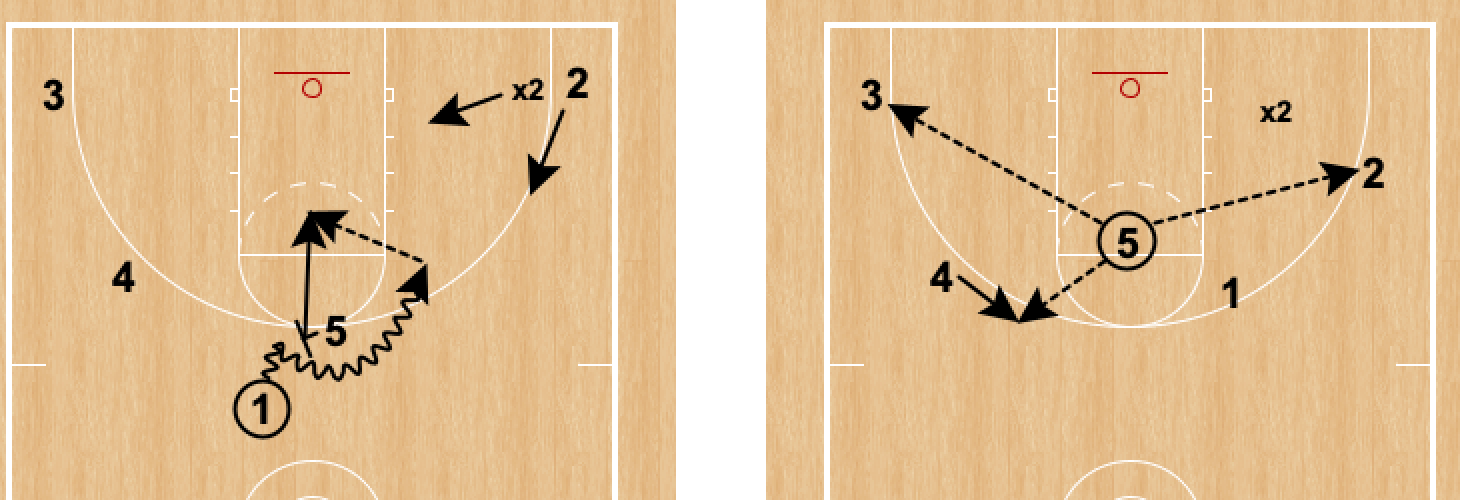

One way to see this is via "short roll passing." 

4. Score in the paint. Scrimmage with scoring only allowed in the paint. Why wouldn't the defense pack into the paint? They might. Add flexibility by allowing perimeter scoring after two paint scores. 

5. 3 on 3 inside the split. Add space constraint (the split is out of bounds) and start play from different initial formations. 


6. Dribble tag (inside the spacing line). Dribble tag works ball handling and you can add constraints such as non-dominant hand dribbling or crossover dribble required every third dribble. 

7. Gauntlet (28 Special). Gauntlet challenges two players to advance through four "zones" with player and ball movement and only one dribble after each catch. The drill rotates players up and previous offense becomes defense in the back zone.


8. Around the world. You all know the game. 

Increase the degree of difficulty by adding time constraint (e.g. 2 minutes) and shot constraints (25 or less)

9. Beat the pro (a.k.a. Bill Bradley). You score one for a make and The Pro (Bill) scores 3 on your miss. The "easy" version of game to 11 means make 11 before missing 4 (11/14 = 78.6%). The "hard" version is make 15 before missing 2. 

10. Situational play. 3:00 on the clock, including shot clock. Leading by 5. Opponent's ball. You must prevent the opponent from scoring six points and offensive possessions are limited to 30 seconds but no scoring. Can you hold the lead without scoring? 

11. Volleyball court, Kirby Schepp movement drills. Learn to move. 


These are just a few 'fun ways' to enhance degree of difficulty to challenge players to improve. Enjoy. 

Lagniappe. Live the standard, not your feelings. 

Monday, October 10, 2022

Building a Strong Team, Lessons from the Bush White House

*Adapted from MasterClass, Authentic Leadership, former President George Bush... "Inspire a culture of teamwork." Be open to opinions from multiple sides. Even if we don't agree, there's value in hearing alternatives. Be willing to learn from anyone. Assess the quality of information from the lessons not only the source. 

Organizations are more than the Chief Executive. Nobody has all the answers or does all the work.

"The Chief Executive is the tone setter." Stay on message

"There is general agreement with the philosophy." Don't hire people for the team who are looking for your job.

"Expect diverse opinions." 

"Look for cultural diversity." As an OG coaching young girls, when I could, I looked for a young woman assistant whom the players could relate to. 

"Is the process thorough? Have you consulted other people?" Some coaches insist on being the ringmaster. That usually means it's a circus. 

"Address your shortcomings." Unrequired work applies to coaches, too. 

"You can never have enough help. Shore up weaknesses...enhance strengths." Sounds suspiciously like Belichick channeling Sun Tzu. 

"Serve something greater than self." Serve the sport, the players, the community. 

"We were looking for team players...fit into a culture of serving the country." Washington is full of self-serving people; your town probably is, too. 

"Welcome other viewpoints"...if not, the culture is based upon the President alone. 

"A certain loyalty is required..." This reminded me of Doris Kearns Goodwin's "Team of Rivals." Lincoln's cabinet held rivals committed to preserving the Union. 

"Give feedback...as a learning experience...a good leader asks how can we grow together? Humility begins with understanding "you're not it."" Coaches help players grow, and players help us grow, too. 

"Be thoughtful and kind...not a bully." Don't complain about a culture of bullying and power games and then reproduce it.

"Don't let power and position cloud your judgment." 

Summary: 

  • Inspire a culture of teamwork.
  • Stay on message.
  • Unrequired work matters for coaches, too.
  • Find team players.
  • Don't be a bully.
Lagniappe. When you're learning, it's okay to see what you're doing.

Lagniappe 2. Match your work to your dreams.  

Lagniappe 3. SLOB Zipper Iverson Boomerang  

Sunday, October 9, 2022

Asymmetrical Warfare: Fast Five; Plus Triple Lagniappe (Something Extra)

"Famed policymaker and diplomat Henry Kissinger once commented that ''the guerrilla wins if he does not lose. The conventional army loses if it does not win.""

This column applies only where we have accepted, profound disadvantage by talent and/or circumstances. How can we best compete against overwhelming force? 

1. Cheat. Sportsmanship and morality aside, we could ask how this could would even be possible? There's no dealing from the bottom of the deck. 

2. Create a unique game plan. In The Games that Changed the Game, Ron Jaworski describes strategies such as the Patriots' focus on taking Marshall Faulk out of the game. In 1971, Alabama's Bear Bryant won the USC rematch springing the wishbone on the Trojans. That's not realistic for almost all of us. A knowledge of history might encourage us to try. 

3. Shorten the game. Historically, that included "stall ball" to reduce the number of possessions and scoring chances.  

4. Build skill. In our boys basketball league, Lexington has both tradition and high enrollment with 1109 boys in 2021-22. Watertown High has 381 boys. But over years, Watertown has played Lexington relatively even and won multiple state championships. How? They have one philosophy from youth to varsity basketball and the great Steve Harrington as coach. When you know you'll face the iron every year, prepare for it. 

5. Reduce mistakes. Coach Bob Knight reminds us, "basketball is a game of mistakes." Turnovers, missed assignments, and poor transition defense get multiplied against better competition. To forge the biggest upsets, find ways to curtail errors. 

Lagniappe. Be hungry to prepare to win. 

Lagniappe 2. Deal with conflict; we have no choice. 

Lagniappe 3. It's not enough to have five good players out there. They must be connected. 


Saturday, October 8, 2022

Basketball Lessons from Hemingway and "The Old Man and the Sea"


From "The Old Man and the Sea" by Ernest Hemingway

I recently reread "The Old Man and the Sea." Great writers share life lessons and timeless truths that cross disciplines. 

Focus on strengths. Hemingway is known for simple writing, short words and sentences. "The Old Man and the Sea" shares many lessons, the beauty and savagery of nature. And resilience. 

Attention to detail. Among other help, Hemingway's hero didn't have the sharpening stone he needed for his knife (see initial quote).

Coordinated operations. Santiago relied on 'the boy' to help him fish. The boy didn't fish with him. Never underestimate the importance of our surrounding staff. Building a capable staff has great value. 

Degree of difficulty. "Any idiot with a whistle can coach." Hemingway expressed doubt another way, "Writing is easy. All you do is sit down at a typewriter and bleed." 

Preparation. The old man is engaged in an epic battle with an enormous fish. “Every day is a new day. It is better to be lucky. But I would rather be exact. Then when luck comes you are ready.”

Resilience. Hemingway wrote, "But man is not made for defeat. A man can be destroyed but not defeated.”

Don't make excuses. Santiago says, "Now is no time to think of what you do not have. Think of what you can do with what there is.”

Experience. Hemingway's hero recognizes its value. “I may not be as strong as I think, but I know many tricks and I have resolution.”

Lagniappe. The first rule of team sports is "make your teammates better."

Lagniappe 2. Become your own coach. Learn how to build, complete, and analyze your workout. Players, you should be developing your own workout and drill book in your notebook. Not keeping one? Start. 

Lagniappe 3. Principles work across sports. 

Players need to learn how to use tempo in multiple ways, time and score, in transition, in the half court, and with and without the shot clock. Failure to teach situational basketball and tempo cost teams games and championships. Never presume players ALL know the answer. It only takes one unaware player to disrupt a team. 


Coaching: Find "The Right Guy"

Study greatness. Ask "what makes great, great?" 

Don't make excuses. "I'll never get to meet Jack Clark" or "I don't have the access." Use what we have, the people we meet and the books we read. We meet exceptional people every day. They might be your parents. Recognize exceptional. 

Read Sam Walker's The Captain Class ("The easiest way to lead is to serve") or Don Yaeger's Great Teams. Pick up a biography on DaVinci or Ben Franklin or read about Lincoln or FDR. Ask, "what can I take forward from these lessons?" 

Dr. Fergus Connolly, human performance expert, shares lessons he's learned in 59 Lessons: Working with the World's Greatest Coaches, Athletes & Special Forces." He helps us understand what inputs drive success. By extension, their absence predicts lower performance. 

Use experience as guidance but recognize ours isn't enough


Recognize character.  
  • She is completely committed to success. 
  • Put the good of the team ahead of their own. "That doesn't mean thinking less of yourself but thinking less about yourself." 
  • Excel in your role while training to expand it. Be an ambitious giver.
Hire tough; find team players. 
  • Set up criteria beyond "likability" or "presents well." 
  • Dig into past behavior. "Past behavior is the best predictor of future behavior." 
  • Develop a network of trusted sources. 
Seek and cultivate leaders. Not every team player will be a leader. 
  • Make great moments possible. "Leadership must intentionally create emotional moments that connect them to their greater purpose." - Don Yaeger
  • Leaders serve the team. From The Captain Class, "According to modern defensive metrics, Russell's career mark in defensive win shares is the best in NBA history-and by a 23 percent margin." (See table)
  • Leaders focus the team. "He is the person responsible for making sure the agenda of the organization is pursued." - Sam Walker

Summary: 
  • Study greatness.
  • Use experience but understand ours isn't enough.
  • Develop a network of trusted sources.
  • Recognize character.
  • Hire tough. 
  • Seek and cultivate leaders. 
Lagniappe. "Girls basketball..." Who teaches defense this way?


Lagniappe 2. 

Lagniappe 3. 

At what are we going to excel, to be our standard above all else? For examples, defeat pressure. Stop the pick-and-roll. Score efficiently in the half court. 

Lagniappe 4. "Discipline is power." 

Friday, October 7, 2022

Picking a Few Favorite Drills

Find one thing every day to take away to build better practices. 

Most agree that drills build skill and teamwork. They don't replace scrimmaging and ideally teach offense, defense, conditioning, and decision-making. Each won't involve all. Here are ideas. Yes, some are redundant. Share yours. 

Warmup - Warm up your shot early in practice. The Jay Wright, "Get 50" approach does that. 


Conditioning

I believe in conditioning with a ball in your hand at some point. The 3 by 3 by 3 shooting drill, tracking makes over five minutes does that. 

Press break. Advocate for 5 on 7, full court, Advantage-Disadvantage. Everyone should get a chance to be in the five, not just starters. Add a constraint of no dribbling and the drill is even better. 

Ball containment. Here's an adaptation of Kevin Eastman's "Dog Drill." If you cannot contain the ball, you're exposed on defense. Lack of containment forces help and rotation "draw 2" and opens up 'drive and kick' offense. 


As Fred Van Vleet said, it's more about determination over 'crazy athleticism'. 

Dribbling. Start at the left corner (use multiple hoops) and have players dribble along the three-point line. Start with right hand dribble out and return (right to left) with the left hand. Progress through speed dribble, crossovers (every third dribble), hesitation (every third), and then combinations (e.g. hesitation/crossover). As players advance, add between the legs and behind the back dribbling. 

Shooting. If it's good enough for Curry...


Passing and cutting. My preferred cut and pass drill is either 4-on-4 ten or twenty passes in the half court. The defense plays full denial, the offense cannot dribble OR shoot until the desired number of passes are completed. If they turn the ball over, offense goes to defense. 

Rebounding. Defensive rebounding is about positioning and toughness. Offensive rebounding favors anticipation and quickness. I favor one-on-one-on one three person rebounding. The coach initiates play with a shot and the ball is ALWAYS live. The rebounder tries to score against both defenders. Miss or make, the ball is live and the rebounder tries to score again. 

Lagniappe. We call this drill "Racehorse" and use only two passers on each side. Go hard or go home. 

Thursday, October 6, 2022

Basketball and Leadership: Fast Five, Lessons from Nelson Mandela

After decades of incarceration Nelson Mandela had a vision of shared leadership in a multiracial South Africa. 

What lessons can Mandela teach us? 

1. "Let it go." He wasn't interested in a "pound of flesh." He wanted a functional government for a black majority nation. This lesson applies for business, sport, and politics. 

This recalls the Chinese proverb, "Before you embark on a journey of revenge, dig two graves." 

Basketball lesson: Blaming our predecessor won't fix our problems. 

2. Listen. As a child, Mandela attended meetings with his father. He noticed how his father listened and always spoke last. Listen to other opinions and develop a more nuanced response. 

Basketball lesson: Great teams are collaborative, player-led. 

3. Don't believe you are the only solutionIt takes more than a single heroic leader at the top to change the trajectory of an institution, or a nation. To be a transformational not a transactional leader, get more inputs. 

Basketball lesson: The players are the product. 

4. Model excellence. People notice character before they consider strategy. In leadership, character is more important than strategy. Mandela refused to succumb to the pull of revenge and the politics of hatred that infected large parts of the anti-apartheid movement.

Basketball lesson: "Our actions speak so loudly that players can't hear a word we say." 

5. Be inclusive. We forget inconvenient truths. Nelson Mandela said about the United States while on a visit there, “it is that racism must be consciously combatted and not discreetly tolerated.” He understood, "Nostalgia for the past – an impulse as prevalent in antiquity as in modern times – comes over people whenever they feel menaced, betrayed or disappointed."

Basketball lesson: Without teamwork, we will be neither happy nor successful. As Coach Wooden said, "happiness begins where selfishness ends." 

Lagniappe. What can we do better? 

Lagniappe 2. Grind. 

Wednesday, October 5, 2022

Examine The Ramsey Coaching Rules - Which Are Right for Us?

Rules have to work for us and our players. Quotes and platitudes matter to the extent that we implement them and impact winning. Adopt some, lump some, and reject some. 

Here are the Jack Ramsey Dozen Coaching Rules:

1. Basketball, like every other sport, is predicated on the execution of the fundamentals. 

2. The coach is a teacher; his subject is the fundamentals. 

3. The highest level of achievement is attained by the teams with the best conditioned players. 

4. Even the greatest players have a level of improvement to achieve. 

5. Even the greatest players accept coaching and value the need for discipline and the order that it brings to the team. 

6. Winning is more related to good defense than good offense. 

7. Break-down drills, under simulated game conditions, are essential to team success. 

8. Teams that play together beat those with superior players who play more as individuals. 

9. There are no physical limits to individual achievement. 

10. Although the game has become more sophisticated, simpler is better in developing and teaching a system of play. 

11. Players draw confidence from a poised, alert coach who anticipates changing in game conditions. 

12. Teams that never concede defeat can accomplish incredible victories. 

Restating: 

1. The coach's job is teaching and training fundamental excellence. 

2. Everyone (including great players and coaches) can improve.

3. Great conditioning is part of fundamental excellence. 

4. Teamwork is essential at both ends of the court. Teamwork is the miracle drug of coaching.

5. Prioritize simplicity and clarity. 

6. Focused, flexible coaching instills confidence.

7. Do not quit

With great respect for Coach Ramsey, I don't agree with everything. Physical limitations exist. Coaches can overwork and overtrain players, wearing them down or worse. 

Excellent defense isn't enough to win amidst the "Arm's Race" of talented offense. You have to score to win. 

Lagniappe. 

Lagniappe 2. 

Lagniappe 3.  

Tuesday, October 4, 2022

The Delicate Ecosystems of Teams

 ecosystem

Δ“′kō-sΔ­s″tΙ™m, Δ•k′ō-

noun

  1. An ecological community together with its environment, functioning as a unit.
  2. system formed by an ecologicalcommunity and its environment that functions as a unit.
  3. The interconnectedness of organisms (plants, animals, microbes) with each other and their environment.


The ecosystem of a team includes its community, fans, coaches, players, and families. When everyone pulls together, great things can happen. But science and psychology favor entropy, agendas, and chaos. 

Examples clarify. 

Sam Walker's book, The Captain Class, profiles teams whose central leader crystallized winning. Bill Russell said that his ego depended on the success of the team. Yogi Berra wasn't the top player on the Yankees, but an engine and leader that propelled the team ahead. 

The University of North Carolina women's soccer team has won over twenty national championships. Yes, they've had great players like Mia Hamm. Coach Anson Dorrance has a sign in their locker room, "Excellence Is Our Only Agenda." 

Great players aren't enough. The pieces have to fit. The Brooklyn Nets trio of Kevin Durant, Kyrie Irving, and Ben Simmons may yet do great things. But will those pieces fit

A high school team was favored to go deep in the postseason. But before the playoffs, the 'star' was accused of hijacking another player's boyfriend. The team fractured and was an 'out' in the first round of the playoffs. 

Women's college teams famously have a blend of straight and gay players. Occasionally, open conflict has fragmented teams resulting in chaotic, selfish play, and eventual transfers. 

What factors bring stability to programs and what factors promote fragility? 

Stability
  • Leadership (Talent aggregation is not enough).
  • Player development - "Every day is player development day." 
  • Character - Etorre Messina preaches character as the coach's first job. Find and keep talented grinders. "Success doesn't measure a person; effort does." 
  • Find the balance of "Give and Take." Giving + ambition = power. 

Fragility
  • "Ego is the enemy." Coach Popovich has players who "get over themselves." 
  • Inflexibility "Takers tend to stick to their decisions because admitting a bad choice makes them look inadequate." We see this a lot as teams stick with high draft choices, trade acquisitions, or scholarship players because they seek self-justification. 
  • Living on the fringe. Players who do not buy in, who sulk and take energy from the team, or who are there to "live the life" disrupt the process. 
Lagniappe. Study greatness. "Leaders make leaders." 


Lagniappe 2. 
Lagniappe 3. Making a difference... 
Lagniappe 4. Simple drills for motion offense. Well-explained. 


Monday, October 3, 2022

90 Minute Middle School Tryouts, What Belongs?

I've been asked to run Middle School tryouts this month. Each class of girls and boys (grade 6-8) has a 90 minute session. What belongs? I I'm just another guy trying to share opportunity and equity. Here are some ideas. 

Players, separate yourself with enthusiasm, energy, or even crazy luminescent socks. Be memorable. 

Times are always approximate but keep it moving.  

(1m) Introduction (1 minute): "Brevity is the soul of wit." 

  • Thanks for interest. Have fun.
  • Show your stuff (use four baskets as much as possible).
  • Be your best self with attitude and effort.
  • Be a great teammate.
(8m) Warmup (@ 8 minutes)
  • 2 half speed laps (don't cut corners)
  • Dribble the lines (outside of three point lines) - out right, back left, crossover every third, hesitation dribble every third 
  • Speed Layups (4 baskets)

(29) Skills assessment (groups of 6 each half-court)

Dribbling combined (multipurpose drill) (5 minutes) 

Layups 1 (4 minutes, 3 dribble maximum from half court)

Layups 2 (4 minutes, 2 dribbles from 3 point line) 

Rollouts (4 minutes, 4 baskets)

Arc 1 on 1 - 4 minutes (assess offense and defense 1 v 1)


Passing (full court) 3 lines 2 balls - 4 minutes

Wing attack (strong/crossover) - 4 minutes 

(20m) Shooting (3 on 3 groups)

UCONN 4 minute shooting (5 minutes)

30 buckets (3 minutes each group for shooters/rebounders)

3 x 3 (half court shooting on the move) (4 minutes)

Competition (elbows) two lines each basket...game to 11 (5 mins, switch sides every time a team 'wins')

(29m) Playing. 60-89 minutes (3 on 3) global assessment of ability to play, make decisions. The coaches will relocate players to different groups to assess skills and need areas. Usually a top group separates itself and more focus goes to the intermediate groups. 

(1m) Wrap up (procedural...thanks...email individually selection)

Lagniappe. Toughness. 

Lagniappe 2. Horns handback PnR clearout. 

Lagniappe 3. Biggest lesson from over fifty years around basketball? There is always something to learn...and always something to share. 


Sunday, October 2, 2022

Basketball: Self-Inflicted Wounds

Broadcaster Ken Beatrice said, "three out of four football games are lost not won." For basketball, it's less, but still probably a quarter to a third.

Don't self-destruct by "shooting yourself" in the foot. What are common foot-shooting strategies that lose games? Start at "possession and possessions." 

1. Bad possessions. What makes bad possessions? 

  • Lack of spacing, lack of player and ball movement 
  • Poor quality shots, poor quality shooters 
  • Turnovers, the "zero percent possessions"
  • Inability to handle pressure
  • Missed free throws 

2. Lack of possession. Get more possessions.

  • Poor rebounding. Get > 75% of d-boards and > 30% of o-boards
  • Force turnovers.
  • Allow "one bad shot." 

3. Combine them...lack of "possession enders." 

  • "Possession enders" win possessions. 
  • Possession enders get scores and stops. 
  • Find or develop possession enders. 
If we think about Dean Oliver's "four factors" they're possession enders - effective field goal percentage, rebounding, turnovers, and getting to the free throw line. Whether coaches accept and teach them, we seek them. The "scorer" who turns the ball over and can't defend may be a liability. The great defender who scores some "3 and D player" adds hidden value. 

Lagniappe. Learn to be professional at every age. 
Lagniappe 2. Celtics run a "triangle SLOB" to open a shooter. 


Saturday, October 1, 2022

Basketball: Dr. Fergus Connolly's Correct Diagnosis

Generate winning concepts from a tweet. Dig deeper into an issue and craft answers. 

Fergus Connolly isn't saying he's smarter than everyone else. He asks us to relate results to what actually happens. Work back to Michael Lewis's Moneyball. "If he's such a good hitter, why doesn't he hit better?"

Shooting. If we're not scoring and winning, why not? 

  • Shot selection 
  • Poor distribution of shots (not enough by best players)
  • Too many bail out possessions (shot clock)
  • Low quality passing "quality of shot relates to quality of passing"
  • Allowing too many 'easy' shots - transition, layups, open threes, free throws
Rebounding (possessions).
  • Allowing too many second shots (higher points/possession on second and third shots)
  • Failure to get second shots
  • Secondary rebounding effects on offensive and defensive transition

Turnovers.

  • Number of turnovers
  • Types - execution or decision-making 
  • Failure to generate turnovers
  • Live ball turnovers leading to high opponents points/possession
Free throws
  • Allowing too many (why?)
  • Not drawing fouls 
  • Poor free throw shooting 

Break down possessions and performance by individual players. Much of this can't be derived off the 'simple' box score. Assess the total contribution of a player with positive, neutral, and negative possessions. 

Lagniappe. Add defense and competition. 

Lagniappe 2. Don't feel creative? Copy. Borrow. Steal. 

The Old Man and the "C"

I can't remember it all. But glorious scents of Tuf-skin and iodine, sweat, orange slices, and tape balls etch memories. 

Nobody expected much from the Boys of Winter. Wins came hard in that league. If nothing else, the team had eight seniors and six players at least six foot four. Yardsticks don't win games. Mom said, "I didn't know they piled it that high." 

They say, "tradition never dies." Our little town hadn't seen its birth. Hockey was the community choice. 

We won the last three the last year, but never touched .500. Lexington, the State Champ, beat us twice. The second loss was a moral victory at 90-72. I drew two charges, a bug on Ron Lee's windshield. His future was NBA. Mine was M.D. 

We went to North Andover for a scrimmage. Their rat-dog point guard went on to play at Merrimack and become a coaching legend. He swung at me, annoyed that a nobody dared play him tight and shut him down. I missed his press clippings. 

Before the season, the team voted for Captain, the mythic "C" that wasn't part of the uniform. I voted for Steve. I always voted for Steve. Coach Lane announced that I was Captain. My first thought was, "We need a recount."

We won a pair of nonleague games and opened the league with a soul-crushing 90-89 home loss to Stoneham. Each of us felt responsible. Coach said people would talk about the game for years. Great. A legacy loss. A defensive disaster. 

The turning point was a two-point loss to...Lexington. "You lost because it said LEXINGTON on their jerseys." Their press forced turnovers, the stuff of rookies. Soul-searching followed by tough training painted a new picture. Advantage-disadvantage became the practice norm. 

We lost the Stoneham rematch 50-49. That left us 8 and 3. It was the last loss for almost two months, just short of the brass ring. Lexington fell twice. So much for tradition.   

Behind the scenes a local pol plotted revenge against the coach who cut his son. Thirteen consecutive wins sank his scheme. "Coach stays." And became a Hall of Famer. 

The local sports writer called us, "The Cardiac Kids." Decades later I became his doctor. 

Ankle and knee pain are the flotsam from fifty years past. Rain and mist won't allow an old man to forget the past. 

Gazing into the stars doesn't ask what might have been but what might be for the hopefuls boarding their boats. Some hook the prize; others come back empty. Tears are real. It's not fair. It just is. Basketball is a cruel mistress. So it was and will ever be.