Total Pageviews

Wednesday, September 11, 2019

Basketball: Five Favorite Individual Shooting Drills, Plus Lagniappe

Somebody. Everybody. Nobody. When asked to spell my name, that's the answer. Just another guy with mostly stolen ideas. Shooting is perishable...practice from competence to excellence. 

My teams haven't shot the lights out...not for lack...of trying. The best drills combine more elements - decision-making, defense, competition. 

Here are five favorite shooting drills (that don't take forever)


Around the world (timed, counting misses, no rebounder)


Elbow to elbow and elbow to sideline (more conditioning). Always set a goal. High school players should make at least eight. An eighth grade girl made 7 of 10 yesterday (as well as 7 of 10 three-point catch-and-shoot). 


"251" - Younger players (and really old guys) shoot closer spots (e.g. 15 footers)

Beat the Pro (Bill Bradley) - Make 11 before missing 4 as a miss counts three points for Bill Bradley (easy). Version 2 is make 15 before missing 2 (hard). 


Celtics 32. Three-level shooting. Scoring in the twenties is excellent for middle school. 

Lagniappe: shooting form via Chris Oliver


Tuesday, September 10, 2019

Basketball: Individual Workout Concepts and Lagniappe from USA-Brazil

Summer brings uncertainty. Sometimes only one or two players participate in a workout. Have clear priorities. I don't have all the answers, not by a long shot. Here's what we worked on two days ago:

1. Footwork for separation
2. Scoring from three levels, plus free throws
3. Finishing  

Obviously, there are countless footwork drills with basketball moves.

Footwork 
- McHale move (up and under from each side)
- Front pivot (off inside foot at block) into reverse layup
- Box drills into layups and one dribble shots 
- Wing attack catch, inside foot pivot, rip through into layup or shot
- Wing attack catch and reverse pivot/deep step into layup 
- Wing attack with outside foot pivot with rip into layup
- Catch into hesitation and crossover dribble into shot

Three-level scoring
- Inside moves above 
- Mid-range shooting off the catch, one-dribble moves, and step back
- Three point shooting off the catch

Finishing at the rim
- Reverse Mikan drill
- Numerous layup finishes above

Expose the player to "second order" thinking. What might I be tasked with and how can I practice that? Practice getting open for catch-and-shoot threes.


Create game simulation practice it.


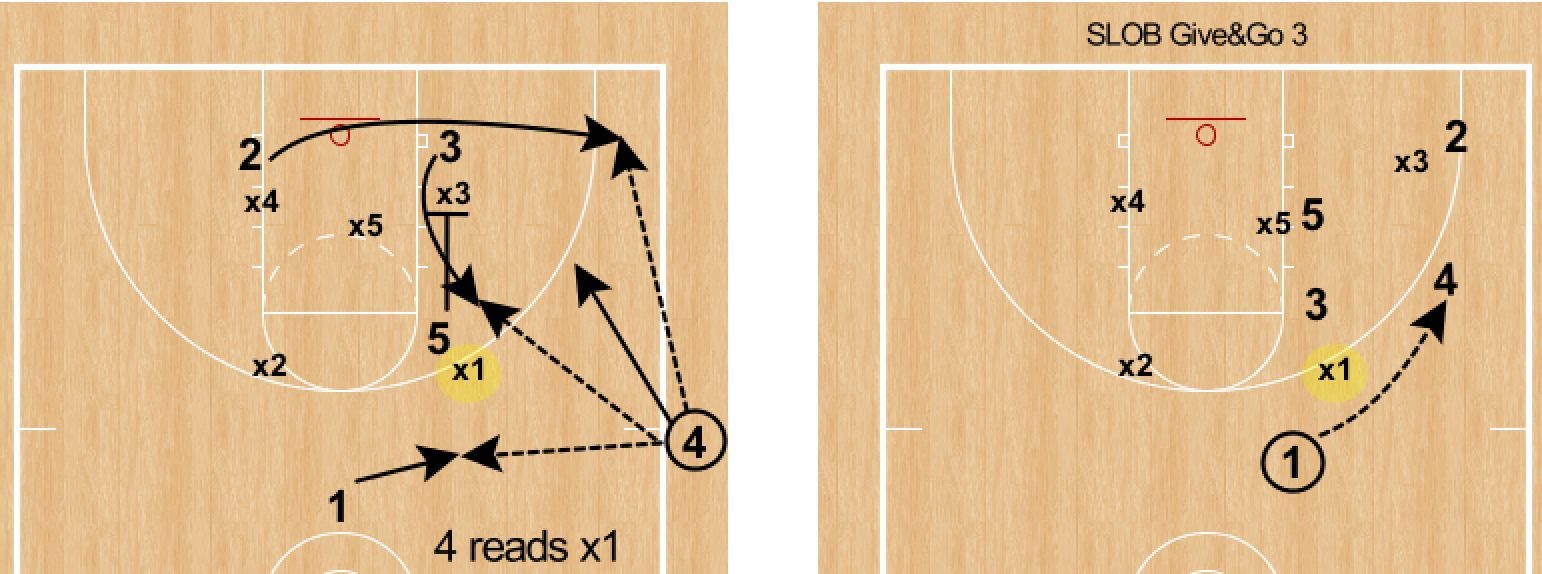
Scoring off the bench. Steve Kerr used to practice sitting on the bench and coming into the game for a three-pointer. We worked on that yesterday with a SLOB inbound into a give-and-go for threes. It's a work in progress (thirteen year-old girl). 

Lagniappe: Jaylen Brown with an assist vs Brazil after attack from top of spread
Lagniappe 2: USA runs hammer action and Smart scores on reverse layup


Monday, September 9, 2019

Fast Five: Leadership in Vogue - Wintour's Edge

Benefit from cross-disciplinary concepts. The latest course at MasterClass.com shares the leadership style of Anna Wintour, Editor-in-Chief at Vogue and Creative Director of Conde Nast

Women share great ideas and a different perspective than some men. Like men, they're not always right. 

Overview:


Figure out how you want to collaborate in articulating and elaborating your vision. Leaders focus on making organizations better. 

Have a clear sense of the "voice" of your organization, what fits and what doesn't. 

Know what you want to accomplish with a meeting or an article. 

Anna believes in what some call "distributed leadership." Everyone deserves a voice, but that doesn't mean everyone gets to decide. Fast feedback works best. 

Be decisive but not peremptory. 


If an idea or personnel group won't work, just say no and move on. 

Lagniappe: A spread offense with multiple options. Our players are not sophisticated enough to run this yet. But the concept is good.


Lagniappe 2: I'd rather invest more practice time in fundamentals and small-sided-games, especially 3-on-3 inside the split. 


With two coaches and two groups, freelance development works well. Some examples are listed; many more exist. 


Sunday, September 8, 2019

Fast Five: Bench Engagement

We can't have separate teams of starters and reserves. Excellence demands total engagement throughout the team.


Great coaches know the importance of full participation. 


"We put a huge premium on body language. If your body language is bad, you will never get in the game...I'm checking what's going on on the bench." 

Pat Summitt routinely filmed the Tennessee bench to assess their involvement. 

Coach Roy Williams was recruiting a player who fouled out. The player didn't sulk. He sprinted to the water cooler to get cups of water for his teammates still in the game. His actions showed a 'team first' player. Williams knew he had someone special. "Your actions speak so loudly I cannot hear a word you say."  

Head coaches can't see everything, so assistants have to monitor the bench. Find willing energy givers on the sidelines. Players who GIVE from both the court and the bench make important contributions. 

Layups.com suggests 8 ways to encourage reserve players
1. Take the time to teach them individually
2. Follow their progress
3. Recognize their skills
4. Motivate them to improve their game
5. Listen to them
6. Give them the responsibility
7. Let them feel that they are important to the team
8. Take chances on them: Let them play
Dean Smith knew the importance of publicly recognizing reserves who contributed to winning. He found ways to praise players who got less media attention, as a tool to get full engagement. 
Lagniappe: Great advice from PGC video


  • Celebrate your teammates
  • Give your teammates reminders
  • Know the time, score, and situation

Saturday, September 7, 2019

Basketball: Defending Your Script

What's your pitch? 

We have to defend our script - the idea, the characters, the plot, the twists, the ending. Before our blueprint becomes reality, it must pass a series of hurdles. 


We all see basketball through different lenses, believing our vision the correct one. But can we fool ourselves? 

The idea. What's our basketball philosophy? If we think "the game is meant to be played fast" but lack the thoroughbreds, do we adhere to that approach or adopt a different one? If our mission is development (e.g. youth coaching), do we sacrifice players to the Lady of Victory? 

Coach George Raveling shares, "Every single day our society will attempt to make you be someone you do not want to be. Life is a beautiful and transformative struggle to become our true self. Oscar Wilde once said, "Be yourself, everyone else is taken." Being yourself and living in your most authentic truth requires self-awareness, self-knowledge, self-love, self-mastery, and graceful patience."


The characters. The game is for the players. An unspoken contract exists between the coach and players that she will act in their best interest - adding value, teaching, communicating respect for the game and for each other. Success is the byproduct of doing the right things the right way. 

The plot. We help the players write their narrative. An uninspired story reveals itself soon enough. As Rick Blaine said, "You'll regret it. Maybe not today. Maybe not tomorrow, but soon and for the rest of your life." Our job is understanding what our team needs now and seeking simple answers to that complexity. 


The twists. Heartbreak is part of the game. Basketball reflects life. The ball takes an unexpected bounce. Injuries happen. A key call doesn't go our way. The hero fails. 


Trust the process, because we can't trust the results. 

The ending. Each practice train for endings. We play offense-defense-offense three possession games rotating among BOBs, SLOBs, and free throws. Some coaches use time-and-score games, like "down 8, three minutes left." Practice must score situations with short clock possessions (1 to 10 seconds). Because many games are decided by one to two possessions, attention to detail for every possession (possession by possession play) defines us. 

We need a best (two) BOB, SLOB, ATO, man, and zone offensive set. For the average game, the Patriots have a pair of two-point conversion plays. For the Super Bowl, they have three. 

As coach (director), we are the keeper of the story. 

Lagniappe: What was that? Coach Nick @BBallBreakdown shares a defensive twist on a SLOB. 

Thursday, September 5, 2019

Basketball: "To Tell the Truth, Just Show It" (Cut the Playbook)

"To tell the truth, just show it." - Ron Howard


Cut the playbook. What matters is what players understand, believe, and can execute. If the fans can't identify intent then we probably don't know our structure. And that's a coaching issue.  

The chessboard: Spacing 
Piece movement: cutting, screening, passing 
Hard to defend actions:  pick-and-roll, pass-and-cut, individual attack, forced closeouts
Game at a glance: do we space, paint touch, reverse the ball?

Summer is a great time to edit the playbook. Simplify. Clarify. 

1. Specials (BOBs and SLOBs) - four of each. I catalog my faves with Google Drive sheets. 
2. Man-to-man offense(s) - Spread, horns/1-4, box sets, freelance 3-on-3 (inside split)
  • Pick-and-roll
  • Simple cutting - face, back, give-and-go
  • Simple off-ball screens
  • Complex off-ball screens (serial, stagger, Spain)
3. Zone offense core concepts 
4. Freelance 3 on 3 against the split (each practice small-sided game concept)
5. ATOs - Maximum 3, goal layups or open 3


This creates a matrix of possibilities that players are familiar with over 2 seasons.
 
Lagniappe: Contain and closeout drill (St. Anthony's via Teach Hoops)


Lagniappe 2: Lakers


Wednesday, September 4, 2019

Basketball: MasterClass Notes from Ron Howard

Lessons cross and transcend disciplines. Great writers, directors, and business leaders share principles about discipline, leadership, and editing our programs. 

Here are some from Ron Howard, director of a host of epic films, from Apollo 13 to Frost/Nixon and A Beautiful Mind. I believe that core principles translate directly to how we lead and coach. 

Great scenes are the building blocks of great movies. The better our execution of 'scenes' the more memorable our experience. 


Great stories touch us emotionally. Excellence connects players with fans. 

"The film is made in the editing room." Constantly edit out less successful actions. 


"Be sure the story has the potential to offer something fresh and interesting."

When considering a script (season?), Howard considers theme, characters, and structure. He looks for plot twists beyond the obvious. He rates components on a ten scale and uses checklists. We use checklists to examine narratives (creating/limiting separation, shot selection/opponent shot quality, possession depth (turnovers/rebounds). 


Howard looks for the old and the new in his films. Splash was a romantic comedy...with a mermaid (above) as the lead. Cocoon examined aging and youth. As coaches we blend time-honored fundamentals with fresh ideas. 


It's never easy. Howard informs, “I have found over the years that you have to understand one thing about directing: that every project you get involved in ultimately is just going to find its way to breaking your heart at some point, no matter how successful
it is."

Akira Kurosawa taught Howard the importance of collaborative problem-solving between writer, director, and producer. Head coach, assistants, and players likewise work on the fly. Gregg Popovich tells players to "figure it out" because timeouts are limited. 

Collaboration doesn't mean surrendering creative decision-making. The director (coach) retains decision-making authority and accountability. 

Howard suggests that students collect visually compelling photographs and scenes. Many coaches use software and notebooks to store lessons. Using FastDraw software from FastModelSports I have over 70 sidelines out of bounds plays although we routine use four or five. 

Lagniappe: A two-point end-of-game SLOB. I'm not confident that our club (middle school girls) can make that pass. 

Tuesday, September 3, 2019

So You Want to Be the Coach's Favorite?

(Modified from my volleyball blog)

Fifty-something years around sports teaches you that coaches have favorites. How do you become one of the favorites? 

"Take care of business - at home, in the classroom, and on the court." Kayla Wyland's parents said she was the same person at home that she was outside - cheerful and helpful. You don't forget that. Kayla and her 2012 teammates go into the Melrose High School Athletic Hall of Fame this month. 


Coach Celli with Melrose seniors, 2012 State Champions

"Be on time." When asked what a young actor should learn, Helen Mirren said, "Show up on time and don't be a jerk." Dean Smith's point guard Phil Ford set his watch ten minutes fast to be on "Coach Smith time." 

"Play hard." Jay Bilas' excellent book, Toughness, reminded players to "play so hard that your coach has to take you out." 

"Play together." Nobody likes a selfish player. Support your teammates. The African proverb says, "You can go faster alone, but we can go farther together." 

Here's an excerpt from an article about Alan Williams' book, Teammates Matter:

“Humility is not thinking less of yourself, but thinking of yourself less” – C.S. Lewis

"Play smart." Coaches analyze stats and study film to parse what is working versus what isn't. Coach Celli will let you know if he wants more outside attack, back sets, middle hitting, back row hitting, quick sets, slide attacks. "Do more of what's working and less of what doesn't." The best hitters know when to bring the heat and when to change it up with tip attacks, cut shots, and short balls. 

Basketball: Lose the Progress Stoppers

 Keep rising. What hinders us? 
We're rising, falling, or stagnating. If we're not rising, why?

Lose the pity party, self-destructive attitudes that arrest development. We control our attitudes, choices, and effort

Leave the island. Remember the African proverb, "We can go faster alone, but farther together." Everyone needs collaboration. But all collaboration isn't equal. 

We can. Players, "Do what you can, limit what you cannot." Don't stop progress

Get on the same page. Write and review your common actions. Confirm them with feedback. And do it again and again. As the teacher said in French class, "ecoutez et repetez." 

"This is how we defend the high ball screen." 
"This is how we block out on free throws." 
"This is how we contain the ball." 
"This is how we defend the post." 
"This is how we read screens."
"These are the shots we want." 

Don't use or avoid a strategy just because others use or avoid it. 

Lagniappe: Recently discussed versatile STS BOB...a screen the middle concept that can work against either man or zone. 


Monday, September 2, 2019

Basketball: Melody, Rhythm, and Premium Lagniappe from John Leonzo


Find inspiration from the world. Life blasts a symphony of melody and rhythm. When listening to Armin van Buuren's Live for That Energy, what do you feel? Defensive pressure? 

Food for thought - can we teach offense as melody and defense as the beat? Or a combination. "Great offense is multiple actions" and "great defense is multiple efforts." 

As we listen to the two-note melody of Batman, especially the French horns, can we translate that?


Kemba uses a three-beat move - crossover, advance, step-back to pour in a three. 


Lagniappe: This is just awesome from John Leonzo. Pure gold. Thanks for sharing, Coach! 

Sunday, September 1, 2019

Repost: The Broken Shoelace


Will you be ready when your opportunity comes? Taylor Pearson was. 

The "bench" should be "in the game." 
Support and encourage the players on the court. 
Champions don't cut cornersGreat attitude begins with elite preparation
Be ready
Coach yourself up
Become invaluable, not a distraction

Saturday, August 31, 2019

Basketball Darwinism


The game, teams, players, and coaches undergo metamorphosis. We adapt and flourish, stagnate, or regress. The root causes of success or failure aren't always clear. 

The Daily Coach shared Darwin's Eight Rules for Learning. Do they apply for us?  What are our annotations? 

  1. A life long program of concentrated self-study.  Setting aside time to read each day and never read without a pen and highlighter.  You must read to learn. (Have a morning routine to start winning the day. I study a MasterClass (today was poet Billy Collins), write, and read.)
  2. The keeping of a daily journal put on paper your progress and write about the subjects you are learning.  Reinforce into your mind by writing your lessons. (The act of transcribing handwritten information helps reinforce learning.)
  3. The habits of scribbling notes immediately after hearing something.  Carry a little notebook with you at all times.  We all have note-taking systems on our phones, but handwritten notes prove more effective. (Many people maintain a small 'commonplace book'. 
  4. The keeping of index cards of book notes and file system to make sure you can refer to those notes. What good is learning something if you cannot go back and use your new-found knowledge? 
  5. Always test “beloved concepts.”  Prevents confirmation bias from occurring.  If you love an idea, keep working on why it might end up being a horrible one. (Confirmation bias is only reading that which you already believe. Being proven wrong or ignorant is painful, and unlearning false information is difficult or impossible. Buffett's partner, Charlie Munger reminds us to "invert" - consider the consequence of the opposite of our belief or decision.)
  6. Learn something by heart—no shortcuts.  Take time.  Gaining wisdom is not a sprint, rather a marathon. 
"To see a world in a grain of sand, 
And a heaven in a wild flower. 
Hold infinity in the palm of your hand, 
And eternity in an hour." 

I memorized this William Blake stanza from a birthday card when I was thirteen. It was worth the trouble; stop and smell the roses. 

7. Seek to EARN the approbation of great people. Find someone you admire and learn how they learn. (Find mentors for general study and specifics. Think about the process of learning; metacognition, thinking about thinking.)

8. Humility to seek not fame. Wisdom flows to the humble man like water flow into a depression. (The act of acknowledging our ignorance is the springboard for learning.) 

Lagniappe: "The next new thing..." via Chris Oliver
Defense works to catch up with offense. "Shortening rotations" might help win the battle between separating and preventing separation.

Friday, August 30, 2019

Open Practices: Coaching with Transparency

We teach youth basketball using a transparent framework. "Trans" derives from the Latin meaning across or through and "parere" to appear or come in sight. 

Transparent implies open for inspection. Basketball harbors few technical or tactical secrets. If we get more and better shots than our opponents and make a reasonable number of plays, the results take care of themselves. With almost 2,000 posts, our program is an open book. The same applies for pre- and post-game meetings and practice. Parents are welcome to see and hear everything. But it's youth basketball

I share everything that we apply, practice, and someday might do. It's not encyclopedic and available for friends or opponents to study. Yes, wins and losses don't define my coaching future. 

Constants among quality basketball are the ability to:
  • apply and withstand pressure
  • take care of the basketball (turnovers crush success)
  • play unselfishly and intelligently (laziness is uninspired and mindless)
  • have sufficient size and toughness to compete on the glass
  • make enough quality shots to be competitive while restricting the same 
The best teams dominate with execution not trickery. The Packer Sweep or the USC Student Body Right (or Left) beat people with power football. 


Advantages:

  • Transparency is authenticity and truth. It's not the same as saying, "I'm throwing you a fastball; good luck." 
  • Be good at what you do a lot. The Red Sox minor league system once raised pitchers part-time on nothing but fastballs, forcing pitchers to focus on location as primary weapon. 
  • It 'forces' teams to prepare for alternatives if they choose.
  • It demonstrates organization, planning, and intent. "What were they thinking?" 
Disadvantages:
  • "What if someone steals a play?" Imitation is the sincerest form of flattery. 
  • "We might lose a winnable game." I've got bigger fish to fry. Prepare players for their basketball future. Struggle is part of ascent. 

Lagniappe 1: Have a core menu to build practice segments. 


Lagniappe 2: Build great habits beginning with our morning routine. 


Thursday, August 29, 2019

Basketball: Finding Tenths, Small Actions that Change the Game


"Maximize all the available track if you're going to find every bit of speed..." 

Learn from other domains to gain sustainable competitive advantage. McLaren pioneered gaining extra "tenths" of a second (per lap) for their racing team. British cycling adopted this philosophy launching their success. 

Many of our games are within two possessions (six points). 

How we can gain extra tenths offensively, defensively, and in conversion? Study how we can get extra possessions, higher effective field goal percentage, improved free throw shooting, and better defensive rating (points per 100 possessions). 

Is our conditioning adequate? The majority of our players are soccer players, many playing year-round. Last year, I felt our overall conditioning was exceptional...because of soccer training. 

Let's consider finding TWO better actions in each phase.  

Offense. 
1. Better weak side spacing and screening. "The screener is the second cutter." Finish your cuts to open space for the second cutter. 
2. Against zone defense, better screening of the top defender to pressure the low defenders


"Providence" 


Michigan State "X"


"Wisconsin" Side ball screen rip. Ball reversal to pound inside. 

Defense. 
1. Leverage athleticism of guards for better ball containment. Reduce unchallenged perimeter shots without fouling. 
2. "372"  three consecutive stops, seven times per half, two halves. 


Conversion. 
1. Point guard rebounding near the foul line. (Chris Oliver podcast @BBallImmersion)
2. No more than three baskets allowed in transition per game, ever.
 

Lagniappe: Coach Daniel with a new video breakdown of the Aussie offense with strong reads and execution. #UCLAcuts #BlindPig #DoubleStaggerHandoffs and more


Wednesday, August 28, 2019

Terrific Ten: Mark Manson Book Summary Compressed, Knowing What to Value

Mark Manson wrote a classic with an unfortunate title. James Clear authors a brilliant summary. Here are ten quotes I found meaningful from his review. 


Some of Manson's concepts derive from Stoic Philosophy, from the Greek 'stoa' (porch). Playwright David Mamet says discussions from "The porch guys" became Stoicism. But I digress. 
  1. Accepting your experience of life as being great and wonderful is the single greatest thing you can do for your happiness. (Extends Cartesian existence)
  2. Finding something important and meaningful in your life is perhaps the most productive use of your time and energy. (Keep the list manageable.)
  3. True happiness occurs only when you find the problems you enjoy having and enjoy solving. Happiness is wanting the problems you have and wanting to solve them. (Want what you have.)
  4. It doesn’t help to feel good about yourself unless you have a good reason for feeling that way. The struggle makes self-esteem useful, not the participation trophy...Counterintuitive insight by (serial killer) Herb Baumeister regarding evil: some of the worst criminals often felt good about themselves. Low self-esteem was not always associated with evil acts.
  5.  Trust is the most important ingredient in any relationship for the simple reason that without trust the relationship doesn’t actually mean anything.
  6. Our lives today are filled with information from the extremes of the bell curve of human experience. The best of the best, worst of the worst, and most upsetting of the upsetting. (Extremes and deviance sell. My son called the news...bad things that happened to other people)
  7. People who are exceptional become that way by thinking they are average and focusing on improvement. You don’t become exceptional by believing you are exceptional.
  8. The man who believes he knows everything learns nothing. (Anyone who believes they are the best at everything is delusional.)
  9. Manson’s idea of “kill yourself” is similar to Paul Graham’s idea of “keep your identity small.” The central point is that if you don’t have an identity to protect, then change becomes much easier. (Ego is the enemy.)
  10. It is the act of choosing your values and living by them that makes you great, not any outcome or accomplishment.


"...give me a lifetime of promises and a world of dreams"

Lagniappe 1: Have a meaningful philosophy. "Share something great." 

Lagniappe 2: "Corner rip." Horns-like action into backscreen for layup. Via Zak Boisvert via Pickandpop.net 


Lagniappe 3: Is your targeting good enough? Collin Castellaw shares concepts and drills. Targeting is definitely an issue for our young players.