Total Pageviews

Friday, April 8, 2022

What Are Your Best Ballhandling Drills?

"Good players need two dribbles. Excellent players need one. Elite players don't have to dribble." - Anonymous

As a high school player, I was a mediocre ballhandler but limited turnovers with decision-making. We learned more with "dribble tag" and playing one-on-one than most drills. And I used precisely two behind-the-back dribbles my senior year (leading to two hoops...Coach hated the Fancy Dan stuff). 

Skepticism about my ballhandling teaching is advised. Here are a few thoughts: 

  1. Economize the dribble. Never take one or two where none will suffice. 
  2. Make the dribble take you somewhere. 
  3. Avoid putting the ball on the deck immediately after the catch. Save your options. Don Kelbick reminds us, "think shot first." 
  4. Where the dominant hand is available, use it. 
  5. Teach change of direction (crossover), change of pace (hesitation), and combinations first. 
  6. Teach young players to score on two dribbles from the three-point line and more experienced players to score with one dribble. 
  7. Attack the front hand/foot off the catch. 
  8. Side step and negative step dribbles can launch your attack. Coach Hanlen calls it "load step." Track guys might think 'sprint start' from the blocks. 
  9. "It's a shoulders game; low man wins." 
  10. The best drills employ offense, defense, and competition...which is why one great reason to play one-on-one. 
Dribbling drills to consider: 
  • Dribble tag (inside the three-point line, add constraints like using the non-dominant hand)...six at each end of the court
  • Dribbling a ball inside a plastic bag (the Kyrie Irving drill)
  • Drew Hanlen's FIVE (an NBA elite trainer recommendation)
  • Dribble pickups. Individual and combination moves into a pickup into your shot pocket. Getting the ball rapidly from the floor to your shot pocket is an edge. 
  • Warmup drill for younger players (multipurpose)...back dribbles help escape pressure.
  • Dribble Flip attack 
I never say anything is the best or only way, just some other ways.

Lagniappe. Curry wall-ball drills. Gimmicky? It works for him. I don't know.


Lagniappe 2. This "Bulls action" sets up multiple actions out of a high ball screen depending on the defensive response. 


Lagniappe 3. I thought this video explained principles and possibilities of switching defenses with high effort, high IQ defenders. 


Thursday, April 7, 2022

Basketball: Why Do We Fall? Overcoming Failure Plus Bonus Material


Lessons envelop us. Stay open. "Why do we fall? So we can learn to pick ourselves up."

Rejection and failure are part of the basketball process. Learn and share the stories of success replacing failure. 

They said no man could run a mile in under four minutes. In 1954, Roger Bannister eclipsed that milestone. 


Within six weeks, a second runner broke the barrier. Over 20,000 runners have done it since. 

Edison learned the 999 ways that making a lightbulb wouldn't work before he succeeded. 

Stephen King started pinning rejection letters on his wall with a nail. By age fourteen it became a spike. His blockbuster novel Carrie, was rejected 30 times before publication...King got a royalty check for $200,000. 

He struck out 1710 times and led the league in striking out five times. But he hit 536 homers, won 3 MVPs, appeared in 20 All-Star games, and was on 7 World Series winners. Mickey Mantle showed that it's what you do when you're not failing that counts. 

It took Kyle Maynard sixteen years to be able to dress himself. Later, he climbed Mount Kilimanjaro. "Don't tell me you can't. Show me you can." 


In the 2012 NBA draft, Draymond Green was picked number 35. That didn't keep him from becoming a key contributor on the Warriors' title teams in 2015, 2017, and 2018. 

Few coaches earn overnight success. John Wooden won ten NCAA titles while at UCLA. It took Wooden sixteen seasons at UCLA to earn his first championship.


Fred VanVleet was the fifth undrafted player to become an NBA All-Star. While the odds were against him, that never defeated him. "You guys know how I feel about myself, and the will and the confidence that I’ve had to have over the course of my life and my career. But to be recognized like that is a special moment for me and my family, and all the people that have been a part of the journey along the way."

See your future self succeeding and winning in the future. "No day will ever be your day if you quit." - Mateusz M


Prove yourself worthy by getting up. 

Lagniappe. "The joy is in the journey." Notes from Geno Auriemma's MasterClass chapter, How to Embrace Both Success and Failure. "I have many faults." 


 Lagniappe 2. Celtics 5-Out Corner Back Cut 


Lagniappe 3. Player development minute. From Dave Love, improve balance for shooting. 


Wednesday, April 6, 2022

Everyone Is Special. Every Player Is not a Special Player.

Treating everyone fairly isn't treating everyone the same. Herb Welling told me, "if you have the special player, you have to take care of her." 

What makes players special? Size, athleticism, skill...and their mental approach. The mental approach facilitates:

  • Optimizing physical play with strength and conditioning (Bo Jackson said he only did pushups and situps, but there's only one Bo)
  • Game knowledge with video study and game experience (pick a great player to study)
  • Deliberate practice to build three-level scoring (inside with either hand off either foot and both feet, basket attack, three-point shooting)
  • The will to defend possession after possession
  • A winning blend of sharing, ambition, and toughness
Become your own coach developing a practice routine:
  • Warmup
  • Inside scoring (practically this requires a defender)
  • Scoring off one dribble from the elbow (box drills) and wing (try different drills)
  • Three-point shooting off the catch (spin to yourself if necessary) and side-dribble

How can we add value for the special player? 

  • Individual attention (rebounding isn't beneath us)
  • Sandwich need areas between praise 
  • Be brutally honest...the great player has targets on her back from opponents and teammates (envy)
  • Develop big picture thinking (impact winning) and attention to detail (microskills like footwork)
  • Focus on strengths (Don Kelbick) 
  • Separating moves

Avoid dysfunction. Be realistic. The player has to add value for the school and vice versa. 

Offer a comparison player (this helps coaches visualize the player). 

Network an appropriate fit for the student-athlete. When players aren't good fits or don't genuinely like their school, don't expect a good experience. 

Mr. Rogers said, "Look for the helpers." Be a helper. 

Lagniappe. Study great players (vision, decisions, execution). 

Lagniappe 2. Xs and Os. "Easing" into a double screen three. 

Lagniappe 3. Thoughts on Watching Video from BBallImmersion. Here are some observations from Zak Boisvert. 

Zak Bosivert @ZakBoisvert @PickAndPopNet Assistant Coach, Army

"I was heavily encouraged by Tom Crean to spend time as a young coach watching film. Many young coaches were intimidated by film and I agree with that sentiment as I was very intimidated at first. I didn’t know what to watch, what to look for, etc.. I made a decision when I was in college to watch one hour of film every day. It’s now as much a part of my daily routine as exercise and sleep. Dick Whitmore encouraged me to start a writing notebook. I use one of those old marble “science lab notebooks” and the 16 I’ve gone through are some of my most cherished possessions...The key is chunking information. The key to knowledge that is quickly-fetched at a moment’s notice is being able to “chunk” information into simpler terms. Expert chess players don’t just memorize the pieces, they recognize common patterns within the game of chess and “chunk” that information."


Tuesday, April 5, 2022

"Just One Thing" to Make Situations Better (Analyze, Organize, Act) Plus Xs and Os Breakdown


How can we fix a mess? Unhappiness often reflects imbalance between expectations and reality. Coaches know innumerable ways to lose our next game. 
  • Lack of preparation
  • Injury or illness
  • Poor execution
  • Bad decision-making
  • Lack of effort 
  • Luck
  • "Quicksand" 
  • Combinations
The list goes on and on. As a player, how many times did you think about the ways to lose? Hardly ever. Any one play can lead to victory or defeat in a one possession game.

Analyze. "Control what you can control." Always offer specifics. 
  • Attitude. Adjust our attitude/perspective about an upcoming challenge. 
  • Choices. What impacts our decision-making? 
  • Effort. Effort includes thinking, time invested, physical effort when applicable. 
Organize. Howard Marks wrote a fascinating book, The Most Important Thing Illuminated: Uncommon Sense for the Thoughtful Investor 

What sayings comes to mind? "Stop and think", "think before we act," and dot b (.b, stop and take a breath). 


Pulling it all together. 


Identify what is superior and what is not. If we're hiring, value is the coach or the player on the come not the ones on the back nine. 


"Value is what we get. Price is what we pay." 

Act. Do the one thing that applies to you:
  • Make the right play, the right hire (don't force the action...playing into traffic, bad shots)
  • Share the ball ("there is no MY TURN"). Share information. We are in an information business. 
  • Make a teammate better (screen, move without the ball, talk, help and recover defensively). Advance the organization. 
  • Play tough (take a charge, be first to the floor). 
  • Work hard in practice (no false hustle). Be loyal. 
  • Be a great (supportive) teammate. Network.
  • Don't pout. 
Lagniappe. "The difference between winning and losing games..." 


Lagniappe 2. Not the Spurs yet but getting closer.  
Lagniappe 3. Xs and Os. Similar to an Elevator screen but out of a stack.  Lagniappe 4. Kansas - UNC selected highlights. Practice getting into your shot. Horns, DHO, pindown. 


Fronting the post demands both backside help AND ball pressure to challenge the entry pass. Most teams have a call to alert the ball defender on that. 


Create advantage with a bit of deception. Small versus big. Carolina runs a ram screen leading to a high ball screen and an easy two. 

Monday, April 4, 2022

Profiling Coach Krzyzewski and Some Duke Xs and Os

Coach Mike Krzyzewski leaves an indelible legacy. 

  • Five NCAA titles
  • Thirteen Final Fours
  • Thirteen ACC titles
  • Three Olympic Gold Medals as coach USMNT
  • Naismith Hall of Fame as Coach and part of the "Dream Team"

I've never done a profile on him, but mentioned him dozens of times in my years of blogging. Here are blog excerpts including mentions, clips, and quotes.

Mike Krzykewski - "Next play."  Jay Bilas includes this in his landmark article "Toughness."

How do we teach it? Duke Coach Mike Krzyzewski teaches the "show" or "hedge" on the pick-and-roll defense as "fake trap." That visual tells players exactly what happens. 

Find a collaborator. 

"It's not about running plays, it's about making plays." - Mike Krzyzewski

"Character drives everything...when you have a lot of it, it drives upward...character is the foundation upon which you win." - Mike Krzyzewski

Coach K USA Basketball achievements

Can we categorize elite coaches? Realistically, nobody is a 'pure version' as each overlaps elements into a unique recipe. 

The Patriarchs (Red Auerbach, Gregg Popovich, Jack Clark)

The Philosophers/The Zen Master (Phil Jackson, Pete Carril) 

The Generals (Bobby Knight, Mike Krzyzewski, Tom Izzo, Bill Belichick, Nick Saban)

The Professors (John Wooden, Pete Newell, Dean Smith, Brad Stevens) 

 "It's NOT okay." A player makes a negative play (e.g. throws the ball away). Teammates say, "It's okay." Don't confuse being sensitive with being sensible. I don't want players looking over at the bench because they make a mistake. I want them to redouble their engagement, not double down on mistakes. Whether it's Coach Krzyzewski's "Next Play" or "be in the moment", the message remains "do the next right thing right."

Just looking. Yogi Berra quipped, "you can see a lot by just looking." Great coaches like Tom Izzo and Mike Krzyzewski share their knowledge as we study their situational play.

In How to Win at the Game of Life, Christian Klemash explains how John Chaney emphasizes the difference between the MEANING of advice and the EFFECT. We can't know what advice Duke's Coach Krzyzewski gave to Grayson Allen last season. But Allen cleaned up his act after the advice...and one game suspension. 

Coaches come from various backgrounds and traditions with different identities and philosophies. Gregg Popovich and Steve Kerr share far different zeitgeist than Bob Knight or Mike Krzyzewski. Fortunately, we have no political litmus test to determine the fitness of basketball coaches. 

Quotes from "Leading from the Heart"

Coach K tells a story about getting mud on his shoes as a plebe at West Point. Initially, he was mad at his friend who had splashed mud and led to a royal reaming. But he realized that it was HIS choice not to go back and clean them up, leading him to remark, "Embrace the hell out of personal responsibility."

Lagniappe: Krzyzewski 3 shot sequence (post motion development)


Use coaches' words and actions as their standard. Coach Mike Krzyzewski says, "There is more than one way to run a business, and just appreciate the expertise of all the people doing it in these ways." On Krzyzewski's website, he writes, “In our program, the truth is the basis of all that we do. There is nothing more important than the truth because there’s nothing more powerful than the truth. Consequently, on our team, we always tell one another the truth. We must be honest with one another. There is no other way.”

Authority figures. Industry leaders have greater reach than nobodies, the food chain principle. An individual author is literally, "vox clamantis in deserto," a voice crying in the wilderness. Coach K suggests an all-in NCAA Tournament. An idea derives some credibility from its source. Others have suggested this previously; but when the big dogs bark, people listen.

Duke's Coach Krzyzewski's teaching spawned an acronym, DR FlaPS
  • Drive into gaps (Punch it)
  • Reverse the ball (Dribble it)
  • Flash into open areas (Cut)
  • Post up 
  • Screen (Screen it)
The decades change but concepts endure. 

One and Done K turns into Calipari


"When you have the best program, most people...won't like you." - Mike Krzyzewski

STORY. Ian O'Connor's new book Coach K: The Rise and Reign of Mike Krzyzewski, shares LeBron's buy-in to the Olympic 'redeem team'. "The room turned quiet...LeBron was not very trusting of male figures and coaches, and Coach K just wore him down and established a trust. That meeting was so emotional and empowering that I think LeBron was like, ‘All right, I’ve got to plant my flag here.’

James started talking about the U.S. needing to be “a no-excuse team.” He looked around the room, saw all the talent any basketball player could ask for and announced that a failure to win gold would be theirs and theirs alone. “How many times do we say, ‘I wish I had Chris Paul in the backcourt,’ or ‘I wish I had Dwight Howard with me,’ or ‘I wish I had Jason Kidd with me’?” he asked. “Well, guess what? I’ve got Dwight Howard. I’ve got Jason Kidd. . . . This is what we always wanted. There are no f------ excuses.”

Lagniappe. Everyone needs an 'early offense' often more than just filled corners and rim running. It might be flat drag screens, pistol, or something like Duke's. 


Lagniappe 2. Simple Duke actions. Duke Horns elbow. 


Duke Zone middle ball screen attack. 


Duke BOBs... Stack and Diamond


Sunday, April 3, 2022

Coaching Mastery Using the Accusations Audit (Life is Negotiation)

Coaching is communication. The accusations audit lets others know that we understand how they feel. 

"I've got bad news." We've all been there, hearing and delivering. We don't have to start with the bad news. Former FBI negotiator Chris Voss explains that introducing "bad news" with an accusation audit can soften the blow of other requests. Limit the emotional pain that's coming. 

"You probably think." 

"You probably think I don't understand how much you've done for the program."

"You probably think I don't appreciate how much player development work you do."

"You probably think I don't know how much you mean to the community." 

"You probably think I don't understand the sacrifices you've made for the game." 

"You probably think I don't recognize the extent of your basketball IQ." 

Some say 60,000 thoughts go through our head daily. Perhaps not enough involve understanding how others think. 


Screenshot from MasterClass

Make a visceral connection. You tell your star player, "I've got bad news. This is probably going to feel like a punch in the gut."  She wonders what she did wrong, if you're quitting, if there's an academic problem. You continue, "I'm asking you to become more of a playmaker because our guards aren't going to be as strong next season." 

She's probably going to say, "oh, I thought it was something terrible." We want enhanced collaboration and trust through the negatives. Voss says, "leave people in a better place than we found them." 

The accusations audit is a useful communication tool to build trust, to collaborate, and show empathy for others. "I appreciate you" has less impact than a series of statements in an accusations audit. 

Basketball: Define, Use Pictures and Video to Imprint Concepts for Young Players


Challenge ourselves to be more. One of the 'smartest' doctors I ever met is Carl June. Carl is a great teacher, has unparalleled knowledge, musical talent, and was a competitive runner. He may win a Nobel Prize someday for a cancer cure. He synthesized knowledge and creativity.


Develop creativity in our players. Teaching youngsters is a challenge as they have no foundation. Tell a fifth grader on day one, "create separation using a backscreen from the elbow." We're talking gibberish. 

Teach using proven concepts from teaching domains. It's deep work. 

Share the why. "Outscore your opponent" by getting more open, easier shots than they do. To do that, we need space, separation by moving yourself or the basketball, and be able to make the shot. 

Apply a definition, an image, and a brief video. 

1. "A movement (cut) without the ball to the basketball and away to the basket" defines a BACK CUT. 


Use one of the most famous back cut plays ever as historical context. 

2. "Make a pass and receive a return pass." GIVE-AND-GO. 


Use "easy" or "elite" level to inform the possibilities.
 

I know you're saying, everybody knows that. If everyone knows it, ask why it still works at every level of basketball? Why do we see so little fundamental excellence at many levels? 

3. Advanced concepts might come easier. "BACKSCREEN the SCREENER" is more descriptive than "Spain action" or "Spain pick-and-roll." 


Complex video shows how some teams apply and adapt the concepts.

Use your imagination to share about almost anything. 

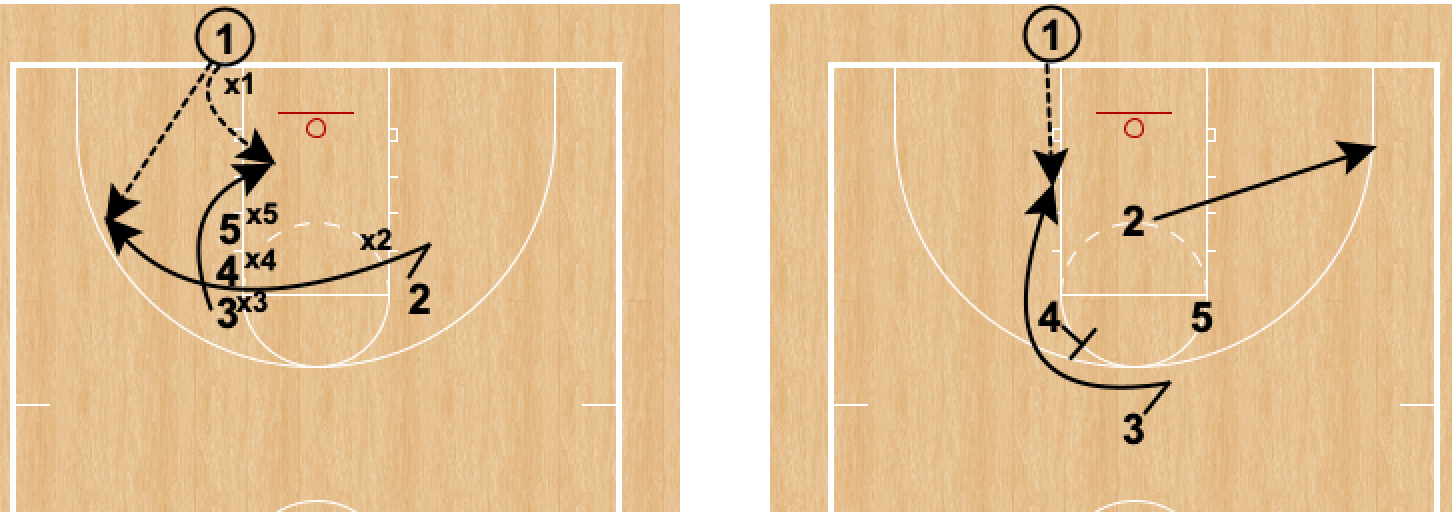
4. "SEPARATE by BLOCKING PLAYERS within 'AREA DEFENSE'"


Offense screens the middle and forces x3 to cover the perimeter or stay home.


5. Screening to separate involves multiple screens, multiple screeners, or both. 


In this action, the screener sets multiple screens to create separation. 


Other "multiple screens" to consider include staggered with Iverson action a variant, double screens (two players set), sandwich/elevator screens, screen-the-screener (pick-the-picker), and Spain pick-and-roll (shown earlier). Defenses often struggle with multiple actions or secondary options (e.g. slipped/Ghost screens). 

Lagniappe. This video discusses zone offense via location (high post, low lane, overload) and types of screens. It's a worthwhile investment. 


Lagniappe 2. UCONN vs STANFORD highlight breakdown


What is the pick-and-roll coverage? Stanford plays DROP COVERAGE against Bueckers and she makes them pay. 


What about BOB? Stanford sets up an iso for Cameron Brink and the 6'4" sophomore uses solid footwork to score in the paint. "Technique beats tactics." 


...a game of separation. Fudd uses the staggered screen to get open for an ON TIME, ON TARGET pass to score in the midrange. 


Talent, "there is no substitute." Bueckers comes off the DHO and finds enough blue sky to score. 


Modern basketball. Penetrate and kick out for an open three.
 

WYSIWIG. What looks to be a stagger turns into sequential curls for a hoop by Bueckers. 

Saturday, April 2, 2022

Basketball: Are We Doing the Deep Work? More Efficient Offense, Inside EFG% and More

"The key ingredient in a cooking show...is the audience." - From Julia, HBOmax

Thinking is "deep work." Someone tells us, "the sky is blue." Is that true, sometimes true? 

Take a basketball concept like the "Four Factors" (shooting, offensive rebounding, turnovers, free throw attempts) that impact winning. "Deep work" expands our knowledge and wins games. 

Cal Newport wrote, "Deep Work" examining how to work to success. "Newport defines the two most important characteristics in these ‘successful workers’ as; 1) the ability to take on hard tasks/things and master them at pace, and 2) producing content/products/services at what can be considered an ‘elite level’ in both speed and quality."

High-Quality Work Produced = (Time Spent) x (Intensity of Focus) 

Consider shooting, specifically "effective field goal percentage." 


Formula from Wikipedia

It shares insights but there's more. The obvious is that more field goals and three point goals per shots taken, the more 'efficient'. Where do 'efficient shots' arise? 
  • Type of shot (e.g. uncontested layup)
  • Area of shot (e.g. mid-range, "below the break" 3 point shot)
  • Type of play (isolation, cut, pick-and-roll)
  • Quality of shooter 
  • Initiation, off the catch, off the dribble
  • Contestedness of shot - how open is the shot?
  • Optimization (e.g. using the backboard as appropriate)
  • Recent results (the "hot hand" theory)
It DOESN'T tell us the impact of:
  • Leading passes (relative EFG% assisted or unassisted shots)..."the quality of the shot relates to the quality of the pass" - Pete Carill
  • The degrading impact of pressure (time and score)
  • the origin of the possession (points/possession higher off a turnover/steal than off opponent's made basket)
If we want to increase our EFG%, what logically and statistically is likely to do that? 

  • Better shooters via player development
  • Better shot quality via type of shot, decreased contestedness
  • Better passing 
  • Situational practice including special situations
  • Teaching players better offense with video

  • Lagniappe. Player development. Quicker release. 


    Lagniappe 2a. Opening a gap creates opportunity. 
    Lagniappe 2b. Geno knows Xs and Os.


    1-4 into screen-the-screener action. 

    Lagniappe 3. "Turnovers bleed into defense." 

    Steals result in higher percentage/shot than dead balls or rebounds. 

    Ditto. Note how the guard attacks with the ball in the inside hand allowing a one-handed pass. 

    Cut urgently. In the NBA, scoring off cuts is the highest point/possession type of play. Bueckers cuts hard and gets rewarded. 


    Friday, April 1, 2022

    Basketball: Advice for Coaches to Limit Trouble Plus Tips (from Del Harris) and Clips

    Everyone needs rules. STOP signs and traffic signals exist not to limit our freedom but to keep us safer. 

    In the Navy, I'd tell subordinates, the first rule is "make your boss look good." As an intern, don't embarrass the Senior Resident. 

    In investing, Warren Buffett says, "the first rule is don't lose money. The second rule is never forget the first rule." 

    Don't make my advice your rules. Encourage guidelines that work for you. Inform the players and families about rules and expectations. Coach Wooden explained that all his decisions wouldn't be correct but they would reflect what he believed was best for the team. It's not the Rosetta Stone, but here are a few ideas. 

    1. Don't make too many rules. The more rules, the more infractions, and the harder to apply equally. 

    2. Be transparent. I've always coached girls. Avoid awkward situations. Parents were welcome at practice, pre- and post-game meetings. It was middle school basketball not the National Security Agency. Your situation may be different. 

    3. Don't discuss other players with parents. Everybody wants to hear that their kid is great. Few want to hear superlatives about other people's kids. 

    4. An open door doesn't mean 24/7/365. Emotions may run high after games about results, roles, and minutes. Have a cooling off period that you specify. Lincoln had his "hot letters" (never signed, never sent). So should we. If you have to say something controversial, have another adult there to witness. 

    5. Acknowledge mistakes. If winning were my top priority, I would have a shorter roster, played the weaker players even less, and played more zone. The pope is "infallible" on faith and morals. Coaches aren't infallible about anything. 

    6. Work on getting a thicker skin. Director Mira Nair said, "a director needs the soul of a poet and the hide of an elephant." Missouri Senator Thomas Hart Benton used to brush his skin with a horsehair brush seeking a leathery quality. We need some of that. 

    7. Prioritize player development every day. Build skill and competition. Can you have too many good players? I'd like to experience that. 

    8. Coaches are economists. Economics is about the allocation of scarce resources. There are only so many minutes, shots, and praise available. Dean Smith made it a point to spread around praise to lesser luminaries who contributed to winning. That's good practice. Teach players to credit teammates and coaches. Everyone likes to be appreciated. 

    9. Results come from skill and luck. "Luck is the residue of design" and "chance favors the prepared mind." Do what we can to get both on our side.  Emphasize special situations (BOBs, SLOBs, ATOs, best action versus man and zone, time and score). 

    10. Make it about the players. "Are we building a program or a statue?" Our legacy is the life success of our players. They are watching us model behavior.  

    Helen Mirren was asked what was the key to success as an actor. "Be on time. Don't be an a**hole." Sounds good. 

    Summary:

    • Have a cooling off period. 
    • Prioritize player development. 
    • Coaches are economists allocating limited resources. 
    • Spread praise around. 
    • Emphasize special situations. 
    • Make it about the players.

    Lagniappe. Player development. 


    Watch the action at half speed. 

    Lagniappe 2. Xs and Os. 


    DHO back screen, hard to defend the second action. 

    Lagniappe 3. Film study. South Carolina/North Carolina


    Misdirection, throw behind. 

    Horns set with pick switched, rescreen creates an open two. 

    "Water the flowers." When the big runs hard in transition, pay her. 

    Lagniappe 4. Advice from Del Harris in Winning Basketball Defense

    • Have a great transition defense. Control the fast break. 
    • Prevent scores by dribble and cutter penetration.
    • Attack the rebound and loose ball. Control the second shot baskets.
    • Rotate to cover/prevent open men. Control the open shot. 
    • Force the opponent to make an extra pass or play.
    • Talk on defense.
    • Help on defense. Be willing to give yourself up on defense.
    • Defend against all penetrations. A good player is always in position to defend his man, the ball, and the foul lane.
    • Have the courage to be physical, to put bodies on people, to make the first hit on blockouts and to challenge cutters.