Total Pageviews

Saturday, March 17, 2018

Leveraging The Compound Effect, Basketball, and Lagniappe

Darren Hardy wrote The Compound Effect. James Clear summarizes. 

Overarching themes include the power of incremental gains, the value of persistence, and the need to track progress to achieve your goals. How do we spend our time? How do we spend our money? How much investment do we make in ourselves? 

Quotes and basketball relevance. 

"Success is doing a half dozen things really well, repeated five thousand times." Do well what you do a lot. Identify what you want to do exceptionally well and focus on excellence in those areas. 

"Knowledge uninvested is wasted." Apply what you know. The RULE OF 2's means that it takes two minutes to study a new skill, two weeks of steady practice to incorporate it, and two months of work before you apply it successfully. 

Link to "Box Drills". Courtesy Herb on Hoops Facebook group. 

"Gratitude is acknowledging there are people in your life who have done things for you that you couldn't do for yourself." Our job as coaches is to help take you where you cannot go by yourselves. Our satisfaction comes from seeing your improvement as a team and individually. 

"All winners are trackers. You cannot improve something until you measure it." SMART actions matter. Specific-measurable-attainable-realistic-timely. Track your time reading, training, free throws made and taken (percentage), your consecutive shots made, your scores in drills like Pitino 168 and "251". 

"The key to success is this: are you learning each day?" Warren Buffett asks, "Do you go to bed smarter than when you woke up?" We cannot accomplish this solely by speaking, but by listening, observing, doing, and reading. 

Bill Parcells remarked, "Confidence comes from proven success." No sixteen seed had ever beaten a top seed in the NCAA Men's Basketball Tournament. That record now stands at 1-135 after the UMBC Retrievers hammered Virginia last night. 


Lagniappe: 


Lunges from Alan Stein. Options include varying the pivot foot, using weighted balls, or weights. 

Friday, March 16, 2018

MSU Half-court Sets


We can examine offensive schemes for spacing, timing and thinking about how we might defend. Here are a few Michigan State actions...


Unusual double screen to set up midrange shot or roll. The set reminds me of a "rocket," so I'd call it rocket. 


Serial screens using the post as screener.


Horns into pindown with slip. 

Thursday, March 15, 2018

Defending Screens (Annotated)


Annotated highlights from a FIBA teaching video:

Information must be "meaningful and relevant for the players." 
"Play to our strengths." Put your team in a position to succeed.
"Summary information in written...visual...and walking through on the floor." (This accommodates different learning styles.)
How many passes does a team need against us to make before they get a good shot?
Benchmark our team for scoring, rebounding, turnovers.
Our preparation should be able to measurably affect performance.

Four principal ways to defend screens: (Communication central to all...goal is to prevent advantage from the screen).
1. Offense can cut straight, back, curl, or flare. 
2. Screener defender calls technique (over, under, through, switch)...I like to have screener defender call "jam" which triggers "under" action...although for long-term I want bigger wing defenders to be able to switch onto the screener
3. Ball pressure is always central.
4. Against curl must get to the outside hip...
5. Screener defender critical for directing the action

6. Side pick-and-roll (emphasizes weak side help at the split)
7. Against PnR first discusses hard 'show' and over with recovery by screener defender (as readers here known NBA preferred defense on side PnR is 'ice')
8. Under (mild vulnerability to shooters)
9. Through (as screener defender steps off)
10.Switch 
11.Blitz (trapping the ball handler)...choice re: personnel involved...for example, teams are trapping Kyrie Irving a lot

This talk shines because it is consistent in emphasizing communication and understanding and allowing coaches at any level to choose their style. "Learning is a change in behavior due to an experience." 

We don't have to teach every technique, but our players need to execute the techniques we teach.


Wednesday, March 14, 2018

The Learning Machine


Warren Buffett partner Charlie Munger describes his colleague as a "learning machine." That allows the octogenarian to remain on top of his game. 

How do we become a "learning machine" - a learn it all, not a know it all?

Intent. Kevin Durant awakens and asks, "how can I get better today?" Kevin Eastman reads a minimum of two hours a day. Steve Forbes reads at least fifty pages a day. Thirst for knowledge and perspective. We can't change the world unless we change ourselves.  

Process. Seeking improvement isn't enough. Read thoughtfully and critically. Farnham Street Blog details better reading (I've read this article four times). The author suggests that we create mental pictures and mental models (biases about how we and the world work). Make our process vivid and clear. 

Preparation. Games structure situations that challenge coaches and players to choreograph solutions. Our 'why' dictates the who, what, and where. One end-of-game situation illustrates. Leading by one (against an undefeated team) with five seconds to go, we had a sideline out of bounds (SLOB). The solution didn't demand genius only dodging disaster.  

Goals: 
1) Inbound the ball safely.
2) Do not foul.
3) Get the ball to a preferred free throw shooter. 
4) Do not inbound closer to our own basket (make it tough for the opponent to score).
5) Avoid deflections on the inbound (easier to the corner or backcourt).
6) Manage risk. If we lose the ball, where do we leave hard conversion and scoring? 


The opposing coach is yelling "switch all screens." I'm okay with that as we designed big on small. We inbounded to the corner but lost the ball after a couple of seconds. We didn't foul and the opponents never advanced the ball to where they could shoot (despite the home timekeeper). The execution wasn't ideal but adequate. 


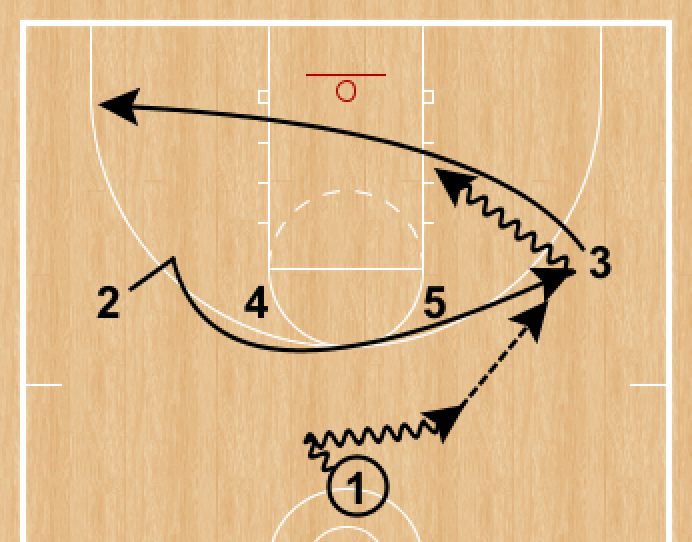
If we needed a three, then I prefer this type of action (to the ball) because we can't consistently make long passes. 

"Orange School" designs structural and situational teaching. Do you have clips that you'd share with your team? I plan to start with our high school's semifinal loss, showing plays that demonstrate core principles. 

Lagniappe: excerpts from an essay by John Celestand

"The day you make the decision to be successful is a day in history for any human being. It is the most important day of your life. This is a day that is more important than a birthday, an anniversary and any other holiday that you can imagine. In fact, the day that you decide to become successful should be marked in your own calendar and celebrated annually. 

Successful people think alike. They behave alike. They have the same habits. Similarly, unsuccessful people behave in a like manner. Success is not an accident, luck or a gift. Success is a mind frame. Money, material possessions and fame don't have anything to do with success. They are simply the results of the decision. 

Those who are successful, carve out "time to be successful." That is part of their week. Many times people tell me they don't have time to read during the week. Some of you won't have "time" to read this article. That is absurd! I have never heard anyone tell me they don't have time to eat during the week. Why starve the mind? The information and education that comes from reading can't be put on the back burner. This is one of the great crimes of humanity. If you are not dedicating yourself to learning and participating in some type of self-improvement every day of your life, then you are severely hampering your existence.

Success is a mind frame. It's never easy or in clear view. Success hides in dark crevices, under rocks and around corners. Only those who dare, who have courage and once in a while, gaze off into the horizon, ever seem to find it." 


Tuesday, March 13, 2018

Fast Five: How Do You Get an "A" in Basketball?

How do we grade our students? Irony dictates that your grade depends mostly upon what you did for your teammates.

We may not give formal grades, but we constantly assess players and teams. How do you earn an 'A' in basketball?

First, consider inversion...the opposite of excellence. What deconstructs success? 

The self-destructive player commits mental errors, especially repetitive ones. Common mistakes include missed defensive individual assignments, lack of help, poor communication, and bad shot selection. Everyone commits physical errors, like bad passes, missed layups, and fouling. But quality players seldom make mental mistakes. 

Second, what positive attitudes are overrepresented among excellence?

Basketball is important to superior players. By definition, extracurricular activities are optional. Superior players invest mental and physical energy. "Success leaves footprints" with better attention, commitment, discipline, and preparation among the most effective players. Every excellent player wants coaching.

Third, "A" players make better decisions. They don't focus on their glass isn't half empty or half full; they're constantly filling it. Decision-making includes both their off court behavior (rest, exercise, diet, study) and on-court offensive and defensive reads. 

Fourth, successful players uniformly see their work as craft, elevate their game, and seek mastery. They add layers to their game and build a portfolio tiered upon physical and mental skills.

Finally, the best players execute at a consistently high level. They find ways to contribute when parts of their game aren't working. They force coaches to put them on the floor because they are success machines. Pete Carril called some players "light bulbs." "They walk on the floor, the light goes on." - February 6, 1991. 

I call them transitional objects as we coaches can't do without them. 


Lagniappe: (a reminder that Lagniappe is 'something extra, unexpected, a little special"


More from the Xavier (top four seed) basketball newsletter...


Even better, don't use chairs or cones, include a defender. 

Monday, March 12, 2018

Captain Obvious: A Few Thoughts on Defensive Teaching

Coaches help players see the game. We can't teach unless we have a coherent and unifying perspective. The ability to create and deny separation constitutes an important symmetrical theme. 

We can divide individual teaching into ball skills (e.g. dribbling, passing, shooting) and off-ball skills. We can't teach ball skills without the ball. Generically, players perform NINETY percent of the time without the ball. Players can learn a lot of the decision-making off-ball theory through film study. They then translate them into practice during drills and scrimmaging. 

Take any subject, like post defense. Ask a player their job and they may say, "prevent the post player from scoring." Factually true, tactically useless. We can follow through by asking "inversion" questions. 


In a classroom setting, we can ask:
1) where does the offensive player want to post?
2) how do they get the ball?
3) once they get the ball, what are our options?


We ask defenders, how could we defend (front, 3/4, behind) and the advantages and limitations of each. I teach post denial via ball pressure (lack of it encourages entry) and individual technique because problems (scoring and fouling) occur after entry. 

We can ask about digging and doubling (defending AFTER entry).


We can double and rotate (left) or double without rotation (my preference), because I consider it less risky. With younger players, we rarely encounter skilled post players.

Ball pressure. Defenders may hesitate to apply ball pressure through fear of getting beaten off the dribble. That can be a legitimate concern. How can we encourage perimeter defenders?


Consistency. Share persistent messaging. "Be the same guy." 
1. Attack mentality. Have a consistent mindset offensively and defensively.
2. Practice. Half and full court one-on-one defense. Two useful drills above.
3. Protection. Defense is 5-on-5. You will get protection from backside defenders.
4. Communication. Insist on talk, so defenders avoid 'wipeouts' from hard screens.
5. Pavlovian Conditioning. "Don't back down." "Nose on chest." "Head on ball." "Crawl into them."
6. Confidence. "I believe in you." Praise the praiseworthy. 

Feedback. Do players understand and practice what we preach? Soliciting and giving feedback is another central process. 

Priority. Is defense a priority (the techniques are emphasis) or lip service? I started one player each game because I valued her as our best on ball defender. But early in the season, I told her that she had earned that opportunity through her actions. That reinforces the value (minutes and contribution to team success) attached to defensive effort, technique, and tactics. 


Sunday, March 11, 2018

Postseason Plays Informing Winning and Losing

What distinguishes our team's individual and collective performance, especially in big moments? Yes, talent matters, but talent reflects not just skill, athleticism, and resilience, but Pete Newell's designation, the ability to "see the game." 

Here are a few plays that defined results because of design, execution, and the defense's inability to respond. A small number of plays often define outcomes. 


After the opening tap, the offense ran ball reversal into a diagonal screen (a reverse action) for a layup. Defensively, you need great communication (from x3) to allow x5 to stay with her assignment by "going under" the off-ball screen. 


Similar action off 1-4 (or horns). High ball screen into diagonal screen setting up a high quality layup or postup. 


BOB "Mousetrap" as two defenders go for the cheese. Offense springs the trap by screening the middle of the 2-3. 


Classic "Iverson cut". First, the alignment (1-4) limits "weakside help." It also informs the defense about the intent of clearing space in the lane. 


Here's how it played out in a Massachusetts sectional semifinal game. 

I intend to offer players periodic "Orange School" film study to help see through 'coach's eyes.' 

Saturday, March 10, 2018

The Progression

What do we mean by "the progression" of players? 

Borrowing from Brett Ledbetter, we see progress as growth of character and 'ethos', and secondarily basketball development. It's rewarding to see confident adults, comporting themselves as thoughtful people, who look you in the eye with presence. 

Players progress by understanding themselves as people and seeing the game. Excellent players determine their destiny. They fully engage, day after day. They win the sprints and don't take drills off. 

Emotional maturity informs decision-making on and off the court. Self-control, self-discipline, and self-reflection accompany personal growth. More developed players recognize the multiple ways they can impact the game beyond scoring. Non-scorers can dominate games defensively or rebounding. I cannot emphasize this enough. Your contribution to team success is not necessarily a function of scoring. 


The Lakers won 33 consecutive games and the NBA title in the 1971-1972 season. Wilt Chamberlain averaged 14.8 points per game, far below his career 30 points per game average but his overall contribution earned a championship. 

The young player asks how she can improve. The mature player asks how she can contribute more to the team. More mature players solidify their strengths while compensating for weaknesses. Mature players understand situations, tempo, and intelligent risk taking. Experienced players rely on coaches and mentors to help them get where they want to go. 

Experienced players play with purpose, eliminating wasted movement. There is more flow to their game and ability to maneuver off the catch quickly and decisively. 

Advanced players disallow direct drives, discourage the dribble from making uncontested passes, get deflections and steals, take charges, play in space, take quality shots, don't get tied up, and support their teammates unfailingly. 

But "the body of work" informs your play. Everyone has a bad game, including coaches. 

You control your playing progression. Manage your attitude, your behavior, your effort, preparation, and study. Define your relationship with your craft. Or as Kevin Eastwood opines, "you are responsible for your paycheck." 

How do you take care of your body, manage your diet, train consistently, and get rest? Do you handle family and academic responsibilities? The more mature athlete has refined a plan for global self-maintenance. 

Progression is the sum of everything you do. You advance your athleticism, conditioning, skill, knowledge, attitude, and emotional makeup. The player with grit and continual ascension mindset surpasses those without drive and purpose. 

Lagniappe: Larry Brown thoughts from Xavier newsletter. 


Friday, March 9, 2018

Individual Defense and Extreme Ownership


The offseason has arrived. Create high expectations. Review technique precisely and prioritize it. Simplify and clarify responsibilities. First, what is your responsibility? It depends on your position in the moment. 

On-ball-perimeter defense ("reach out and touch someone")
Off-ball-perimeter defense ("The ball scores." I don't care if YOUR player didn't score if you didn't help, rotate, or recover.)
Screen-and-roll defense (Be consistent in what we teach.)
Post off-ball defense ("Your problems start once you allow the ball in the post.")
Post on-ball defense ("Wall up. Stay vertical.")
Transition defense (Sprint, don't run.)
Defending special situations (Understand offense to excel at defense.) 

For instance, especially if you choose to FRONT the post, you must apply pressure to the perimeter passer. Great defense requires multiple actions.

What is your overarching defensive mandate? Restate the goals as ONE BAD SHOT, NO EASY SHOTS, and HARD 2's. 

Defensive corollaries. 
Pressure the ball.
Deny the middle/paint.
Deny post entry and cutters to the ball.
Challenge/contest shots without fouling.
Own the defensive boards. 

Quiz yourself: CARE (concentrate/anticipate/react/execute). Head, heart, feet.

Do I understand what core principles belong to our defense? I have to do a better job of giving and getting feedback. 
Am I communicating, "early, loud, and often?" It's never enough. 
Am I competing to succeed this possession? COMPETITIVE FURY. 
Am I ALWAYS playing in a stance? 
Am I between my assignment and the basket? (Ball-you-basket)
Am I between my assignment and the ball? (Ball-you-man) 
Do I see both the ball and my assignment? ("See both.")
Am I ready to help? ("The ball scores.")
Am I running or sprinting in transition? ("Basketball is a sprinting game.") 

Lagniappe: We get what we accept. EXTREME OWNERSHIP. 


Basketball and sport are not war. But it shares lessons about humanity, humility, honor, teamwork, and sometimes courage. "When a team takes ownership of its problems, the problems get solved." 

Thursday, March 8, 2018

Wasted Possessions Come from Avoidable Errors

"Little things make big things happen." - John Wooden

HoopCoach shares thoughts about key possessions. Do our players understand what changes outcomes? Avoidable errors inform results. Players need to understanding winning and losing plays. Here are just a few opportunities for change that happen most games. 

The opening tap. We should never allow a hoop off of a tap play. We should sometimes score off the tap. Net-net, we should always come out ahead. But it only happens once a game...except with overtime. 

Failed block outs. Years ago I saw a game where the home team failed to block out the first two defensive possessions, allowing putbacks and the visitor to go up 4-0. The opponent had not won in our gym for twenty years. The locals lost by two and fans lamented a failed possession at the end. The team gave away four points in the first minute. 

Bad screens (offensive fouls). A hip check is not a screen. Flying elbows are not screens. The screener is the second cutter. The screener sacrifices her team's and her chance to score through poor discipline and poor technique. 

One bad shot (shot turnovers). If we score a layup (or great postup) as 4, excellent shot 3, contested good shot 2, bad shot 1, and turnover as 0, what is our average possession over a quarter or a game? We should want mostly 3s and 4s, realizing it's impossible to take turnovers to zero. 

Bad fouls. "Foul for profit," according to Kevin Sivils. Think about the couple of bad shots that get fouled every game (sometimes it's worse). Don't foul jump shots or threes. Never reward bad decisions by opponents. 

Turnovers (boundary calls, three seconds, perimeter travels). We'll never be good enough that we can give away possessions. 

Strategic blunders at the end of quarters. Every quarter the final possessions offers a potential (+3,-3) six point risk-reward. Years ago in a state tournament semifinal game (Boston Garden), our high school team led 15-7 during the final thirty seconds of the first quarter. The team shot early, missed and the opponent scored a three at the horn. The opponent scored the first hoop of the second quarter, and an eight point lead evaporated to three in under thirty seconds. Everyone must be on the same page with situational basketball.   

Don Meyer's words echo through locker rooms, "what is unacceptable in defeat is unacceptable in victory." Successful teams put themselves in winning positions by understanding the game and maximizing each offensive and defensive possession. 

Lagniappe: High Performance Behaviors


What skill creates below average payrolls and above average performance? Assists. GSW was about 30 percent higher than the 'coffin corner' teams in assists (cooperation). 

"Cooperation...is the essence of teamwork...but always involves a sacrifice." 

More individuals points correlates 40 percent greater than any other statistics with pay. 

"People typically active in ways they believe will benefit themselves." 


Do you fear disappointment or humility? Penalty shooters are vilified for shooting at the middle of the goal, although it increases their chances to score. 

"Systems reward rational responses." 


How did the USWNT (soccer) outperform for years? The team played for a higher calling (than winning) but to achieve gender equality through sports. "They also played to dominate the game." The coaches gave as much praise to the 20th player who kept the star player functioning. 

They had a concept called, "Walk in others' shoes." They understood each others' roles. 


Wednesday, March 7, 2018

Winning Versus Development in Youth Basketball: Cognitive Dissonance


"Winning isn't everything; it's the only thing." - Vince Lombardi

“A champion needs a motivation above and beyond winning.” - Pat Riley

Everyone likes to win. But as a youth coach, should I choose winning over development, justice, and context? Winning at any cost contradicts accountable youth coaching. It defines cognitive dissonance. 

Rule 1. Relationships matter. Teammates matter. Everyone can't be a great player. Everyone can be a great teammate. But relationships extend among coaches and between coaches and players. Opportunity injustice harms these relationships. Does the 'first' player on your team see you the same as the 'last'? 

Rule 2. The game is for the players. We need an overarching philosophy. I facilitate the play. Draw the lines on the paper and players write the story. Do you want to watch robots play? Go to a game and watch a middle school coach call out fifty different plays. You've seen it. 

Rule 3. Kids need to learn how to play. Coach Mike Krzyzewski notes, "the game is about making plays not running plays." Once that happened far from adults at the asphalt jungle. We have "car athletes" who play when an adult drives them somewhere. It's not universally safe for children to go to the park. We live that sad reality. 

Rule 4. "Never be a child's last coach." Make it fun. I love practice. If the players don't enjoy practice, they should find other ways to invest their time. 

Rule 5. Ego is the enemy. Are we building a statue or a program? You will win more with a shorter roster, unequal playing time, multiple defenses including zones, and getting more opportunities (shots) for your best players.  French football manager Arsene Wenger remarked, “At a young age winning is not the most important thing… the important thing is to develop creative and skilled players with good confidence.”

Rule 6. How you play is how you live. Good players want coaching. Coaching includes constructive criticism (be demanding, not demeaning), motivation, and balanced feedback. "Catch people doing the right things." As a player, what is your purpose? An exemplary player gives outstanding effort at home, at school, and on the court. Don't let praise or criticism inform your self worth. 

Rule 7. Basketball is eighty percent mental. Concentrate. Study. Learn as much as you can. Use the resources available from coaches, teachers, mentors, fellow players, and the Internet to see the game. 

Rule 8. The parents are the parents. Coaches share our experience, teaching basketball and life lessons. But we recognize boundaries that parents own. 

Rule 9. Success and winning aren't equivalent. Sometimes you play well and lose on the scoreboard. Sometimes you play poorly and win. Playing well with your best effort and best decisions is the goal. Never let a score define you. 

Rule 10. Love your losses. "Experience is the best teacher, but sometimes the tuition is high." Failure and disappointment come to all of us. Adversity is our companion on life's journey. Learn from struggles, but don't struggle to learn. 

Lagniappe:

We need to finish better and play tougher with the ball. 


BBallBreakdown shares ideas about finishing tough off two feet. I'm reluctant to create adult-initiated contact that could result in injury with our players.  


Note how often the players finish with shoulders parallel to the backboard (not squared to the rim) to protect the ball with the body. If you want to score inside, then you need to train to specific skills. 

Tuesday, March 6, 2018

Lessons from Tufts Versus Westfield State

"Cast thy bread upon the waters: for thou shalt find it after many days." - Ecclesiastes 11 King James Version

Philosophy: learn daily and share information freely. 

There is always more to learn. During the first round games at Tufts, teams shared imagination and information.


Ithaca Horns slip away. 


Geneseo STS cross into downscreen for three. 

Warmups:

Tufts began with UCONN two dribble jump stop from half court with wing cutter layup drill.

Westfield began with 3-man weave with everyone shoots; one person shooting layup and wings outside shots (from two players underneath)...wing shooters become new underneath passers.

Tufts ran "two lines under" with loop pass for high finish.


Tufts Reverse layup lines


Westfield four corner layup passing (pass and follow diagonally)


Tufts quick hitter back cut. "Simple works well." As I remind our players, "fall in love with easy."


Westfield tried to run DHO into second ball screen but Tufts shut it down with switching. 

Fast Five: Priorities for Summer Development

If you believe in Extreme Ownership, then you establish priorities and emphasis. As we transition from in-season to offseason, we need clarity. Every team has different needs.

Part of the offseason program includes reaffirming the ecosystem...hardening the understanding of why we do what we do and how we do it. 


At our final practice last night, I showed the girls this drill that I call "16". You quickly make two at each spot to advance to the next spot. Ideally, it takes you 16 shots to go out and come back in. After one of my best players went, I demonstrated...as an old man it took me 17. The point is, "you can do this." 


Priority 1. Improve shooting
    Primary Emphasis: Proper form leading to increase accuracy "form begets function"
    Secondary Emphasis: Extending range


Priority 2. Game understanding
    Primary Emphasis: Film study (see Orange School) 
    Secondary Emphasis: Reading defenses

Priority 3. Playing strength
    Primary Emphasis: Physical strength
    Secondary Emphasis: Conditioning

For these preadolescents, encourage flexibility, balance, and aerobic exercise. 


Find five jump rope exercises and spend FIVE minutes total on them. 

Priority 4. Inside scoring
    Primary Emphasis: Playing through contact 
    Secondary Emphasis: Post moves to create space


Olajuwon attributed his footwork to growing up as a soccer player. 

Priority 5: Suddenness 
    Primary emphasis: Attacking the basket
    Secondary emphasis: Explosiveness

We need the mindset to become more SUDDEN. Then we need more explosive athletes who combine WILL AND SKILL. 


Monday, March 5, 2018

Spacing Considerations


Spacing. It's not all the same. Chuck Daly remarked, "offense is spacing and spacing is offense," both truth and a fine use of rhetorical chiasmus. 

Excellent players play in space. Adults tell children, "do not play in the traffic." Good advice. Spacing informs NOT playing in the traffic. Bad spacing hijacks offense. 


You can envision 'spacing' zones. Consider using the 3-point line as the SPACING LINE. 

Spacing opens driving and passing lanes; spacing makes it more difficult for defenders to double team. Draw 2 (the help defender) and free a teammate. 

"Sets" establish spacing early. Defense always involves five players but offense frequently comprises fewer. If you want a bigger offensive role, embrace spacing. 


The basketball resembles magnets with polarity. Done right, offense repels players from the ball; defensively the ball is a magnet (right, "Helpside I")


Westfield State tried to run dribble handoff (DHO) into secondary screen-and-roll against Tufts in the Women's D3 first round game Friday night. Tufts switched everything and shut it down. One limitation of highly screen-oriented offense is changing the spacing. 

Spacing creates "natural" offense. But receivers must remember that "the ball is a camera" and you must get into a passing lane to get in the picture. 


You can "automate" offense when defenders overplay by programmed backcuts. Defensively, against 'spread' concepts, we emphasize taking away 1) direct drives, 2) give-and-go action, and 3) the backcut. Offensive concepts inform teaching defensive symmetry.


You want to drive your coach crazy? NEVER cut to an OCCUPIED POST. Spacing killers are coach killers. I'm not saying that players can't cross screen, but that involves both players aware of intent and execution. Some players habitually violate this rule. They sit.


Spacing is dynamic. 3 (sink to corner) and 2 relocate to create opportunities for themselves as perimeter shooters. 

Real-world NBA examples. Even non-elite NBA teams space. Medium shares spacing, cutting, and passing leading to high quality offense. 

Mavs Drill from Ganon Baker:


Baker brings more intensity to the drill with a second ball. I like that.