Tom Brady explains his success as "having the answers to the test." What questions belong on our daily self-examination?
1. How do I improve today? Be specific.
2. What does my team need now? We're young. Mike Krzyzewski's advice, "it's about making plays, not running plays." We're playing a lot of 'small-sided games' (3 on 3) in confined spaces.
3. How can I simplify the game? Everything offensively starts with spacing. We're starting to understand how "ball gravity" is negative for offensive flow.
4. Is this drill/activity translating directly to game play?
I repeat this drill. The girls really "got it" as far as attacking with this last night.
5. And from Michael Useem in The Leadership Moment, the after-action review:
What went well?
What went poorly?
How can I improve what went poorly?
What is the enduring lesson?
Thursday, December 14, 2017
Fast Five: The Psychology of Performance
We have great tools available.
We know that you need emotion to make decisions. We cannot trash emotion and make decisions. The opponents come out and score the first six points. Do we take a timeout by emotion (to stop the run), by rule, or do nothing?
But emotion gets layered upon other "business" analysis, such as perceived quality, value, and growth prospects. How good is my "team" (family, work, sports team), where is the value, and how can we improve?
A few lessons extracted from Market Mind Games:
FUNDAMENTALS
Key Concepts
The task in trading is to predict the future perception of other market players. (What can the other team do to give us trouble? Experienced teams understand context. Younger players can't color within the lines because they don't see the lines or connect the dots. We have to provide a lot of structure while teaching context.)
Beliefs are pre-existing conditions that create implicit context. (We know that good teams need to create and defeat pressure.)
The Spectrum of Fear
On the left: Fear of Losing (Teams need to play to win, not to avoid loss.)
Middle: Anxiety due to Ambiguity / Uncertainty (paralysis by analysis)
On the right: Fear of Missing Out ("If only")
HANDLING YOUR EMOTIONS
Hold On to Winners by Improving Self Awareness.
Do more of what works and less of what isn't. We can improve - WRITE down what is working and what isn't.
“Emotions as Data” — Monitor Your Emotions for Analysis
"Reams of research indicate that putting feelings into words does indeed provide a great benefit, it not only reduces anxiety but verbalization can actually allow us to work more effectively on a thinking level."
Unconscious Motivations Are Dangerous
"What am I doing and why?" Are my actions consistent with my stated (written) intent?
Accept Your Emotions as Natural and Stop Blaming Yourself
But-I-Know-Better (BIKB) trades set up feeling and emotional contexts of self-recriminations. Just catching yourself in those — and the feelings surrounding them — will impact your bottom line in a positive way.
Get used to admitting to yourself (and if possible to someone you can trust) what you are feeling.
Walk Away When Your Emotions Get Intense
Stay grounded. Be the adult in the room. When the feelings and emotions you are experiencing become the most intense, you can be assured that it is not really about the markets or the money.
LEVERAGING ON YOUR AWARENESS
Use Your Emotional Awareness for Risk Management and for Reading the Market
The more conscious you are of your emotions, the more you can use this knowledge first as risk management and eventually as a tool for reading others.
Maintain your Physical-Psychological Edge
Trading (Coaching) is actually a physical game. Playing the “sport” of trading should be handled as if you are the quarterback of an American football team.
Rest: Being well-rested is an edge.
Diet: When one really concentrates, the body and brain use an inordinate amount of energy. Eating properly keeps your energy up and adds to that physical-psychological edge.
Exercise: Exercise gives us a physical boost that makes us feel more optimistic, and that counts as psychological capital.
The body counts essentially as much as your intellect. If the body is feeling the static of tired or drained, the feelings and emotions of risk-management and people reading can’t properly communicate their data.
Why Pros Trade the Close, and Amateurs Trade the Open
Use available data to make better choices. "Literally, your mind has more contextual details to make a judgment call about what the next play will be." (Simple is better. It's always tempting to teach to a higher level.)
Why People Fight Trends
Trends are facts. Why do we choose to deny facts? Sometimes it takes time to identify the facts. "I have yet to find someone who habitually fights trends that doesn’t ultimately reveal a very clear and specific reason that arises out of their personal and family history." (Our emotions can betray us.)
Lagniappe: a HORNS SLOB


Wednesday, December 13, 2017
That Which Is Seen and That Which Is not Seen
In 1850, Frederic Bastiat wrote a lengthy essay, "That Which is Seen and That Which Is not Seen." He reminds us that easy actions often have unintended consequences. "The sweeter the first fruit of a habit is, the more bitter are the consequences. Take, for example, debauchery, idleness, prodigality."
We are all economists, weighing finite resources such as practice time, playing time, roles, and our personal time.
Practice time. Amidst practice time, we determine time spent offensively and defensively, and allocation within those domains. Applying and defeating pressure owns time, the half-court game, specialty situations like inbounds plays, end-of-clock and end-of-game management. Conditioning within drills does double duty. Within our choices, is every activity transferrable to game play?
Playing time. Chuck Daly noted, "every player wants 48 - 48 minutes, 48 shots, 48 million dollars." More time for Peter means less for Paul. Competition for those limited resources motivates positive and negative behavior. Situations impact lineups and the goal is to succeed with the players who play the best together not the best players. Nobody pleases everyone.
Roles. Players earn minutes. Define your role and excel within. Dominate defensively or rebound, and offensively become facilitators, scorers, screeners or combinations. When insight and work ethic match aspiration and skills, the possibilities are limitless. If unhappy with your role, ask the coach how you can contribute more. "Do more to become more; become more to do more."
Personal time. Coaching and playing can consume us. Attend to our family, personal growth, exercise, sleep, and proper diet. Bastiat counsels us, "Let us accustom ourselves, then, to avoid judging of things by what is seen only, but to judge of them by that which is not seen."
Lagniappe: layup under pressure drill.
Tuesday, December 12, 2017
What's Your "Wow" Factor?
Tony Hsieh at Zappos discusses "wowing" his customers. Zappos uses 'wow' as a verb. What can we do as coaches (or players) to wow our program?

Lagniappe. Lagniappe means 'something extra.' Find ways to help them do more and become more. Last night I had them play "Ultimate." Ultimate 1 is full court, no dribble pass and cut with the goal of getting a "touchdown" in the end zone (two feet catch over the end line). If the ball touches the floor it's a turnover and the other team plays the ball from the spot. Ultimate 2 changes to the goal to scoring and allows bounce passes. Ultimate helps 'cure' the disease of excess dribbling. In our world, we make the rules.
To wow prioritizes relationships and exceeds expectations.
Communication. Relationships come first. Build relationships, trust, and loyalty. Greet every player by name within the first minutes of practice. Catch people in the act of doing something right. Find successes to praise, "I believe in you."
Investment. We invest in our teams in many ways. They don't have to be expensive. Notebooks and handouts are simple and inexpensive.
Add value. Teach. Encourage a growth mindset. Share something great.

Last night I distributed this inspirational quote poster to each player and to my assistant (to hang in his high school classroom). Almost all of the girls knew of Mia Hamm. "How did you know she was my favorite?"
Lagniappe. Lagniappe means 'something extra.' Find ways to help them do more and become more. Last night I had them play "Ultimate." Ultimate 1 is full court, no dribble pass and cut with the goal of getting a "touchdown" in the end zone (two feet catch over the end line). If the ball touches the floor it's a turnover and the other team plays the ball from the spot. Ultimate 2 changes to the goal to scoring and allows bounce passes. Ultimate helps 'cure' the disease of excess dribbling. In our world, we make the rules.
Authenticity. "You can't fool children, dogs, and basketball players." Don't let the short-term (a bad loss on Sunday) corrupt the big picture. We change lives but it doesn't happen overnight.
Purpose beyond passion. Can I help create better people, who care about their teammates and their community as well as themselves? I hope I live long enough to find out.
Last Night's New Drill: "Bradleys".
Each group has a shooter and a rebounder. The shooter holds the ball (at the block) at least at shoulder level. She "bounces" three times, maintains balance and shoots. I tell them to say "bounce, bounce, bounce, shot." The goal: get more elevation, balance, and better releases in close.
Each group has a shooter and a rebounder. The shooter holds the ball (at the block) at least at shoulder level. She "bounces" three times, maintains balance and shoots. I tell them to say "bounce, bounce, bounce, shot." The goal: get more elevation, balance, and better releases in close.
Monday, December 11, 2017
Defense 101a: Position and Rotation
"Technique beats tactics." - Gregg Popovich
Size and athleticism help but don't replace technique. Proper defensive positioning emerged as an issue for us today. It won't happen automatically or overnight. But it's on me to help our team understand and execute.
Alertness and awareness inform defensive reaction and execution. Players have to "see both" the ball and defensive assignment. As a middle schooler, we faced a grim reminder of losing vision...a volleyball would come flying out of nowhere at us. We learned... although this would never be acceptable today.


Even if a young team spaces well, 4 and 2 won't hurt you consistently with perimeter scoring. Get into position to help and then recover to your assignment.
Size and athleticism help but don't replace technique. Proper defensive positioning emerged as an issue for us today. It won't happen automatically or overnight. But it's on me to help our team understand and execute.
Alertness and awareness inform defensive reaction and execution. Players have to "see both" the ball and defensive assignment. As a middle schooler, we faced a grim reminder of losing vision...a volleyball would come flying out of nowhere at us. We learned... although this would never be acceptable today.

"The ball scores." x4 helps but other help defenders, like x3 must "help the helper" to protect the basket. Communication with help and recover actions are at the core of team defense.

Even if a young team spaces well, 4 and 2 won't hurt you consistently with perimeter scoring. Get into position to help and then recover to your assignment.
Fast Five: Finding Mentors
Our knowledge, wisdom, experience, and perception are both imperfect and limited. Mentors can help us work within our limitations. We can acquire mentors in different domains - our job, hobbies, interests.
Overconfidence in our beliefs and process informs hubris. Overconfidence exposes us to errors. Mentors provide feedback, ask relevant questions, and modify our perspective.
Tim Ferriss suggests that we are the average of the five people with whom we associate most. We define our truth.
Kentucky Coach John Calipari has a personal "board of directors" with whom he meets several times yearly. Could we do the same? If so, whom would we impanel?
Consider seeking mentors in literature and communications (e.g. books and podcasts). Aristotle, Lincoln, or Marcus Aurelius sustain thought leadership through time. Our mentors sharpen our process.
Atul Gawande, author of The Checklist Manifesto, Better, and Being Mortal enlisted an experienced surgeon to oversee some of his cases to suggest improvements on technique and process. As a young Navy doctor, I often lunched with senior physicians. My colleagues asked, "why are you eating with those old guys?" I answered, "they know stuff and willingly share."
Want to improve. Mentors add value to us that we can redistribute. Their legacy literally informs ours. Sideline our ego not by asking "am I right" but by seeking "how can I improve?"
Ask better questions. What's specifically wrong? Can we do this better, simpler, smarter? I use Michael Useem's "question set" from The Leadership Moment.
Explore ways to enhance your strengths. Mindfulness exercises encourage focus.
10 Best Ideas: What do the world's best do?
1. What would this look if it were easy?
2. Macro versus micro. "Decisions determine destiny." Focus on now.
3. What failure helped you succeed?
4. "Crush one platform." Manage your energy. "The main thing is the main thing."
5. Self-esteem is how you see your reputation. Improve your personal reputation.
6. Extreme ownership...via the Navy SEALs.
7. Make your life what you want.
8. "Discipline equals freedom." Our process defines us.
9. Ask better questions.
10.Honor the struggle. It's the grind.
We take life's raw materials, refine them into intermediate goods and finished product. We can always do it better with a little help.
Overconfidence in our beliefs and process informs hubris. Overconfidence exposes us to errors. Mentors provide feedback, ask relevant questions, and modify our perspective.
Tim Ferriss suggests that we are the average of the five people with whom we associate most. We define our truth.
Kentucky Coach John Calipari has a personal "board of directors" with whom he meets several times yearly. Could we do the same? If so, whom would we impanel?
Consider seeking mentors in literature and communications (e.g. books and podcasts). Aristotle, Lincoln, or Marcus Aurelius sustain thought leadership through time. Our mentors sharpen our process.
Atul Gawande, author of The Checklist Manifesto, Better, and Being Mortal enlisted an experienced surgeon to oversee some of his cases to suggest improvements on technique and process. As a young Navy doctor, I often lunched with senior physicians. My colleagues asked, "why are you eating with those old guys?" I answered, "they know stuff and willingly share."
Want to improve. Mentors add value to us that we can redistribute. Their legacy literally informs ours. Sideline our ego not by asking "am I right" but by seeking "how can I improve?"
Ask better questions. What's specifically wrong? Can we do this better, simpler, smarter? I use Michael Useem's "question set" from The Leadership Moment.
- What went well?
- What went poorly?
- How can we do better next time?
- What are the enduring lessons?
Explore ways to enhance your strengths. Mindfulness exercises encourage focus.
10 Best Ideas: What do the world's best do?
1. What would this look if it were easy?
2. Macro versus micro. "Decisions determine destiny." Focus on now.
3. What failure helped you succeed?
4. "Crush one platform." Manage your energy. "The main thing is the main thing."
5. Self-esteem is how you see your reputation. Improve your personal reputation.
6. Extreme ownership...via the Navy SEALs.
7. Make your life what you want.
8. "Discipline equals freedom." Our process defines us.
9. Ask better questions.
10.Honor the struggle. It's the grind.
We take life's raw materials, refine them into intermediate goods and finished product. We can always do it better with a little help.
Sunday, December 10, 2017
Dirty Dozen: Specific Advice for Young Players
Work hard, get your rest, "eat the rainbow," blah blah blah.
Be specific. Advising, "avoid 'dumb' mistakes," adds nothing. Do you want to excel? Add these twelve to your "nice" list. There are far more.
1. Dribble with purpose. Klay Thompson scored 60 points with 12 dribbles. You're not getting paid by the dribble. You're not Kyrie. "Good players need two dribbles, excellent one dribble, and elite players don't have to dribble."
2. Don't immediately catch and dribble. You're eliminating critical options - catch and shoot, quick pass to a cutter or open shooter, or an aggressive drive.
3. Read the defender constantly. She is 'giving' you something. This isn't the WNBA. Why did you make the play you made?
4. Look ahead. Do you have an open teammate downcourt? Reward her with a pass.
5. The screener is the second cutter (and usually open). Be a greedy screener and roller.
6. Don't play in the traffic. Your parent was right. If you're good enough to "draw two," then find the open player with a pass.
7. Know your "Go To" and "Counter" moves. If you don't, they don't exist. No good offensive player goes into battle unarmed. Fill your toolbox.
8. Constantly improve your footwork. Learn to pivot comfortably with both feet, both front (chest leads) and reverse (back leads). Know how to "jump stop" which gives you more options in footwork. You play 100% of the game with your feet.
9. Become an expert on shot selection. What is a good shot for you and each of your teammates? Don't force "shot turnovers."
10.Use the glass. Great shooters use the backboard proficiently to increase their percentage.
 11.Don't be a ball sticker. Practice the two-second rule. Effective field goal percentage is higher when the ball is shot within two seconds...usually meaning "open." Keep the ball moving.
12.Reach out and touch someone...in a good way. "These celebratory touches included fist bumps, high fives, chest bumps, leaping shoulder bumps, chest punches, head slaps, head grabs, low fives, high tens, full hugs, half hugs, and team huddles."
Cooperation and "non-sexual" touching are linked. We are social animals.

Players who become proficient at all these skills will be sought after for their ability, their work ethic, and their team contributions.
Be specific. Advising, "avoid 'dumb' mistakes," adds nothing. Do you want to excel? Add these twelve to your "nice" list. There are far more.
1. Dribble with purpose. Klay Thompson scored 60 points with 12 dribbles. You're not getting paid by the dribble. You're not Kyrie. "Good players need two dribbles, excellent one dribble, and elite players don't have to dribble."
2. Don't immediately catch and dribble. You're eliminating critical options - catch and shoot, quick pass to a cutter or open shooter, or an aggressive drive.
3. Read the defender constantly. She is 'giving' you something. This isn't the WNBA. Why did you make the play you made?
4. Look ahead. Do you have an open teammate downcourt? Reward her with a pass.
5. The screener is the second cutter (and usually open). Be a greedy screener and roller.
6. Don't play in the traffic. Your parent was right. If you're good enough to "draw two," then find the open player with a pass.
7. Know your "Go To" and "Counter" moves. If you don't, they don't exist. No good offensive player goes into battle unarmed. Fill your toolbox.
8. Constantly improve your footwork. Learn to pivot comfortably with both feet, both front (chest leads) and reverse (back leads). Know how to "jump stop" which gives you more options in footwork. You play 100% of the game with your feet.
9. Become an expert on shot selection. What is a good shot for you and each of your teammates? Don't force "shot turnovers."
10.Use the glass. Great shooters use the backboard proficiently to increase their percentage.

12.Reach out and touch someone...in a good way. "These celebratory touches included fist bumps, high fives, chest bumps, leaping shoulder bumps, chest punches, head slaps, head grabs, low fives, high tens, full hugs, half hugs, and team huddles."
Cooperation and "non-sexual" touching are linked. We are social animals.

Players who become proficient at all these skills will be sought after for their ability, their work ethic, and their team contributions.
Saturday, December 9, 2017
Fast Five: What Went Wrong?
Things go wrong. We had a competitive 26-24 loss today.
As events unfold, can we impute 'cause and effect', correlation, trends, or randomness? Can we intervene earlier via strategy, personnel, or operations?
Have we planned and practiced foreseeable scenarios? In Extreme Ownership, Navy SEAL Jocko Willink writes, "Implementing Extreme Ownership requires checking your ego and operating with a high degree of humility. Admitting mistakes, taking ownership, and developing a plan to overcome challenges are integral to any successful team."
Effective training informs performance. We worked a lot this week on passing, moving, and layups. We need more work and continued emphasis on player and ball movement leading to high quality shots. We had enough good shots. Don't dribble the air out of the ball and play north and south to attack, instead of ball reversible by dribbling.
After the game I reviewed the importance of possession and possessions - getting the ball, limiting turnovers, creating opportunities, and forcing opponents into low quality shots.
Military operations project a desired "end state," the successful operational conclusion. But they succeed via 'intermediate stages'. For example, in transition defense, intermediate steps include conversion, sprinting, ball awareness, basket protection, and shaping up (geometrically).
Operational success (what went well?) needs more implementation and repetition. Need areas (rebounding) encouraged reminders about d-boards (position and toughness) and o-boards (anticipation and aggressiveness).
Were there any enduring lessons from today? I told the players the story of Coach John Wooden and his father's mule. Wooden yelled at the mule and pushed it but it wouldn't budge. His father, Joshua, went over and whispered in the mule's ear and she responded. Fyodor Dostoevsky wrote, "everything seems stupid when it fails." The lesson is that you don't always get more by yelling more.

One of our inbounds plays against the 2-3 zone created repeated easy shots but few hoops. We could have easily scored another eight points on this alone.

Great gym today at Peabody High School.
Scal Nuggets, C's-Spurs Diagrams, and More
Celtics' analyst Brian Scalabrine had an extended NBA career, coached in the NBA, and extensive broadcast experience. He has a great eye for the game.
Sharing his analysis helps us see more.
Questioning Brad Stevens, "the offensive numbers are better, is it shooting or better understanding of the system?" Stevens, "guys are making better reads."


Sharing his analysis helps us see more.
Questioning Brad Stevens, "the offensive numbers are better, is it shooting or better understanding of the system?" Stevens, "guys are making better reads."

Simple works. The Spurs get LaMarcus Aldridge a post-up with a basic cross screen.
"That's how you work the official. Popovich has earned that right." (Spurs got 7 of the next 8 calls.)
"Good multiple efforts on that defensive possession..."
"Ball movement can create rebound opportunities."
"This is a T (technical) to motivate his ballclub."
"Good defense, better offense (by Aldridge)."
"Best South American player ever? (Ginobili)" My comment: Hard to know about Oscar Schmidt...
"Good decision to clear out...mismatch with Terry Rozier against Gasol" (in space).
About Popovich, "He knows the guy he needs out there to stretch the floor for other guys."
"Spurs guards get the defender on their hip on the pick-and-roll and take it all the way to the basket."

Another way the Spurs get the ball into Aldridge (screen from the corner). Nothing tricky...just power basketball.

Celtics got predictable with this one and Spurs handled it with a switch.
Friday, December 8, 2017
Homework and the Five Guys
"Did you outwork the 'five guys'?" - Julian Edelman's father
Adam Schefter interviewed Julian Edelman, recovering from knee surgery. Edelman said that his father asked about the five guys. "Did you outwork the 'five guys'...the ones that are trying to take your job?"
We all have homework, taking care of business. Take care of the details necessary to succeed today, tomorrow, and the future. As a physician, I regularly ask young people if they are doing today what is needed to succeed in their choices over the next five to ten years. It applies equally to me.
I ask myself, "what am I doing TODAY" to improve? If I answer honestly, then fairness allows us to ask the same of our players and our teams. What homework are we doing?
What am I reading? Working through Seeking Knowledge: From Darwin to Munger.

Seeking Wisdom: From Darwin To Munger. Peter Bevelin begins his fascinating book with Confucius' great wisdom: "A man who has committed a mistake and doesn't correct it, is committing another mistake." - Goodreads.com
What am I eating? Fewer calories, less meat, and "eat the rainbow" (more fruits and vegetables).
Did I exercise? Did stretching and need to do more walking.
Did I practice mindfulness? I've missed about two days in almost three months ("make it an indulgence, not a chore" and "Breathe as though your life depended on it.")
Basketball knowledge: a site worth bookmarking...www.Coachmeyer.com
Excerpts:
4 Things To Do To Build A Team:
1) Shared Ownership
2) Shared Suffering
3) Individual Responsibility
4) Collective Pride
Greatness Defined:
“Greatness is not about someone who has the ability to be great…Greatness shows up when someone might not have the ability but finds a way to succeed. They outwork their opponents, they outhit their opponents, they outfight their opponents. They want it more. Don’t give me the guy who’s supposed to be all-world and you’ve got to try and talk him into something. Give me the guy who has maybe just enough talent to be on the field but thinks he’s great, and who’s willing to do whatever he can do to contribute, to make the team better. That’s what I want…” – Mike Singletary
Thursday, December 7, 2017
Fast Five: Focus, "Ball Gravity" and "Night at the Opera" Basketball
"Whatever did or didn't happen in the past is a matter of record, so I'll leave the commentary on that to you guys. I think we really need to just focus on what we're doing." - Bill Belichick

What does my team need now? We need fundamental skill the most. We need "this drill." We can't practice motion offense, quick hitters, or matchup defenses. We struggle to make layups, free throws, set up cuts, or screen AND roll. Right now, we're playing "rec ball." That's to be expected with a young group. Give it time.
Reviewing Newellian footwork and balance, and improving maneuvering speed are the details that matter most for us.
EDIR. Explain. Demonstrate. Imitate. Repeat.
How can we speculate when we're getting closer? Offensively, we don't understand "offense is spacing and spacing is offense." The worst NBA teams space well. When we play 3-on-3 inside the split, the "ball gravity" is killing our spacing. "The ball is a camera." You don't want a closeup of your nose.
After spacing, you must make basketball plays. Attack the basket, operate in the post, make open shots. Early on, it's Night at the Opera basketball (me-me-me). We're far away from being able to "draw two" defenders and pass to open players.

We can serve up a taste of early complexity. Show them how a basic dribble handoff (above) opens up a downhill drive and how adding a second screen (below) becomes almost impossible to defend.

"Do the next right thing right." - Don Meyer
A World Champion explains focus. "Focus is simply choosing the right thought among thousands."
I remember reading (A Sense of Where You Are, John McPhee) that Bill Bradley focused on shooting free throws by concentrating to hit the center of the four bolts that tied the rim to the backboard. That's focus. Focus gets results. Find out where focus belongs.

What does my team need now? We need fundamental skill the most. We need "this drill." We can't practice motion offense, quick hitters, or matchup defenses. We struggle to make layups, free throws, set up cuts, or screen AND roll. Right now, we're playing "rec ball." That's to be expected with a young group. Give it time.
Reviewing Newellian footwork and balance, and improving maneuvering speed are the details that matter most for us.
EDIR. Explain. Demonstrate. Imitate. Repeat.
- Explain how a long jab step creates imbalance and makes either 'jab and go' or rip moves harder. Center of gravity? Forget about it.
- Show why it's better to rip high or low to keep defenders out of your "strike zone."
- Read whether to attack the front hand (or foot) or the 'swinging gate.'
- Find solutions to 'creating space' and get open shots. Not many will go in right now.
How can we speculate when we're getting closer? Offensively, we don't understand "offense is spacing and spacing is offense." The worst NBA teams space well. When we play 3-on-3 inside the split, the "ball gravity" is killing our spacing. "The ball is a camera." You don't want a closeup of your nose.
After spacing, you must make basketball plays. Attack the basket, operate in the post, make open shots. Early on, it's Night at the Opera basketball (me-me-me). We're far away from being able to "draw two" defenders and pass to open players.

We can serve up a taste of early complexity. Show them how a basic dribble handoff (above) opens up a downhill drive and how adding a second screen (below) becomes almost impossible to defend.

"Do the next right thing right." - Don Meyer
A World Champion explains focus. "Focus is simply choosing the right thought among thousands."
Wednesday, December 6, 2017
An Hour Practicing Layups? Finishing School
A million thousand times I've said, "the two most important shots in basketball are layups and free throws." Did I mean it? We all know, "it's a layup" means easy. Is it really that easy?
Do well what you do a lot. As a young team, we don't do anything well, yet. We could devote an hour or a whole practice to layups? Should we? Yes.
Key point: "Eyes make layups; feet make jump shots." - Kevin Eastman
Find something to use and subtract something 'not as good.' Here are some (we all have a huge number) finishing drills.
1. Flips aren't exactly layups, but they're a building block for finishing.
2. No-dribble layups, a.k.a. footwork layups.
3. Mikan drill. Everyone knows the Mikan Drill. Not everyone knows reverse Mikan. As a kid, I used to make ten consecutively from each side before moving on.

4. Hinkle layups. Butler Coach Tony Hinkle preached making layups from different angles. I like to include reverse layups for 'exposure' to finishing from both sides.
5. Half-court layups (three dribbles). Unless you're going hard, you have no shot, literally.

6. Catch-and-attack versus one and two. Lawrence Welk drill (For the elders among us, "And a one and a two...")
7. Full-court layups (better with a chaser).

8. Brian McCormick layup chase drill (above)
9. Villanova Bully Series. Outstanding video.

10. Kentucky layups (speed dribbling, two minutes per round).
11. Drop step layups.
12. McHale move layups. Every coach reading this KNOWS this, but many players do not. How many players can explain it as an inside 'face up' and 'step through' move?

13. UCONN layups (above). (Good pregame warmup drill...)

14. "One more." Pass, follow, and finish drill (above). Passer rotates to next spot. Coach exhorts, "one more, one more" pass as players execute.


16. Inbound streak (layup off the inbound)
17. One-on-one-on-one. Queen of the court...you can vary whether the ball is alive after a score or not. The coach can initiate the pass to one player underneath.
With our first league game this weekend (whatever that means), we need to spend the lion's share of practice on fundamentals.
Do well what you do a lot. As a young team, we don't do anything well, yet. We could devote an hour or a whole practice to layups? Should we? Yes.
Key point: "Eyes make layups; feet make jump shots." - Kevin Eastman
Find something to use and subtract something 'not as good.' Here are some (we all have a huge number) finishing drills.
1. Flips aren't exactly layups, but they're a building block for finishing.
2. No-dribble layups, a.k.a. footwork layups.
3. Mikan drill. Everyone knows the Mikan Drill. Not everyone knows reverse Mikan. As a kid, I used to make ten consecutively from each side before moving on.
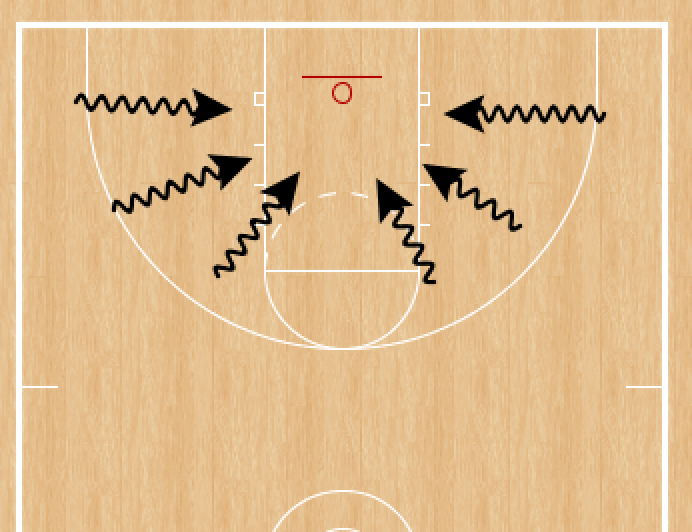
4. Hinkle layups. Butler Coach Tony Hinkle preached making layups from different angles. I like to include reverse layups for 'exposure' to finishing from both sides.
5. Half-court layups (three dribbles). Unless you're going hard, you have no shot, literally.

6. Catch-and-attack versus one and two. Lawrence Welk drill (For the elders among us, "And a one and a two...")
7. Full-court layups (better with a chaser).

8. Brian McCormick layup chase drill (above)
9. Villanova Bully Series. Outstanding video.

10. Kentucky layups (speed dribbling, two minutes per round).
11. Drop step layups.
12. McHale move layups. Every coach reading this KNOWS this, but many players do not. How many players can explain it as an inside 'face up' and 'step through' move?

13. UCONN layups (above). (Good pregame warmup drill...)

14. "One more." Pass, follow, and finish drill (above). Passer rotates to next spot. Coach exhorts, "one more, one more" pass as players execute.

15. Pass and chase half court layup.

16. Inbound streak (layup off the inbound)
17. One-on-one-on-one. Queen of the court...you can vary whether the ball is alive after a score or not. The coach can initiate the pass to one player underneath.
With our first league game this weekend (whatever that means), we need to spend the lion's share of practice on fundamentals.
Tuesday, December 5, 2017
Three Easy Tips for Young Players
Player contribution builds a four-legged stool of size, athleticism, skill, and game understanding (this includes psychology).
Game understanding requires time and teaching. Knowing where opportunity lies is a big part of experience. That allows the game to come to you.
Here are a few examples for young players to absorb:
Post doubles.

When defense doubles the post, the rotation exposes the opposite wing as the 'open' area. Your reaction accelerates if you understand where to look. The game slows down.
Help side offense.

Helpside (weak side) offense must attend to spacing. Occupy your defender, set screens, and look for cuts to open areas on the opposite side of the split (yellow line bisecting baskets). You disrupt your teammates by crowding the ball side or cutting to occupied posts. Find ways to be involved without cluttering the middle.
Relocation.

Real estate is about location, location, location. Basketball is about movement (relocation). Players cut to the basket, to open spaces, to screen, or to move defenders. If 3 is a strong driver, the post relocates to open the driving lane.

Here 5 relocates to open the driving lane and become available when the help defender stops the ball, opening other areas for the post player. Sometimes helping means getting out of the way.
Subscribe to:
Posts (Atom)