Total Pageviews

Sunday, August 12, 2018

Basketball: Revenge of the Nerds: Stats and Charts. What Matters?

When my son was sixteen he said, "I may not be the most popular kid in school, but I know that nerds run the world." He's almost thirty-seven now, a stats guy, but that hasn't changed. Good stats accompany success. 

Great teams pass the eyeball test and statistically. Win "possession and possessions." This season Villanova was second in effective field goal percentage and fourteenth in turnover percentage. 

From a practical standpoint, find reliable, vital numbers and use them for improvement not character assassination. 

Shooting


The EFG formula corrects for three point shots made. 

If we're charting, make the work worthwhile. Shot charts inform where the rubber meets the road. Who makes what and where? 

Tweet of note: 


Golden State defeated Houston in Game 7 with an explosive third quarter, abetted by Houston striking out from the perimeter. Ultimately, it's EFG% differential that has the highest predictive value. 


The Rockets came up completely empty. 


The Celtics were outliers in EFG% this season, but lead the NBA in defense. 

Rebounding

Dean Oliver's original 'four factors' were field goal percentage, rebounding differential, turnovers, and free throws taken. 


I was surprised to see that Golden State captured the second highest percentage of all rebounds in the postseason. 

Assists. 


The numbers are smaller for assist ratio, assist percentage, and assist-to-turnover ratios but GSW led the NBA in assist ratio and assist-to-turnover ratio during the most recent playoffs. "Assist ratio in basketball is defined as the percentage of a player's possession that results in an assist."

With young players and lower shooting percentage, my coach argued the importance of assists (leading to easier shots) and net rebounds (more opportunities). 

Turnovers. This tweet says it all.
Keep it simple. Track EFG% and turnovers and reap the benefits. 

Lagniappe:

I won't call this Evan Turner's signature move, but it's impressive nevertheless.


Saturday, August 11, 2018

Basketball: Q & A for Teams and Players

"This is who we are and that is who we are not." Teams establish their identity with help from mentoring and training. When a player strayed toward selfishness, my daughters' AAU Coach, Shawanda Brown, would simply remind her, "that is not how WE play." 

Asking better questions affirms our identity. 

After practice, games, tournaments, or seasons, ask: 

- What went well?
- What went poorly?
- How can I do better? 
- What are the enduring lessons? 

During the offseason, ask:

- What is my plan to wear down our opponents?
- How can I leverage my strengths and lessen my weaknesses? 
- How can I share better?
- How can I become physically and mentally tougher? 

In Getting to Us, Seth Davis explains Tom Izzo's football mentality, that defense and rebounding are the blocking and tackling of basketball. But if we don't have the people to play that style, that's the wrong answer. That doesn't mean we don't defend and rebound but it can't be our primary focus. 

The historical core of warfare is infantry, cavalry, and artillery. Basketball is no different. The infantry pounds the ball inside. The cavalry leverages team speed. Long-range shooting supports both. Few teams excel at all, so every team identifies its principal edge and style of play. 

John Miller's QBQ (Question Before the Question) demands better questions. If we use "when" it implies procrastination. Using "I" means that it's MY problem, not someone else's. Miller says, Begin with "What" or "How" (not "Why," "When," or Who"). This contrasts with Simon Sinek's "Begin with Why?" 

Responding better questions forces specifics. "I need to get better" is an empty promise. Urban Meyer uses an equation    E + R = O   Event plus response equals outcome. Find a better response, play by play, minute by minute, day by day. 

WHAT? I need proper, repeatable shooting form. 

HOW? I will make two hundred jump shots and one hundred free throws TODAY. I will find a teammate to practice with me. This addresses my needs and sharing. 

There is no WHEN. NOW. 

Lagniappe: 


"A good day is filled with knowledge, understanding, and sharing." - George Raveling

Coach George Raveling combines a lifetime of experience, overcoming hardship, and achievement with relentless sharing. Read his newsletters here. Coach Raveling encourages us to serve not to take. 

Friday, August 10, 2018

Basketball: PEAK Performance, Seth Davis Style

Two key components of learning are self-examination and spaced repetition. Seth Davis' Getting to Us studies how elite coaches operate. Internalize their lessons taught by watching film, attending clinics, mentoring, and reading. But use caution before putting mortals on pedestals.   

Coaches often come in two flavors, relationship-oriented or task-oriented. The former are called "players' coaches" and the latter taskmasters or hard guys. Players can wear out the player-friendly coach and the authoritarians sometimes grind down the players. What stands out is that substance and style both matter, although no one approach works. 


Davis uses the acronym PEAK to summarize the qualities of successful coaches. 

Calvin Coolidge owns the most famous persistence quote..."nothing in this world can take the place of persistence." John Wooden won his first NCAA title during his sixteenth year at UCLA. Dean Smith won his first at Carolina in his twenty-first season. Winners are too-often labeled unsuccessful until they've won a championship. 

Davis believes that empathy is the most critical quality of the great coach. Leaders care about their players and their feelings. We've all met technically solid coaches lacking communication skills, humanity, or both. Getting to us demands getting the players to buy in

Although we study leadership, we recognize that great coaches are comfortable in their own skin. Some are vocal and demonstrative like a John Harbaugh; others are reserved like Brad Stevens. Judge neither on style alone. 


Steven M.R. Covey uses a tree to depict character and competence of leaders in The Speed of Trust. Without integrity and good intent, capable people can work great wrongs. Knowledge is necessary but not sufficient for success. Applied knowledge requires real-time analysis, flexibility, and teams that can execute based on those inputs. 

Ironically, Davis first profiles Urban Meyer and Tom Izzo. Meyer has three NCAA titles, Izzo one and a legion of Final Four appearances. But Meyer is currently suspended and Izzo reticent on scandals surrounding their programs. It's fair to ask how and to whom their empathy extends. 

Lagniappe: 
Chris Oliver shares a complex sequence with 'floppy-like' action, leading to a flare screen into screen-the-screener action. Too complex for my young'uns but maybe good for you. 

Thursday, August 9, 2018

Basketball: Have the Courage to Struggle

"You have to fight for each note." - Hans Zimmer

You want to be the pro from DoverExcellence won't come easily. If it were, everyone would be great. 

Nobody's watching. Doesn't matter. Nobody cares. Doesn't matter. Does it matter for you? How are we investing our time, right now? 

So many luminaries have lived the struggle. It's shocking. Eighteen year-old Wolfgang Puck stood on a bridge for an hour contemplating jumping. Drew Carey attempted suicide twice as a young man. Billy Joel's Second Wind followed his depression. They have plenty of famous company. The greatness coin has madness on the flip side. 


How do we ease the struggle? Entertain. Energize. Excite. Bring value to the players and to the game.

If my youth team came out an played 2-3 zone for 32 minutes, slowed the game to a crawl, and made a couple more shots than our opponent, where's the fun and where's the learning? 


Make a great argument for your team's play (from Coursera.org). This is what we do, it's exciting, and it's worth your time. 

Engage the players and the fans. Make it relevant. Make the game beautiful. 


"Fall in love with easy." Pass and cut, give and go, look ahead, inside outside, move the ball. 

Lagniappe: 
Find ways to put players in a position to succeed. Chris Oliver shows how spacing, screening, and cutting set up a driver. 


The corollary to "don't play in the traffic" is to get opponents to play in the traffic. 


Wednesday, August 8, 2018

Basketball: Bringing Back Former Players


"Are you building a program or a statue?" - Anonymous

We build legacy. Former players are part of our legacy, for better or worse. Sometimes they share both savoir faire (know how beats know that) and sense of urgency. "This is what you do to be successful. Now is when you do it." 

Coaches influence players but players make programs. The Greeks claimed ethos (character), logos (facts), and pathos (emotion) as principles of persuasion. Robert Cialdini (Influence) studied influence and found six major principles. 


In coaching, we'll substitute words like relationships, minutes (playing time), expertise, and culture. Does our twelfth player feel as valued as our first? 

Growth culture outperforms fear and loathing. Players who return to help a program feel positively about their experience, relationships, opportunity, and performance. They radiate energy and purpose. They remind players who we are and who we are not. 

Returning alums reinforce our philosophy, culture, and values to help forge team identity. They serve as role models for young players. They demonstrate proper technique. They usually do 'us' better than we do. 

Warriors coach Steve Kerr preaches mindset, mentors, and culture. When alumnae (I coach girls) return, they embody a legacy of commitment and achievement. 


Little girls (like Victoria Crovo, on right in both pictures) make big things happen. She did excellent work as an assistant for us and one of her mentees was a league All-Star and team Offensive player of the year this season as a freshman. 


Tuesday, August 7, 2018

Basketball: Need a Two and "The Winner's Brain"

Every coach develops a portfolio of 'best actions' to score for man, zone, ATO, BOB, and SLOB situations. 

The "best action" depends on offensive and defensive relative strengths and may have analytic evidence in favor of it. 


Alice Waters' MasterClass reminds me to think simplicity and planning of how a 'meal' comes together. Her honors include election as a Fellow of the American Academy of Arts and Sciences in 2007; the Harvard Medical School’s Global Environmental Citizen Award, which she shared with Kofi Annan in 2008; and her induction into the French Legion of Honor in 2010.

We need to 'hunt' easy shots. The one's I'm showing aren't necessarily my favorites, but illustrate "multiple actions" within solid offense. 

Medium.com offers possibilities and I'm supplying a few more. 


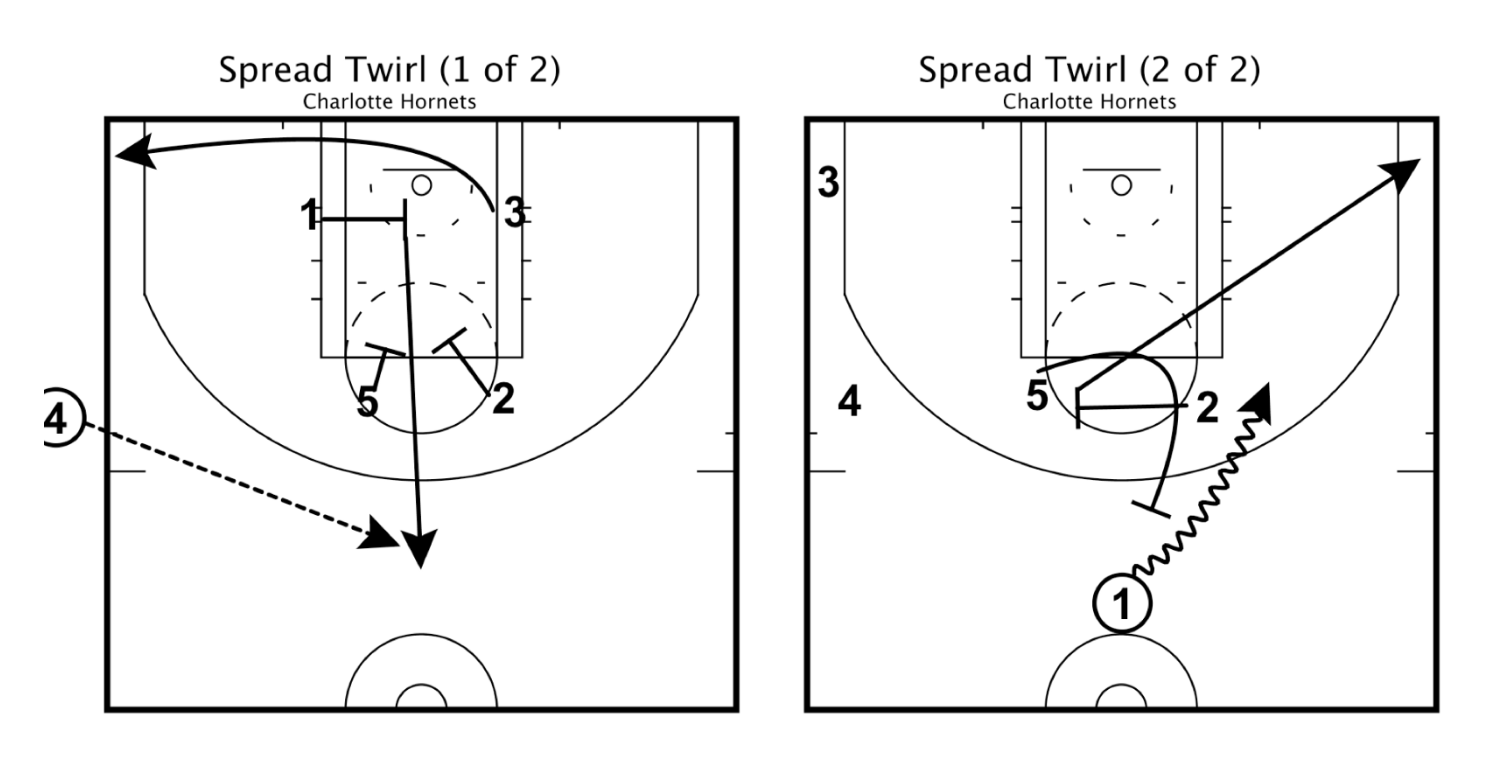
Hornets "Spread Twirl" with elevator screen into spread PnR with corner option. I copied this creative design into the high ball screen. 


SLOB, Handback Horns PnR weak. 


BOB, Horns 15 screens. 


Man. Zipper Pinch Cross screen


Zone. 2-3 Providence "Push" screen X2. Almost a 'cousin' of Michigan State's "X" but differs with '1' the key. 

Lagniappe:

Self-improvement covers many dimensions. In The Winner's Brain, the authors discuss the science of brain enhancement and maintenance. They distill four factors in Brain Care - adequate sleep, exercise, diet, and brain training (especially favoring yoga and music). 

1.  Self-awareness: thinking about yourself to become a winner
2.  Motivation: cultivating the drive to win
3.  Focus: locking on to what's important
4.  Emotional Balance: making emotions work in your favor
5.  Memory: "remembering" to have a winner's brain
6.  Resilience: bouncing back into success
7.  Adaptability: reshaping your brain to achieve
8.  Brain care: maintaining, protecting and enhancing your winner's brain


I'm studying guitar online and am literally THE worst guitar student in the world...but I'm committed to improving. 


Monday, August 6, 2018

Basketball: Patience

"Patience is the ability to wait and calmly persevere." - John Wooden


Craftsmanship takes time. 


Studying MasterClass teachers, I get to see REAL genius at work, artists at the top of their craft...Hans Zimmer, Steve Martin, James Patterson, Thomas Keller, Garry Kasparov, Steph Curry.

Coaches don't insert the DNA; we amplify the DNA. Encourage players to express themselves through their play. Make them 'interesting' and relevant

How do we learn to think differently, more creatively? Give players tools and then situations to build in randomness. Yesterday, early in practice, I reviewed the "Sikma Move", the counter from the corner with an upfake and baseline drive. Later on during the '2 on 2' segment, a player executed it but missed the shot. What mattered was a willingness to develop a new tool. 

Patience arrives in many forms...the basket cut at the right time, waiting for screens, waiting for the cutter to free herself or the defender to fly by. Actions have to develop. The passer has to see you to make your cut relevant. 

At the end of quarter, half, or game, you must know what to do and when. In a given possession, the first shot might be a great shot...or not. 

Do you have a great example of how patience with a player or team paid dividends? Everyone knows Michael Jordan's story. Bill Walton's UCLA backup, Sven Nater led both the ABA and the NBA in rebounding and was the 1974 ABA Rookie of the Year. He averaged less than 5 points and 5 rebounds per game in college but his apprenticeship paid off. 


Near the pinnacle of Wooden's "Pyramid of Success" are FAITH and PATIENCE (or belief and time if you prefer). 

The will to work unrecognized in the summer heat and humidity shows commitment, discipline, and patience. Craftsmanship takes time

Lagniappe:


Basketball Immersion shows video of pivoting to change direction and create space, especially in traffic. 

Sunday, August 5, 2018

Basketball: Thinking About Screening

Screen thoughtfully and greedily. Screens open teammates, open you, and sometimes punish defenders when teams communicate poorly. The hard, clean ‘thunder screen’ (heard not seen) gets in a defender’s head.

Rule of six from Bob Woodward, investigative journalist - provide at least six key points. 

Ball side, screen the ball. Weak side, screen for a teammate. Yes, we violate those rules.

Wait for the screen. Being late gives you better options and limits offensive fouls. 

“The screener is the second cutter. Seal and score.” Screening is opportunity not grunt work.

If a teammate is played tightly, give her a present...a backscreen.

If you are played loosely, set a down screen.

As screener on the pick-and-roll, if your defender cheats high on the hedge/show beyond your outside shoulder, slip to the hoop. 

When the post player screens across, the cutter must read the defender’s response and attack opposite (defender high, cutter low).

Always sprint to the screen, but often use misdirection, as in angling your cut to give defenses less time to communicate.

Develop your own methods to signal or to ask for a screen.

Screen-the-screener and screen-the-roller are efficient ways to challenge defenses. 

Saturday, August 4, 2018

Basketball: The Blank Canvas

Imagine we walk onto the freshly resurfaced court with our returning players as a blank canvas. But they have blank stares because summer vacation magically erased their basketball minds, but not their athleticism or skill.

It’s like we received new computers with better processors and video cards but no software, but no bad sectors and no buggy programs.

Where do we start? We get on the same page with shared philosophy and culture.

Teamwork. The discipline of execution begins with collaboration. We’re listening intently and sharing ideas. The only bad question is the one not asked.

Process. We’re committed to focus, improving through better habits and repetition at the highest possible tempo. We come on time to work on form, flips, and consistency with purpose.

Separation. As a team, we’re together, but we play to get individual and collective separation offensively and to deny it defensively. That demands high levels of fitness, communication, and situational awareness.

Separation starts with footwork and cutting. That demands spaced repetition, self-testing, and constructive feedback. Note that we haven’t touched a ball yet.

Ball movement. There’s no point in cutting if you’re never getting the ball. We say basketball is a game of player and ball movement, passing and cutting. But you have to give up the ball. I say, “water the flowers” because the bigs stop running when you refuse to fill their cups. “Movement kills defense.”

Spacing and screening. “Spacing is offense and offense is spacing.” - Chuck Daly.  We add the ball. Force the defense to defend larger areas, open passing and driving lanes, and make it hard for them to double team, get deflections, and steals. Spacing with paint touches and ball reversal distorts defense, wears them down, and forces closeouts. Against pressure, screens and back cuts create mismatches and separation because of spacing. The screener is the second cutter. Screening means opportunity not drudgery.

The big picture. We haven’t added defense or dribbling or Xs and Os. We add individual offensive building blocks, because offense starts with winning individual battles. Teach one v one, two v two, and three v three (within constrained areas) after practicing finishing and shooting. We can have the most wonderful score but fail with players unable to play their instruments.

I want players to examine their canvas, their palette, and their intended subject. Then, we’ll create art.

Friday, August 3, 2018

Basketball: Attacking Switching Defenses

Combatting switching defenses becomes a forward-looking theme. In some cases, defenses seek longer, quicker, more athletic players to defend multiple positions. 

Coaches brainstorm alternatives ranging from drag screens in transition to sets of varying complexity. Simple may help many players keep the concepts straight.  


The simplest action begins with conventional ball screens opening drives and rolls.  


Adding a cross-screen (small screens big) complements the high ball screen. 


The talented post player can get into high-low action. 


More complexity brings maddening options, from an initial post-up (if switched) to staggered screens for a three in Spurs action. 

Mismatches create scoring chances and potential foul trouble. The tradeoff is getting away from your basic offense into less familiar territory. Including some small on big screening in core offense might help. 

Coach Liam Flynn uses video (above) to illustrate some other principles, especially slipping screens. 


Thursday, August 2, 2018

Basketball: Lessons from 1972 Still Play...Rise Up


Performance starts at about 2:22. 


We hear about misguided youth, less about guided youth. Source your players and bring them to life like Shaw in Pygmalion. Collaborate


Chicken chasing. Frank MacDougall. I spent a lot of time chicken chasing Frank dribbling around practice. Coach was making me quicker. Hans Zimmer discusses the actor "inhabiting the character." The player inhabits the role - scorer, rebounder, playmaker, rim protector, stopper. Chicken chasing wasn't much fun. But winning was. 

Chicken chasing is random practice, not block practice. Dribble tag and capture the flag work, too. 

"PESTilence." Be a pest. Get under the skin of your opponent. Be hard to play against. Your play speaks. 


Everyone's a critic, a skeptic, a philistine. Prove yourself through your decisions and execution. Players need to find conviction in themselves and their play. 

"I'm pleased but I'm not satisfied." We heard this a lot. Complacency is stagnation. Winning isn't enough; bring your best. Show what you can do; combine aggressiveness and play under control.  


"Who are those guys?" Be relentless. Successful teams have a conceit or arrogance born of effort. They have no quit. Know your process and legitimize yourself. 

"Find the fire in your eyes." Nothing replaces internal motivation. Energize yourself AND your teammates. If you can find enough 'guys' who want to win as much as the coach does, you'll have something. 


Use the strengths of your team to inform extraordinary play. 


The playing, not the notes, defines the sound. 
We had no tradition. So what. "What's the scaffolding for your architecture?" Chris Oliver's podcast advised, ABC, "always build culture." Culture and character allow you to RISE UP. 

Lagniappe 1.

Villanova uses roll-and-replace to open both the roller and the relocated post. Imitators abound...via Chris Oliver. 

Lagniappe 2. "No dancing." Shoulders, hips, ball get separation. 


Wednesday, August 1, 2018

Basketball: Practice with Two


Only two players (both guards, soccer players) came to a workout yesterday. I wasn't surprised, because the local high school girls' camp was underway. Plus, kids are always away on vacation. 

What kind of operation runs with two on another blazing hot day on the asphalt? 
1. Lithuania layups...you need a minimum of three, so I had to jump in. The ball should never hit the floor. 

2. One dribble layups from the arc.

3. Box drills from each elbow.
a. Front pivot attack (emphasize explosion)
b. Front pivot rip through into shot from mid-lane (counter 1)
c. Front pivot rip through, crossover back to strong hand into layup (stay low, be quick)
d. Run from both sides.

4. Flips (emphasis...elbow in, good extension, follow-through, backspin

5. Bradleys 


Go to about 3:50 of video (heck, the whole video is great) for Bradleys. Emphasis: balance, high, consistent release 

6. Catch and shoot from each elbow (old guy rebounds). Emphasis: quick release. "When are you most open? On the catch." Massive water break for me after this. 

7. Wing tutorial (each side)
a. Direct drive
b. Pullup (first counter)
c. Drive baseline, two dribble, spin back.
d. Hesitation into layup

8. One-on-one tutorial.

Footwork, quickness, read the defender (attack the front hand, front foot), shoulders game, commit to your move, learn to finish, attack mentality (believe you will score). The game becomes more fun when you become a legitimate scoring threat. "Be the queen, not the pawn."


9. One-on-one competition. 

The rubber meets the road. 

When players show up on a hot day and work hard, they care. Add value so they feel good about themselves and can bring the work home into their driveway. 

Tuesday, July 31, 2018

Basketball: Top Ten Recent Concepts

"Si vis pacem, pare bellum." 

We all see the world differently. We have an 'automatic' (System 1, reflexive) processor and a contemplating (System 2, reflective) processor. Change arrives by choosing an open framework of belief to analyze new information on merit. If we don't wish to change or be open to change, then spending time on it makes no sense.

We consume information emotionally. "That really makes me mad." Is it because it's wrong or because it's right? Or we hear information from someone we don't like and dismiss it on sourcing.   

Did any recent messages resonate? 

1. Be mindful of the story. The game is the story. The players are the story. Teamwork is the story. The coach isn't the story. Don't block the story.

2. "Was your work good enough that you would sign your name to it?" Do good better

3. Build an offensive palette of concepts, for example:
  • Isolation (1 on 1)
  • Two man-game (2 on 2)...includes pick-and-roll
  • Three on three inside the split
  • Back door actions
  • Single-screening actions
  • Staggered screens (including Iverson cuts)
  • Screen-the-screener
  • Screen-the-roller (Spain pick-and-roll)
4. "Whatever our role...elevate our game, be at the top of our game to advance the story." Excel in our role

5. "Create a world on the basketball court. Build a story. Define the rules." To improve players or simulate reality, add constraints. 

6. "The team that makes the most layups wins." Fall in love with easy

7. "Can you play one-on-one and get stops?" (via Chris Oliver) Learn to win individual battles. 

8. "General feedback is a hindrance to learning." (Chris Oliver) Details define destiny

9. Keep a catalog of your best actions (man offense, zone offense, BOB, SLOB, ATOs) and regularly update it. 

10. "Make the gnocchi." - Chef Thomas Keller. Repetition informs excellence. The '10,000 hours' bashers miss the point. The magic is in the work. 

Lagniappe: (via Chris Oliver)
Bonus idea. Every team needs a metronome, steady, reliable, unwavering. What's your tempo? 


I'm weak at remembering poetry. But I got this in a 13th birthday card...

"To see a world in a grain of sand,
And a heav'n in a wild flower.
Hold infinity in the palm of your hand,
And eternity in an hour."
-William Blake

Blake tells us to appreciate the world and the time available to us. Find the bits that make a difference today.