Total Pageviews
Saturday, April 8, 2017
Coaching Profile: John McLendon
I've seen that Coach John McLendon inspired many players and coaches. That deserves investigation. The New York Times profiled Coach McLendon here. General Ray Odierno described critical success dimensions: competence, commitment, and character. McLendon was known for his fundamental teaching skills, composure, and strategic expertise.
He helped pave the way for successful generations of African-American coaches like John Thompson, Nolan Richardson, Jon Chaney, Tubby Smith, and others.
Tennessee State won three consecutive NAIA titles, as they were disallowed in the NCAA at that time.
Philosophy: Long before John Wooden, Coach McLendon believed that "basketball is a game meant to be played fast." His teams flourished with superior conditioning, transition offense, and pressure defense. His team ran three miles daily before the season and the tournament. At Kansas he studied under his adviser, basketball's founder, Dr. James Naismith.
He believed in Naismith's advice, to always be on the attack. "The game should be played from baseline to baseline." His teams looked for "numbers" and wanted a shot every eight seconds.
But he also recognized that success followed character. "McLendon believed that basketball was to be used as a tool to help develop discipline and character."
In 1944, his team played a team from Duke Medical School (with many former college players) in a non-sanctioned (and closed gym) contest, winning 88-44. The players then played an integrated game and spent hours socializing. This was not publicized until 1996!
Video: Big House & Coach Mac. "But John had quick eyes. He saw everything that was going on around him, which is necessary in a basketball player. The best thing John had going for him was his mind. He had one of the best-organized basketball minds I have ever seen. He was able to motivate his players to do just about anything possible with a basketball."
"One of the most remarkable people I've ever been around." - Larry Brown
Impact: Coach McLendon revolutionized the game into an uptempo sport. He was the first black professional basketball coach and the first black coach of a US Men's Olympic basketball team. In addition to paving the way for other African-American coaches, he sent numerous players into professional basketball.
Partial List of Coaching Profiles: Ron Sen Blog
I've profiled successful coaches periodically. For some, I've just annotated interviews or podcasts.
The list isn't designed for inclusiveness or ranking. I study coaches that I find intriguing or different. As for original ideas...they did that.
In the pros, the players are the product. In college, the players share the spotlight with coaches.
Here's a partial list, which also reminds me about the many worth study that I haven't profiled - Red Auerbach, Pete Newell, Pat Summitt, Phil Jackson, Tara VanDerveer, Doc Rivers, Mike Krzyzewski, Roy Williams, Lefty Driesell, Jerry Tarkanian, Chuck Daly, Etorre Messina, Muffet McGraw, Scotty Bowman, Kevin Eastman, Dawn Staley, and so many more.
So many coaches...so little time. Maybe your favorite isn't on the list...they might be great but not so fascinating to me...not naming names.
Regardless, we have to be ourselves...and opinions are like, well, you know.
Archie Miller
Chris Holtmann
Frank Martin
Jack Clark
Dean Smith
John Wooden
Tom Izzo
Shaka Smart
Gregg Popovich
Bob Knight
Geno Auriemma
Bill Belichick
Don Showalter
George Raveling podcast highlights
Dale Brown
Dwayne Casey
Don Meyer
Dana Altman
Anson Dorrance
Brad Stevens
The list isn't designed for inclusiveness or ranking. I study coaches that I find intriguing or different. As for original ideas...they did that.
In the pros, the players are the product. In college, the players share the spotlight with coaches.
Here's a partial list, which also reminds me about the many worth study that I haven't profiled - Red Auerbach, Pete Newell, Pat Summitt, Phil Jackson, Tara VanDerveer, Doc Rivers, Mike Krzyzewski, Roy Williams, Lefty Driesell, Jerry Tarkanian, Chuck Daly, Etorre Messina, Muffet McGraw, Scotty Bowman, Kevin Eastman, Dawn Staley, and so many more.
So many coaches...so little time. Maybe your favorite isn't on the list...they might be great but not so fascinating to me...not naming names.
Regardless, we have to be ourselves...and opinions are like, well, you know.
Archie Miller
Chris Holtmann
Frank Martin
Jack Clark
Dean Smith
John Wooden
Tom Izzo
Shaka Smart
Gregg Popovich
Bob Knight
Geno Auriemma
Bill Belichick
Don Showalter
George Raveling podcast highlights
Dale Brown
Dwayne Casey
Don Meyer
Dana Altman
Anson Dorrance
Brad Stevens
Make a STOP List to GO Further
Early on in Medicine, I learned two important answers, 1) "I don't know" and 2) "that's a good idea, we should consider that."
Marshall Goldsmith's book What Got You Here Won't Get You There notes "as you advance in the career, behavioral changes are the only significant changes you can make."
He writes that we must overcome two types of flaws, information-related and emotional.
Information-sharing flaws:
- Too much (knowing when to stop, negativity, being judgmental)
- Too little (withholding information, credit, responsibility, all leading to mistrust).
Emotional flaws:
- Responding in anger
- Below the line behavior (Urban Meyer's BLAME, COMPLAIN, DENIAL)
We need a personal stop list, finding "behavioral solutions." Why? Goldsmith notes that successful people tend to have two responses - denial (I don't have a problem) or attack ("Maybe they are right but why is a smart guy like me listening to a loser like you?")
How and what can we stop to become better? In trading and investing, speculators discuss "the other side of the trade." Why am I wrong?
Possible Solutions to STOP and GO.
1) Listen better.
2) Film the bench (what behaviors have to stop?)
3) Monitor our statements.
4) Solicit feedback.
5) Inform others that we are working on change.
Change is hard. But it demands attention to Kevin Eastman's triad of telling the truth, living the truth, and taking the truth...wanting to improve, working to improve.
Lagniappe: 3 on 2 Continuous Drill
Marshall Goldsmith's book What Got You Here Won't Get You There notes "as you advance in the career, behavioral changes are the only significant changes you can make."
He writes that we must overcome two types of flaws, information-related and emotional.
Information-sharing flaws:
- Too much (knowing when to stop, negativity, being judgmental)
- Too little (withholding information, credit, responsibility, all leading to mistrust).
Emotional flaws:
- Responding in anger
- Below the line behavior (Urban Meyer's BLAME, COMPLAIN, DENIAL)
We need a personal stop list, finding "behavioral solutions." Why? Goldsmith notes that successful people tend to have two responses - denial (I don't have a problem) or attack ("Maybe they are right but why is a smart guy like me listening to a loser like you?")
How and what can we stop to become better? In trading and investing, speculators discuss "the other side of the trade." Why am I wrong?
- Avoid negativity.
- Saying "thank you" more after suggestions (regardless of our adoption of them)
- Working on being a 'learn-it-all' not a 'know-it-all'
- Share credit liberally.
- Avoiding responding when angry. I have a friend who uses the '24 hour rule'. When he's angry, he doesn't respond for 24 hours.
Remember the acronym THINK
Possible Solutions to STOP and GO.
1) Listen better.
2) Film the bench (what behaviors have to stop?)
3) Monitor our statements.
4) Solicit feedback.
5) Inform others that we are working on change.
Change is hard. But it demands attention to Kevin Eastman's triad of telling the truth, living the truth, and taking the truth...wanting to improve, working to improve.
Lagniappe: 3 on 2 Continuous Drill
Friday, April 7, 2017
Introduction to Building a Run-and-Jump Defense
Excellent teams can apply AND handle pressure. The key to maximal pressure is aggressiveness, combined with intelligence and elite conditioning. The "fire" or "red" defense only works with the mindset of extreme pressure.
What do you believe in? What are you trying to accomplish? Find solutions to 'wear down' an opponent, create momentary confusion, force turnovers, exhaust them, take advantage of weaker guards, turn defense into offense, and have a comeback game.
The "run and jump" defense is really a misnomer. We should call it "trap and switch," because it creates transient doubles with switching to deny or intercept passes.
Build the defense off one-on-one defensive attack. That has to be drilled. Young players often 'fear' getting beaten off the dribble. Too many play "dead man's defense" (six feet under the ball). Remind them with "nose on the chest", "head on the ball", "don't back down" or whatever your favorite.
"Dog Drill." Offense vs defense with maximum pressure within lanes. Trappers would attack from outside the lane (across).
What not to do? Attack with extreme pressure without fouling. First decision is whether you play full denial.
1) All off ball players must be 'ahead' of offensive player.
2) Trap horizontally not vertically. Mismatches will happen.
3) Build the defense off hyperaggressive one-on-one defense.
4) When beaten, run to a spot ("cornerback"/hip turn).
Layups will happen but can't dominate.
'Evolve' the defense playing "two-on-two." Have to build off sideline (trap from help side), middle attack, and back pass. Trap when dribbler loses vision or automatic middle.
Mechanics of trapping. I tell players "put the ball handler in a GLASS BOX." They cannot GUT PASS (through the trap), as the only passes out of the initial trap are lob or over the outside shoulder. The 'temporary trap' has the trappers inside feet at least touching if not crossed.
On the "back pass" a switch occurs (above).
Three-on-three (from inbounds). I prefer face guarding (hawk) with guy taking away 'over the top' pass.
What do you believe in? What are you trying to accomplish? Find solutions to 'wear down' an opponent, create momentary confusion, force turnovers, exhaust them, take advantage of weaker guards, turn defense into offense, and have a comeback game.
The "run and jump" defense is really a misnomer. We should call it "trap and switch," because it creates transient doubles with switching to deny or intercept passes.
Build the defense off one-on-one defensive attack. That has to be drilled. Young players often 'fear' getting beaten off the dribble. Too many play "dead man's defense" (six feet under the ball). Remind them with "nose on the chest", "head on the ball", "don't back down" or whatever your favorite.
"Dog Drill." Offense vs defense with maximum pressure within lanes. Trappers would attack from outside the lane (across).
What not to do? Attack with extreme pressure without fouling. First decision is whether you play full denial.
1) All off ball players must be 'ahead' of offensive player.
2) Trap horizontally not vertically. Mismatches will happen.
3) Build the defense off hyperaggressive one-on-one defense.
4) When beaten, run to a spot ("cornerback"/hip turn).
Layups will happen but can't dominate.
'Evolve' the defense playing "two-on-two." Have to build off sideline (trap from help side), middle attack, and back pass. Trap when dribbler loses vision or automatic middle.
Mechanics of trapping. I tell players "put the ball handler in a GLASS BOX." They cannot GUT PASS (through the trap), as the only passes out of the initial trap are lob or over the outside shoulder. The 'temporary trap' has the trappers inside feet at least touching if not crossed.
On the "back pass" a switch occurs (above).
Three-on-three (from inbounds). I prefer face guarding (hawk) with guy taking away 'over the top' pass.
Thursday, April 6, 2017
Fast Five: Truth or Consequences? And Basketball Bonuses...
"Numbers, you can't do anything about. You can just make sure that the process is done correctly and then the numbers will take care of themselves." - Chili Davis
How we mentor young people determines our success, as we work in a relationship business. We model responses to frustration and disappointment.
1. Anger clouds thinking. Anger causes loss of self-control. Anger compromises our decisions and our choices define us. Maintain self-discipline.
2. Trust defines relationships...no trust, no relationship. We build trust when we provide opportunities not guarantees. Kevin Eastman says that we need to be able to live the truth, tell the truth, and take the truth. Xs and Os only matter when players commit to executing plays, not running them.
3. Non-verbal communication matters. Do you hang your head after a mistake? Do you 'double down' on a bad play (e.g. a turnover) with a "stupid foul?" Is your shirt on your chest or in your mouth? Does your posture connote attention and engagement? Amy Cuddy has shown that our posture has effects on our biology, as expansive postures raise testosterone and lower the stress hormone, cortisol. Make better communication a daily priority.
4. Listen. We learn while listening, not speaking. Coach Bob Knight describes an exercise where he simulates a timeout during practice. He hands out cards and pens and asks players to write down what he said.
5. Differentiate yourself. Bill Russell said, "imagination leads to innovation, that leads to differentiation." Force the coaches to play you with your concentration, alertness, reaction, and effort. Win every sprint. Compete every drill. Battle every possession.
None of these 'talents' requires size, athleticism, or physical skill.
Lagniappe.
Most games with young players feature steals off the "wing-to-top" pass. Take advantage of defensive aggression with back cuts.
How we mentor young people determines our success, as we work in a relationship business. We model responses to frustration and disappointment.
1. Anger clouds thinking. Anger causes loss of self-control. Anger compromises our decisions and our choices define us. Maintain self-discipline.
2. Trust defines relationships...no trust, no relationship. We build trust when we provide opportunities not guarantees. Kevin Eastman says that we need to be able to live the truth, tell the truth, and take the truth. Xs and Os only matter when players commit to executing plays, not running them.
3. Non-verbal communication matters. Do you hang your head after a mistake? Do you 'double down' on a bad play (e.g. a turnover) with a "stupid foul?" Is your shirt on your chest or in your mouth? Does your posture connote attention and engagement? Amy Cuddy has shown that our posture has effects on our biology, as expansive postures raise testosterone and lower the stress hormone, cortisol. Make better communication a daily priority.
4. Listen. We learn while listening, not speaking. Coach Bob Knight describes an exercise where he simulates a timeout during practice. He hands out cards and pens and asks players to write down what he said.
5. Differentiate yourself. Bill Russell said, "imagination leads to innovation, that leads to differentiation." Force the coaches to play you with your concentration, alertness, reaction, and effort. Win every sprint. Compete every drill. Battle every possession.
None of these 'talents' requires size, athleticism, or physical skill.
Lagniappe.
Most games with young players feature steals off the "wing-to-top" pass. Take advantage of defensive aggression with back cuts.
Double bonus. "Manitoba" rebounding.
Wednesday, April 5, 2017
Fast Five: Grand Theft from Radius Athletics
"Good artists borrow, great artists steal." - Picasso
Radius Athletics is a must see Twitter feed. Today, I'm stealing images from the Radius feed. They illustrate important principles.
Fight through screens.
Young players usually hate zone. Here Wisconsin is playing in the gaps. I thought Syracuse's Coach Boeheim teaches the front to be able to 'touch hands' to limit entry to the nail. Del Harris teaches wings to position themselves to avoid being in the passing lanes.
Frank Martin's Gamecocks want to keep the ball out of the middle. He wants to make life hard with ball pressure and pressure one pass away. But he reminds players, "the help cannot get beat."
You have to know what you can't give up...layups and uncontested "rhythm" 3s.
Radius Athletics is a must see Twitter feed. Today, I'm stealing images from the Radius feed. They illustrate important principles.
Fight through screens.
Cutting is an art. You can basket cut, cut to an open spot, cut to screen, cut and replace yourself, cut and fill, and cut to move defenders. I've previously shown the Toronto (Dwayne Casey) approach to defending cutters with 'tag'. Make them defend.
Young players usually hate zone. Here Wisconsin is playing in the gaps. I thought Syracuse's Coach Boeheim teaches the front to be able to 'touch hands' to limit entry to the nail. Del Harris teaches wings to position themselves to avoid being in the passing lanes.
Excellent example of cutting, filling, ball reversal, and then applying off-ball screens with or without give-and-go. "Movement kills defenses."
Frank Martin's Gamecocks want to keep the ball out of the middle. He wants to make life hard with ball pressure and pressure one pass away. But he reminds players, "the help cannot get beat."
You have to know what you can't give up...layups and uncontested "rhythm" 3s.
The Feynman Technique: Explain It and Hit 'em Where They Ain't
How can a Nobel Prize winner and a tiny right fielder help US?
When teaching (concept, skill, drill), imprint the details upon our students. Employ the Feynman technique, named after Nobel Prize winner, physicist Richard Feynman.
N-E-C-S. Get the students to teach.
1. Name the domain
2. Have them explain simply with examples.
3. Discuss areas that could be confusing.
4. Simplify ...subtract the jargon.
Consider "reading" screens.
When teaching (concept, skill, drill), imprint the details upon our students. Employ the Feynman technique, named after Nobel Prize winner, physicist Richard Feynman.
N-E-C-S. Get the students to teach.
1. Name the domain
2. Have them explain simply with examples.
3. Discuss areas that could be confusing.
4. Simplify ...subtract the jargon.
Consider "reading" screens.
Name: Reading off-ball screens
Explain: Cut away from defender
Challenge: Wait, set up the cut, 'explode'
Simplify: WWK* "Hit 'em where they ain't"
Tuesday, April 4, 2017
Stamina Training for Basketball
How am I improving today? How am I preparing my team for the future?
Conditioning for basketball relies on both training environment and heredity. We know, that for distance runners, that the respiratory response to exercise (VE/VCO2 = minute ventilation response to carbon dioxide) varies in both the runner AND family members.
UNC soccer coach Anson Dorrance calls conditioning essential to the "competitive cauldron."
First, define 'fitness'. In exercise physiology, using a metabolic cart to collect expired gas, we measure maximal oxygen consumption (VO2Max). This is how much oxygen your working muscles can use. This reference provides an introduction to understand VO2Max.
Second, we approximate VO2max simply using a Cooper 12-minute running test. This article includes 'normal' values.
Third, Japanese investigator Dr. Izumi Tabata developed a high intensity interval training (HIIT) regimen for the national speed skating team that dramatically increased both aerobic and anaerobic fitness.
"Tabata training simultaneously develops the ability to sustain explosive bursts of strength and speed along with endurance for prolonged exercises like running or rowing. Tabata is not only more effective, it saves time, since you can achieve your training goals in only 14 minutes."
It's not that simple...read on.
You can customize your Tabata training.
Tabata's initial workout incorporates ten minutes of fifty percent maximal effort then high intensity interval training. The video below omits the warmup, which is important. Also, you can perform multiple repetitions of the training.
Tabata's original article discussed exercise at 170% of VO2max during the HIIT. That is WAY more than doing some squats or curls. Resting VO2max (1 met) is about 250 ml/min of oxygen consumption. If your VO2 max were 40 ml/kg (we'll use 80 kg man = 176 pounds), that's 3200 ml/min or about 12.8 mets.
What does that mean for treadmill exercise?
According to these calculations, the 20 second exercise periods would have to be at 10 mph and 9.5 grade.
I'd expect to star in the next version...
Obviously, strength and cardiopulmonary fitness training require acceptable health with medical oversight.
Conditioning for basketball relies on both training environment and heredity. We know, that for distance runners, that the respiratory response to exercise (VE/VCO2 = minute ventilation response to carbon dioxide) varies in both the runner AND family members.
UNC soccer coach Anson Dorrance calls conditioning essential to the "competitive cauldron."
First, define 'fitness'. In exercise physiology, using a metabolic cart to collect expired gas, we measure maximal oxygen consumption (VO2Max). This is how much oxygen your working muscles can use. This reference provides an introduction to understand VO2Max.
Second, we approximate VO2max simply using a Cooper 12-minute running test. This article includes 'normal' values.
Third, Japanese investigator Dr. Izumi Tabata developed a high intensity interval training (HIIT) regimen for the national speed skating team that dramatically increased both aerobic and anaerobic fitness.
"Tabata training simultaneously develops the ability to sustain explosive bursts of strength and speed along with endurance for prolonged exercises like running or rowing. Tabata is not only more effective, it saves time, since you can achieve your training goals in only 14 minutes."
It's not that simple...read on.
You can customize your Tabata training.
Tabata's initial workout incorporates ten minutes of fifty percent maximal effort then high intensity interval training. The video below omits the warmup, which is important. Also, you can perform multiple repetitions of the training.
Tabata's original article discussed exercise at 170% of VO2max during the HIIT. That is WAY more than doing some squats or curls. Resting VO2max (1 met) is about 250 ml/min of oxygen consumption. If your VO2 max were 40 ml/kg (we'll use 80 kg man = 176 pounds), that's 3200 ml/min or about 12.8 mets.
What does that mean for treadmill exercise?
According to these calculations, the 20 second exercise periods would have to be at 10 mph and 9.5 grade.
I'd expect to star in the next version...
Obviously, strength and cardiopulmonary fitness training require acceptable health with medical oversight.
The Wisdom of Popovich, Broken Down
I found an old article about Gregg Popovich, replete with wisdom. After the interview, the Spurs delivered 39 assists on 43 hoops. Here are the highlights, offensive essence. Most of the time, the Spurs have the answers to the test.
"I still have to remind them, run a drill every now and then or have an emphasis in a scrimmage in a practice where we’re talking about. Maybe we’re holding the ball too long, and it’s not moving, and we’re not going good to great with our shots.” Note: movement kills defense.
"Contested shots are really bad shots. People’s percentage goes down almost by 20, almost without exception." Good shots are in range, in rhythm, not closely guarded, and situationally appropriate. When a player 'resets' because of defensive challenge, an 'open' shot often becomes an out-of-rhythm shot.
“You want to penetrate not just for you, but for a teammate." Excellent players excel because they make everyone around them better. It's not rocket science or a national secret. Penetration stresses defense and opens up the perimeter.
"You guys got to get together and talk. You guys might see a mismatch that I don’t see. You guys need to communicate constantly." Getting players to communicate challenges every coach. We haven't built it into drills enough and that has to change.
"It’s a players’ game and they’ve got to perform. The better you can get that across, the more they take over and the more smoothly it runs." Jocko Willink, a Navy SEAL, wrote "Extreme Ownership." The SEALs thrive on preparation, communication, and discipline, with down the line leadership to execute 'commander's intent'.
Popovich's system coupled with experienced players capable of constant adjustment, makes for outstanding basketball.
"I still have to remind them, run a drill every now and then or have an emphasis in a scrimmage in a practice where we’re talking about. Maybe we’re holding the ball too long, and it’s not moving, and we’re not going good to great with our shots.” Note: movement kills defense.
"Contested shots are really bad shots. People’s percentage goes down almost by 20, almost without exception." Good shots are in range, in rhythm, not closely guarded, and situationally appropriate. When a player 'resets' because of defensive challenge, an 'open' shot often becomes an out-of-rhythm shot.
“You want to penetrate not just for you, but for a teammate." Excellent players excel because they make everyone around them better. It's not rocket science or a national secret. Penetration stresses defense and opens up the perimeter.
"You guys got to get together and talk. You guys might see a mismatch that I don’t see. You guys need to communicate constantly." Getting players to communicate challenges every coach. We haven't built it into drills enough and that has to change.
"It’s a players’ game and they’ve got to perform. The better you can get that across, the more they take over and the more smoothly it runs." Jocko Willink, a Navy SEAL, wrote "Extreme Ownership." The SEALs thrive on preparation, communication, and discipline, with down the line leadership to execute 'commander's intent'.
Popovich's system coupled with experienced players capable of constant adjustment, makes for outstanding basketball.
Monday, April 3, 2017
Fast Five: The Jar of Awesome
Awesome is in the mind of the beholder. Find awesome in our everyday lives. Happiness researcher Shawn Achor encourages us to spend a few minutes daily identifying gratitude moments. We can reference them for later use.
Tim Ferriss gifts an even simpler method. His girlfriend presented him the Jar of Awesome. He replenishes the jar daily with awesomeness. When we look for awesome, we find it.
I got my Jar of Awesome. I watched episode one of March to Madness on HBO that examines the UCONN Huskies women's basketball program. But earlier, we had worked to assemble over 10,000 meals (rice, soy protein, flavoring, vitamins) to fight global hunger. That's truly awesome.
Jon Gordon, author of The Positive Dog, suggests fourteen simple steps to be more positive.
Here are a few ideas that fit our jar well:
Happier employees are more productive, experience less burnout, and earn more.
Tim Ferriss gifts an even simpler method. His girlfriend presented him the Jar of Awesome. He replenishes the jar daily with awesomeness. When we look for awesome, we find it.
I got my Jar of Awesome. I watched episode one of March to Madness on HBO that examines the UCONN Huskies women's basketball program. But earlier, we had worked to assemble over 10,000 meals (rice, soy protein, flavoring, vitamins) to fight global hunger. That's truly awesome.
Jon Gordon, author of The Positive Dog, suggests fourteen simple steps to be more positive.
Here are a few ideas that fit our jar well:
2. Take a Walk of Gratitude - I do this each morning and it feeds me all day long.
3. Turn off the News - Starve the negative dog.
8. Reach Out - Call or visit someone who has made a difference in your life and thank them. (research shows this is a huge happiness booster)
12. Be a Coach - Coaches bring out the best in others. The best coaches mentor, encourage, praise, inspire, and lead with optimism and positivity. Today, feed others and yourself with positivity by being a coach.
13. Start a Success Journal - Write down the one great thing about your day. The more you look for success, the more you will find it.
Happier employees are more productive, experience less burnout, and earn more.
Coaching Profile: Dana Altman
Dana Altman led the Oregon Ducks to the Final Four. Like most coaches, his "overnight success" began long ago. What makes him tick?
Coaching Philosophy:
Altman, like most successful coaches (11th in wins in Division 1) is a grinder. He favors pressure and switching defenses. He believes that pressure encourages confidence and aggressiveness.
He's pragmatic, “To have a good basketball program, you have to have good players, and you have to have guys who want to be here. You need guys that want to work hard and train as a team, and play unselfish basketball."
Clinic notes:
I've found most coaches willing sharers. The best in every field are unafraid to share because 1) there is no 'secret sauce', 2) they do what they do better than you, and 3) they doubt you will outwork them.
Zak Boisvert provides some Altman notes at PickandPot.net. My sense reviewing the notes is 'hardscrabble' basketball...set solid screens, pass well, spread the floor, cut hard. Some of his offense is reminiscent of the Frank Martin South Carolina offense.
It's easy to see how his 'step to pass, step to the pass' teaching would set up the back door actions above.
Innovation. Wes Kosel shares a Flex variant, with typical flex action, leading to a weakside staggered screen.
Video.
Wes shares action against Duke, with fundamentally sound actions - 1) attack the gaps, 2) reverse the ball, 3) drive and dish.
Coach Nick interviews Altman discussing managing tempo with pressure (both speeding and slowing the game), rim protection, and the importance of handling pressure.
Coaching Philosophy:
Altman, like most successful coaches (11th in wins in Division 1) is a grinder. He favors pressure and switching defenses. He believes that pressure encourages confidence and aggressiveness.
He's pragmatic, “To have a good basketball program, you have to have good players, and you have to have guys who want to be here. You need guys that want to work hard and train as a team, and play unselfish basketball."
Clinic notes:
I've found most coaches willing sharers. The best in every field are unafraid to share because 1) there is no 'secret sauce', 2) they do what they do better than you, and 3) they doubt you will outwork them.
Zak Boisvert provides some Altman notes at PickandPot.net. My sense reviewing the notes is 'hardscrabble' basketball...set solid screens, pass well, spread the floor, cut hard. Some of his offense is reminiscent of the Frank Martin South Carolina offense.
It's easy to see how his 'step to pass, step to the pass' teaching would set up the back door actions above.
Innovation. Wes Kosel shares a Flex variant, with typical flex action, leading to a weakside staggered screen.
Video.
Wes shares action against Duke, with fundamentally sound actions - 1) attack the gaps, 2) reverse the ball, 3) drive and dish.
Coach Nick interviews Altman discussing managing tempo with pressure (both speeding and slowing the game), rim protection, and the importance of handling pressure.
Sunday, April 2, 2017
Leadership Interview with General Ray Odierno
The Internet informs us about policy and process...I spent ten plus years in the Navy (medicine) and have some understanding and experience with 'military thinking'. Most leadership translates well if not perfectly across disciplines (sport, military, business)
Here are excerpts for those with less time.
- Attended West Point starting in 1972 (during the Vietnam War)
- "West Point challenges you personally on a mental and physical level"
- "incredibly diverse environment"
- recognized the sacrifices of his wife and family
- considered unconventional thinker
- "tried to evolve my thinking"
- served 18 months as military advisor to the Secretary of State
- son injured in Iraq
- "wanted to get it right"
- "trust" an issue (on many levels with allies and between us and others)
- we need to be prepared
- "what are we trying to achieve?"
- talking always good
- consider secondary effects of any policy shift
- aware of economic impact of policy
- increase relationships among external peers
- be aware of divides (we can't just ignore others' opinions)
- "it's all interrelated"
- "adaptive leadership" during complexity and history
- interservice/interagency/intergovt cooperation (or not)
- not only your interests matter
- develop down the line leaders...more than warriors
- critical thinking courses now part of USMA curriculum
- broaden experiences via assignment-academia/overseas
- continuous growth
- mentoring and interchange
- After Action Reviews are not designed to make you comfortable; make you better.
- feedback
- culture of expansion of personal growth
- reading lists
- problems repeat - George Washington and the press
- anticipate but realize can't predict the future
- recurrent themes
- integration of women evolving
- change the culture to unify values
- need to use everyone's talent
- creative ideas are needed, but consider the repercussions and impact on soldiers
- "What was the most important lesson you've learned? You need competence in the fundamentals, commitment (selfless sacrifice), and character. Character defines who you are as an individual and as an organization."
- We must constantly learn, including from those with differing opinions from ours.
Thes last points blend well with the book from Mike Smith and Jon Gordon...a.bove
Seventh Circle of Hell
Sport affords us the highest highs and the lowest lows. Team sports inform profound collective experience.
(2006, Tsonagas Arena, my daughters and teammates celebrate sectional championship)
Emotion sears memories into our consciousness, the double-edged sword of the ecstasy of victory and indelible scars of defeat. Emotion changes us (see below).
Emotion reinforces memory to add value...the fear aroused by predators helps us with avoidance behavior.
But soul-crushing defeat can feel as though we enter Dante's 'Seventh Circle of Hell'.
We can feel as though we're in the boiling blood of Phlegethon...guarded by the Minotaur and trapped by Centaur archers...among neighbors like Attila and Xerxes.
What brings us to the seventh circle? Does the paragon of pain follow narrow defeat, overwhelming humiliation, or "turning victory into defeat?" There is a bigger picture?
Red Auerbach described his worst defeat in Let Me Tell You a Story. The prep school team he coached lost a one-point lead when the inbounder threw a behind-the-back pass that was intercepted and turned into a game-winner.
UCONN crushed Mississippi State by sixty in the 2016 NCAA Women's tournament...but the Bulldogs exacted payback as top dog over the Huskies to advance to the 2017 finals.
The Northern Iowa collapse against Texas A&M ranks among epic examples of victory turned into defeat. The Aggies forced overtime despite trailing by a dozen with only forty-four seconds remaining.
Dean Smith's Tarheels trailed Duke with seventeen ticks left, tied, and won in overtime.
Reggie Miller scored eight in nine seconds in a playoff game against the Knicks.
But the coaching family faces far greater losses. Brad Stevens delivered a eulogy after the cancer death of his former player, Andrew Smith. "Life is not measured in years, but in meaningfulness."
Loyola Marymount lost Hank Gathers to sudden cardiac death during a 1990 game. NBA coach Erik Spoelstra played for their opponent as a guard at the University of Portland.
Loss isn't final. Bill Buckner moved on. Donnie Moore suffered demons worse than defeat that ended his life. Great players in every sport (Dan Marino, Carl Yastrzemski, Charles Barkley) never win a professional championship. We only enter the Seventh Circle when we lose perspective. Persist.
(2006, Tsonagas Arena, my daughters and teammates celebrate sectional championship)
Emotion sears memories into our consciousness, the double-edged sword of the ecstasy of victory and indelible scars of defeat. Emotion changes us (see below).
Emotion reinforces memory to add value...the fear aroused by predators helps us with avoidance behavior.
But soul-crushing defeat can feel as though we enter Dante's 'Seventh Circle of Hell'.
We can feel as though we're in the boiling blood of Phlegethon...guarded by the Minotaur and trapped by Centaur archers...among neighbors like Attila and Xerxes.
What brings us to the seventh circle? Does the paragon of pain follow narrow defeat, overwhelming humiliation, or "turning victory into defeat?" There is a bigger picture?
Red Auerbach described his worst defeat in Let Me Tell You a Story. The prep school team he coached lost a one-point lead when the inbounder threw a behind-the-back pass that was intercepted and turned into a game-winner.
UCONN crushed Mississippi State by sixty in the 2016 NCAA Women's tournament...but the Bulldogs exacted payback as top dog over the Huskies to advance to the 2017 finals.
The Northern Iowa collapse against Texas A&M ranks among epic examples of victory turned into defeat. The Aggies forced overtime despite trailing by a dozen with only forty-four seconds remaining.
Dean Smith's Tarheels trailed Duke with seventeen ticks left, tied, and won in overtime.
Reggie Miller scored eight in nine seconds in a playoff game against the Knicks.
But the coaching family faces far greater losses. Brad Stevens delivered a eulogy after the cancer death of his former player, Andrew Smith. "Life is not measured in years, but in meaningfulness."
Loyola Marymount lost Hank Gathers to sudden cardiac death during a 1990 game. NBA coach Erik Spoelstra played for their opponent as a guard at the University of Portland.
Loss isn't final. Bill Buckner moved on. Donnie Moore suffered demons worse than defeat that ended his life. Great players in every sport (Dan Marino, Carl Yastrzemski, Charles Barkley) never win a professional championship. We only enter the Seventh Circle when we lose perspective. Persist.
Saturday, April 1, 2017
Coaching Profile: Mark Few
I've shared a few Coach Profiles to learn about the philosophy and process of some highly regarded coaches who are not all household names.
Mark Few leads Gonzaga into the Final Four for the first time.
Coaching Philosophy: Few's first principle is finding players with the "right fit." That means willing to defend as the Zags finished third in defensive efficiency.
Mark Few leads Gonzaga into the Final Four for the first time.
Coaching Philosophy: Few's first principle is finding players with the "right fit." That means willing to defend as the Zags finished third in defensive efficiency.
Offensively, "old" Clinic notes discuss "traditional" offense including UCLA cut, Flex, and the 'two-man game' with screen-and-roll. More current information argues for transition, ball security, and basket attack to create free throws.
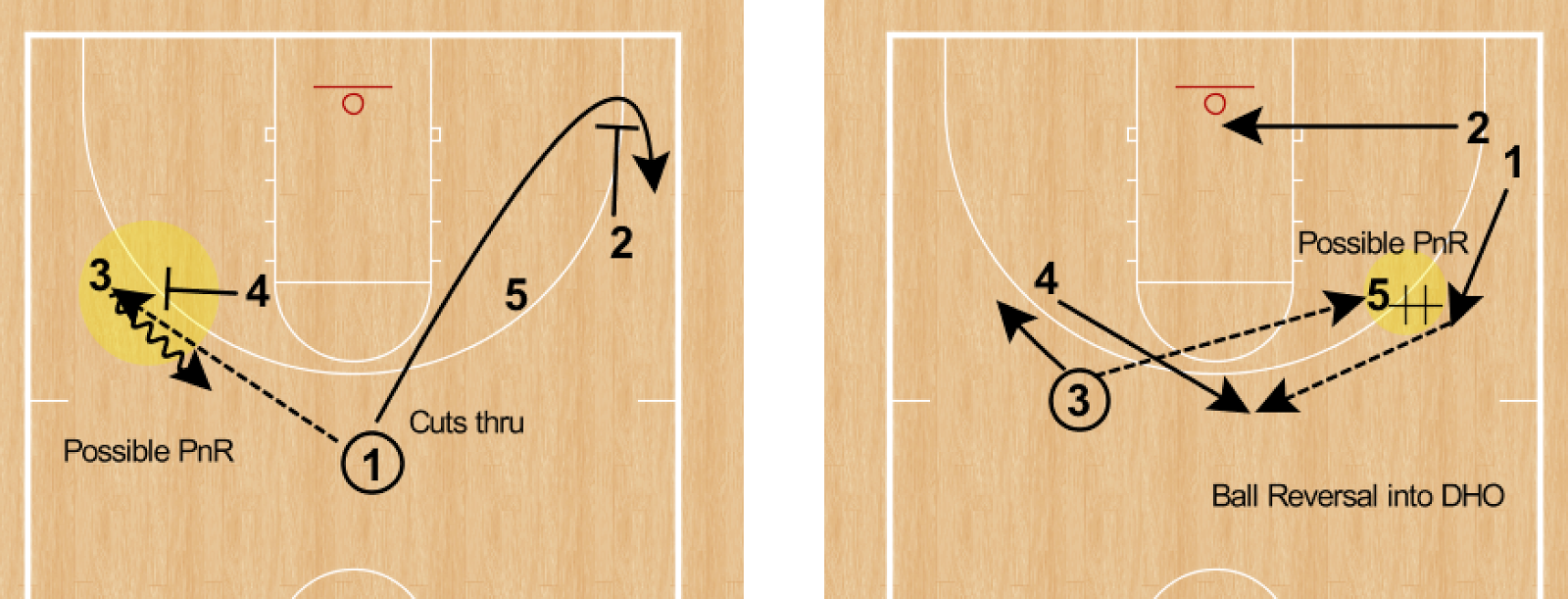
They have run a motion offense designed to set up pick-and-roll and dribble handoff options into perimeter shots.
Diagrams below.
Defense. Gonzaga's defensive success is no mystery. They work hard at practicing closeouts to contest the 3-point shot. That has enabled them to climb the efficiency charts by reducing three-point field goal percentage.
In addition to their perimeter excellence, the Zags' success relies on rim protection by their massive centers...
Clinic Notes: Wes Kosel shares some Gonzaga actions (video and diagrams) at HoopsChalkTalk. And here with a BLOB.
Additional video. Triangle version of Shaka Smart's Circle Trap drill.
The best coaches seldom focus on trickery. They emphasize fundamental excellence and Don Meyer's "mature simplicity." Few's work speaks for itself.
They have run a motion offense designed to set up pick-and-roll and dribble handoff options into perimeter shots.
Diagrams below.
Defense. Gonzaga's defensive success is no mystery. They work hard at practicing closeouts to contest the 3-point shot. That has enabled them to climb the efficiency charts by reducing three-point field goal percentage.
In addition to their perimeter excellence, the Zags' success relies on rim protection by their massive centers...
Clinic Notes: Wes Kosel shares some Gonzaga actions (video and diagrams) at HoopsChalkTalk. And here with a BLOB.
Additional video. Triangle version of Shaka Smart's Circle Trap drill.
The best coaches seldom focus on trickery. They emphasize fundamental excellence and Don Meyer's "mature simplicity." Few's work speaks for itself.
"Lagniappe" and Coaching
Coaching is teaching, adding value. The word "lagniappe" means something extra. Some track its usage to Mark Twain's Life on the Mississippi. He wrote, "It is the equivalent of the thirteenth roll in a ‘baker's dozen.’ It is something thrown in, gratis, for good measure."
Lagniappe might represent "superior service." The restaurant server who knows your name, the driver who offered clients coffee, or the car salesman who sends holiday cards offers lagniappe.
Coaches and players can both give lagniappe. Intangibles matter...kind words, "you're making progress", "I can see a difference", or the most powerful "I believe in you." Players share lagniappe when they run extra sprints, watch more film, or spend more time in the gym.
What have we seen coaches do that's 'more'? Don Meyer kept notebooks of new basketball knowledge, general knowledge, and a third notebook of appreciation for his wife (which he presented to her annually). He answered email at his website, usually within a day.
What do we do for others and ourselves? In medical practice, I encounter patients who are struggling at home or at work. I don't tell them what to do as much as ask them what can they do TODAY to improve their situation or move them toward their five or ten-year goal. Steve Forbes reads at least fifty pages a day. Tim Ferriss and other successful people often meditate and have an exercise program.
What can we do?
- Give more consistently. Brad Stevens complimented Ronald Nored, “He’s the best leader and giver I’ve ever been around.” Nored says, “It’s about how much we’re willing to sacrifice for the betterment of the players.”
- Improve our habits - diet, exercise, and rest.
- Teach players how to improve their habits and discipline themselves.
Lagniappe:
A couple of old Celtics' BOBs.
Subscribe to:
Posts (Atom)