Total Pageviews

Tuesday, August 24, 2021

"The Education of a Coach" How a GOAT Got There (Bill Belichick)

Learn across disciplines, across sports, across eras. This piece shares quotes from David Halberstam's The Education of a Coach about the origins of Bill Belichick. Like him or not, he's garnered eight Super Bowl rings, six as head coach and two as  defensive coordinator. His biggest coaching influence was his father, but other keys included his high school and postgraduate year coach, and Ted Marchibroda. It's worth the read. 

"Find out what the other guys do best-which is what they always want to do, especially under pressure in a big game-take it away from them, and make them do things they are uncomfortable with."

"What football men...admired about him more than anything else was his ability to create a team in an age when the outside forces working against it seemed more powerful every year..."

"Modern media created a Me-Me-Me world, whereas he insisted on a We world."

"His ego was about the doing it and fused into a larger purpose, that of his team winning. It was never about the narcissistic celebration of self..."

"He wanted to bring his players to the highest level of preparedness, hand them an edge in a world where everyone was so evenly matched that any edge might determine the outcome."

"...where the people who took care of the tiniest details tended to be rewarded for it...he was the king of Post-It notes." (Note the pencil...)

"There is no celebration of any victory in the past..."

"He does not allow complacency." 

"...he held on to the most elemental job of all: looking at film."

Of Ernie Adams (Belichick's Belichick) "I was impressed by everything about him - his intelligence in all areas, his almost unique knowledge of football, his work ethic, and his innate decency." 

"...all offenses have weaknesses. The job is to find them."

"In addition to the usual pitfalls - the injuries sustained by key players, the coveted recruits who went elsewhere, the bad calls by referees, there were other forces, like politics." (This references Bill Edwards and Belichick's father Steve Belichick fired from Vandy)

"The most important thing any young coach could learn, he said, was how much football meant to them." - of the athletes at the Naval Academy

"And by watching him, I learned to see the game, how well prepared you have to be and how quickly your eyes have to shift." - Bill Belichick on learning from his father...remember how Pete Newell said a "coach's job is to help players see the game"

"...fame for an assistant coach was not usually regarded by the head coach as a good thing..." 

“…they challenged you, challenged you to reach for more, to work harder than you thought you could and always to think for yourself.”

“He understood from the beginning the one great truth about film, that

the more you ran it, the more you saw.

“…collegial courtesy was not just important, it was mandatory. Coaches tended to look out for one another.”

“You could always give him more-he always wanted more. He always wanted to get better.”

Players respected coaches who could help them play better and who knew things that they didn’t know.”

“Yet he knew that in film there was power…he had been taught by a man who was the best.”

“What I didn’t know, I could learn - one of the things I had working for me was that I knew how to learn.” (Reminiscent of Joshua Lawrence Chamberlain, the Bowdoin professor who commanded the battle of Little Round Top at Gettysburg...)

“The impression he made on colleagues…open-minded, incredibly hardworking, absolutely committed to being a little better every day, and knowing a lot more than most other young coaches.”

“He had this rare ability to place himself in the other team’s position.”

“You’re not here to be their pal. You’re here to coach them, and that often means telling them things they don’t want to hear about doing things they don’t want to do.”

“You had to look at your players and defend every player to the rest of the organization.” (The mantra of the Al Davis Raiders)

“…the more you knew at every minute what you were doing and why you were doing it, the less time you wasted and the better coach you were.”

Ray Perkins on Ernie Adams, "a football mind that was almost apart from other football minds, that he had a very rare gift of being able to look at film, to be able to understand it all, being able to dissect it, store it away, and then be able to call it up whenever he needed it." 

"He was driven by his brain power, and his fascination with the challenge that professional football represented to the mind of the coach as well as the bodies of the players." 

"He was more analytical than most other coaches, and he never lost that analytical ability, not even in the most tense moments of the game." (Post hoc game analysis does no good.)

"...character and a willingness to fit into the system would be of the essence, not just ability." Belichick would not sell free agents with wine, surf and turf, but with football. 

"There had been an attitude among all too many players, he had decided, "that I'm a starter, I own my job, you can't bench me or even rotate me." (Belichick despises entitlement...)

"The younger players came to understand...the better you were, the harder you worked." (That was Belichick's view of life in the NFL as a filtered version of the Al Davis method.)

"...as they got the kind of players they wanted...the players themselves were beginning to buy in and to enforce a winning culture."

The Education of a Coach restates what you expect...hard work and commitment, especially if blessed with insight and aptitude, produce excellent if not always spectacular results. 

Lagniappe (something extra): To err is human, to finish divine. Versatile finishing rocks.


Lagniappe 2: Spacing drill. 

Lagniappe 3: New app from Phil Handy. Not sure I want to invest but the samples are promising. "94feetofgame" available from your app stores. 


Monday, August 23, 2021

Undiscovered Country: (Free) YouTube Internet Basketball Destinations Worth Exploring

Excellence demands curiosity, open minds, and study. Here are a handful of underrated destinations that provide free basketball education. Hearing different voices adds value and perspective for the developing player. 

YouTube channels:

Pure Sweat Basketball Coach Drew Hanlen trains NBA stars like Brad Beal and Jayson Tatum. Need I say more? 


Zak Boisvert. An indefatigable sharer of high level basketball content. 

By Any Means Basketball (Attention to Detail)  Several hundred videos with a wealth of skill training information. 


Mason Waters Coach Waters provides skill training videos, star player breakdowns, and workouts. 

Fundamentos EuroBasketWomen 21 It's a small site with only fifteen videos as of today but the quality is high. In comparison with encyclopedic sites, there is none. Remember David Halberstam's commentary about a twenty-something year-old Bill Belichick in The Education of a Coach, "“He understood from the beginning the one great truth about film, that the more you ran it, the more you saw.”


The young player can see the urgency of the crossover followed by penetration and finishing with a "pro hop." 

John Leonzo. Coach Leonzo is another young gun who's going places. 

Don Kelbick Coach Kelbick is another experienced trainer and coach. Two key principles he espouses are 1) think shot first and 2) leverage your strengths. 


Lagniappe (something extra).

Many more already popular sites earn visits. None of it matters if we don't do the work. 

FIBA, the Basketball Channel (nearly 23,000 videos)


Basketball Immersion

BballBreakdown

Half Court Hoops 

Adam Spinella

Coach Daniel 

M14 Hoops


Sunday, August 22, 2021

Ten Lessons from "Gridiron Genius"

Learn across disciplines. In Gridiron Genius, Michael Lombardi explores his thirty years with Al Davis, Bill Walsh, and Bill Belichick. Mike Lally shares a lengthy review.

Here are translatable highlights:

1. "Champions behave like champions before they’re champions." —BILL WALSH 

As a young player or young coach, develop "professionalism" or something less leaves us short of our best version. Professionals are on time, "off book" and thoroughly prepared. If a player doesn't know her job, how can she do it?  

2. "You start first with a structural format and underlying philosophy, then find people who can implement it.”

Develop a philosophy and complementary approach. Refine and revise. "Basketball is a __________ game" or a "game ____________." What and why? 

Fill the blanks with your beliefs and values:

  • 'sprinting'
  • 'separation'
  • 'cutting and passing'
  • a "game meant to be played fast" (Wooden)
  • a game of finding and exploiting edges
  • a game of "wearing down your opponent" (how?)

3. "Exhibit a ferocious and intelligently applied work ethic directed at continual improvement." 

Excel at what we do a lot. No football winners are poor red zone teams or bad at special teams. Solid basketball teams must: 

  • control transition
  • defeat pressure
  • defend in the half court
  • get quality shots in the half court
  • execute via player development
Mediocrity at any of these guarantees big picture failure. So ask ourselves, how does our teaching and preparation specifically address each

4. "Be willing to go the extra distance for the organization."   

Chuck Daly said, "I'm a salesman." Sara Blakely said, "Make it. Sell it. Build awareness." Representing and promoting the institution is critical to attract, retain, and develop players. It's unrealistic to think players will care more than we do. 

5. Peter Drucker: “Culture can eat strategy for lunch.”

Culture is the product of how we do what we do with whom we do it. Culture translates into ACHIEVEMENT = PERFORMANCE x TIME

That equation applies to a short workout, a full practice, or a career. 

6. "Coaches are first and foremost great leaders."

We earn the right to have followers and leaders make leaders. Not everyone wants to assume the burden and struggles of leadership. 

7. "If someone needed to be critical of a player’s talent, he was to keep it professional. Stay clean and to the point, and don’t denigrate."

Be positive. Grow the time difference between perception and response. Set expectations for coaching to sustain competitive advantage.

8. "Never begin with the end in mind."

Many factors affect player performance - talent, effort, coaching, level of competition, fatigue, injury history. Lombardi warns against groupthink and confirmation bias. Bill Belichick often responds to a question, "We'll see how it goes." 

9. "The best teams force players to prove their value."

A patient who played college football explained that players know who can play and who can't. It's frustrating for players who can't get more opportunities because of bias (e.g. seniority systems) and scholarships (draft status).

10. Find your guys. "Moss displayed another Belichick staple: mental toughness, which the Patriots define as “doing what is best for the team when it might not be best for you.”In New England, Moss was a “program guy”: someone who works hard, is a supportive teammate, and cares deeply about winning. In other words, someone with football character.

Set high expectations. Create opportunities for growth. Be specific in what you're looking for and your plans to add value for individuals and teams. Some coaches constantly lower expectations in hopes of exceeding them. 

Lagniappe (something extra). "Fundamentos" shows short clips of execution of a variety of moves. It's worth a look. 


Saturday, August 21, 2021

Basketball Lessons from Sesame Street: PTRW

Formats evolve. Some stories inform the end first and work backwards. For example, Cold Case or Death in Paradise (BBC) are crime shows where the murder is presented first and then cops solve the mystery. 

Sesame Street educates preschoolers (and grandparents) with segments like "Letter of the Day," musical interludes, counting with The Count, "Elmo's World," and so on. The producers design each show around a central narrative (e.g. family). 

Construct a "basketball" version of Sesame Street. An email, a blog, a practice. 

Central narrative: e.g. PTRW (Play the Right Way) 

  • Our 'characters' share examples of accountability. 
  • They play the right way - focusing and listening, teamwork, playing hard, playing smart. 
  • Control the controllable.
  • Focus on individual and group improvement each day. 
  • One disengaged player who loses her player, commits a bad foul, or takes the wrong shot at the wrong time can undermine an entire season. 
  • Teach the "wrong" ways to play - selfishness, disengagement, laziness, "soft", and poor decision-making contrasts with PTRW. 
  • Win this possession translates to outplaying opponents - play harder for longer

Play of the Day. "It's the ATOs of the day" from Adam Spinella. The "ghost screen" fake DHO rescreen is innovative. 

Teamwork video. The "memorable" film (grainy black and white) from my youth emphasized fixing mistakes. What was that? "Shitbird defense." It wasn't personal. It was about correcting mistakes for sustainable competitive advantage. 

Count ways to PTRW

  1. Respect the game. 
  2. Respect your teammates. 
  3. Respect your opponent. *Some colleges have social media monitors. 
  4. Respect the officials.
  5. Respect the process (practice hard, study the game plan).
  6. Respect yourself. Take care of business (academics). Eat right. Get your rest. Dress warmly during cold Boston winters. "You're no good to us sick." 
  7. We didn't need to be told to respect our coaches. 

Lagniappe. Sell your move. 

Lagniappe 2. Teach resilience. 

Friday, August 20, 2021

Basketball: "What If You Hire This Guy?"

Basketball Friday examines concepts and presents a drill and a set play. 

Imagine you're the interviewer, picking 'the next guy' (who could be a woman). What do you get when you choose? Competence? Confidence? Intensity or psychosis? Baggage? 

What constitutes due diligence? It's not about "gotcha" but whom are we getting? 

  • Character is job one. How has the candidate modeled excellence both on and off the court? P's and Q's matter as much as X's and O's. 
  • Connection. What does it feel like to play for her? Have you contacted not only references but players who played for and with her? 
  • Communication. Does the coach express herself clearly and concisely? 
  • Curiosity. What is the coach's self-improvement process? 
  • Competence. Give the applicant an open-ended opportunity to discuss philosophy and approach to basketball, team culture, player development specifics, and adding value.
How do coaches deal with adversity? Adversity is our companion on life's journey.
  • How have you overcome a major setback in the past? 
  • How can coaches help players develop resilience? E.g. model accountability and compassion. 
  • How do you respond to players/parents unhappy with their role/minutes? Be solution-focused..."these are the areas in which you can improve and the ways to work on them."
Drill. 4-on-4 no dribble. Coach taught us "not to dribble the air out of the ball." Constraints can include no dribble or a maximum of up to 1 or 2 dribbles per touch. Don't play as though you get paid by the dribble. The drill is competitive, includes offense and defense, and is consistent with my coaching belief.


Set Play. Football season is underway. "Middle Screen" pass. 


Lagniappe. "Basketball is a game of separation and preventing separation. Don't learn FIVE, master a couple. 


Lagniappe 2. During shooting practice, invest a few minutes on your "closer" moves, if you're a closer. Invest a couple of minutes on "emergency shots" that come into play end of shot clock, end-of-quarter...runners, fallaways and drifting shots, stepbacks (if that's not a core move). 


Thursday, August 19, 2021

The Psychology and Reality of Winning and Losing Plus Triple Extra (Rocky, Harden, Belichick)

"You're never as good as you look when you win or as bad as you look when you lose." - Earl Weaver 

Mom taught us early, "somebody's gotta win and somebody's gotta lose."

There's a result-performance hierarchy

At best there's the hero box and at worst the 'goat horns' box. But secondary effects occur such as the Oklahoma woman's team player who sulked when not scoring because her father denied her emotional access when she wasn't filling the scorebook. 

Loss aversion studies show that loss feels about twice as badly as winning feels good. In sports, that may have nuance. For example, in development, we experience "good losses" as a worthy opponent and heavy underdog. And at many levels, we have unsatisfying wins, winning while playing poorly. 

Self-awareness of process and results. Reflect on the link between process and results. 

Attribution bias casts ourselves in a positive light. When we win, we exult in our achievement and when losing we blame field conditions, officiating, weather, or bad luck. 

Scapegoating assigns blame for losses. "Scapegoat theory refers to the tendency to blame someone else for one's own problems, a process that often results in feelings of prejudice toward the person or group that one is blaming." Scapegoating allows us to protect our ego during setbacks. In Gridiron Genius, Mike Lombardi asserts the difficulty of playing for Jon Gruden who takes credit for wins and disperses blame on players for losses. 

Resulting occurs when we overrepresent outcomes on skill or decision-making and ignore the impact of luck. In Thinking in Bets, Annie Duke estimates poker results as about three-quarters skill and a quarter luck. She points out that the Pete Carroll pass decision leading to Malcolm Butler's interception was a low probability event amidst a reasonable decision tree. 

Live by design with private and public statements in the heat of battle. Don't crush the souls of children through ill-advised speech. Recall President Lincoln's hot letters "never sent, never signed." Another alternative is the '24-hour rule' of holding fire. That doesn't preclude coaching and motivation, but what is reasonable for for older adolescents may be abusive for children. 

Lagniappe. "See yourself doing right and you do right." 

Lagniappe 2. The magic of Harden, slowed down. "You can't go anywhere without your feet." 

Lagniappe 3. From Michael Lombardi, "Gridiron Genius" 

"COMMAND OF THE ROOM Followers need something to commit to. Great leaders know how to grab a team’s attention and then show them what they’re all fighting for. As Belichick says, “Unless commitment is made, there are only promises and hopes but no plans.” You can’t buy into a plan unless one is laid out clearly and plainly for the entire franchise.

He cared only about what was ahead and how to move forward with a collective blueprint that gave them the best chance of victory.

COMMAND OF THE MESSAGE

Players can’t accomplish anything unless they can visualize the path.

COMMAND OF SELF

Personal accountability is the ultimate sign of strength. When a leader admits mistakes, it shows the team that he expects as much from himself as he does from his players.


Wednesday, August 18, 2021

Basketball: Theory and Practice, Raw Data Versus Analysis, True Shooting and More


Basketball theory and practice diverge. Dr. James Naismith warned, "basketball is an easy game to learn and a difficult one to master.

One of my pet peeves is raw data. "Susie led the Appaloosas with twelve points." That gives no insight as to her scoring effectiveness. She may have scored on four shots or twenty. 

The video explains measures of scoring efficiency. I'm not saying that data manipulation turns mediocrity into excellence. But data is nuanced and true shooting percentage tends to be 'normally' distributed. 


"Well, that's bad coaching." As far as the NBA 2021 true shooting percentage leaders, no Boston Celtics player landed in the top 80. Not to say that shooting is independent of coaching. 

The NBA True Shooting Percentage is 56%. 


Career True Shooting Percentage Leaders. FYI, Wilt Chamberlain had a career true shooting percentage of .547 and NBA Finals TSP of .529. Free throw shooting drags the number down. Michael Jordan's career TSP was .569. Larry Bird's was .564. Magic Johnson's was .610. Walt Frazier's was .542. Sam Jones (Mr. Clutch?)....503. Pete Maravich was .500. It's one measure, not the Holy Grail. 

Player proficiency at three point shooting has raised the TSP of the top players. Always consider statistics in the context of the era. 

"Statistics don't mean that much." Maybe it depends on which statistics we examine, for example VORP.


If we look at VORP (value over replacement player), the top five are Jokic, Curry, Giannis, Doncic, and Lillard. 

"I know what I see (the eyeball test)." Get granular. "It's the details."


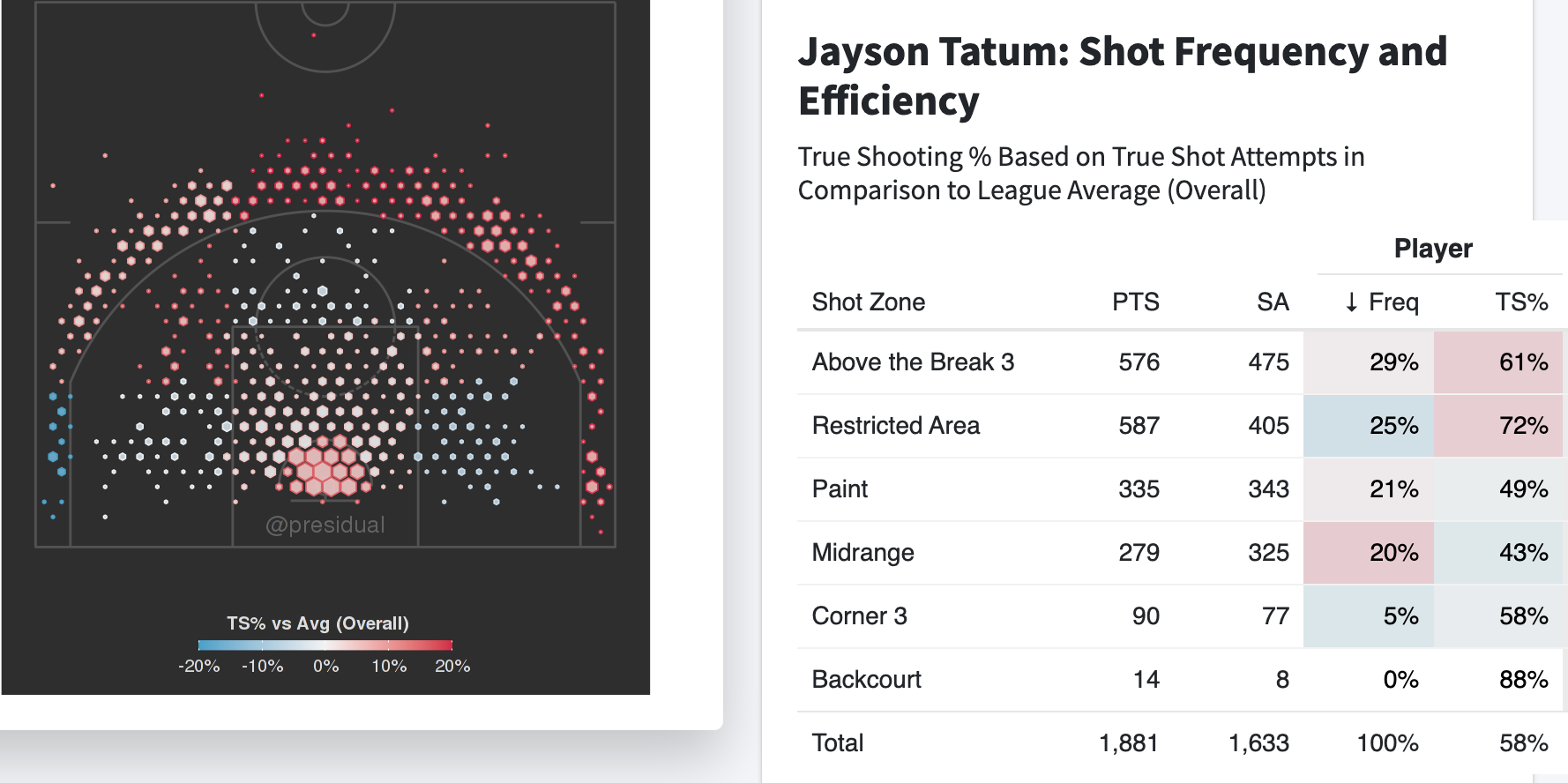
Jayson Tatum shoots best in the restricted area (despite "contestedness") and his midrange game isn't nearly as good as I would have guessed. Although his corner 3 percentage is lower than above the break, he takes relatively few. 


Kevin Durant had a 65 percent true shooting percentage and is effective almost everywhere.

With more data, granular analysis is better. 

Lagniappe. Thoughts on building vision. I think you have to play and study the results and watch the film. 


Lagniappe 2. Simple actions create high quality shots. 


Lagniappe 3. Learn across disciplines. "The Swedish Investor" shares "The Psychology of Money" from Morgan Housel. Lessons translate.

1. "Pay the price." You want to excel? 
2. What is enough? Each of us decides.
3. What are our values? Stick to our circle of competence. 
4. Peekaboo. We cannot see around corners. The unexpected. Black swans.
5. The Seduction of Pessimism. Pessimism doesn't pay. 


"Let’s say you put two finance basketball experts in front of each other. Both will come up with their own best strategies. Although both are experts on the same topic basketball, they may make different decisions. What’s causing that? Beliefs cause the difference in the opinions.

Give an example. At one point, Coach John Calipari parlayed '1 and done' recruiting into epic success. Others chastised him for his approach...and then copied him. "Try to come up with your own ideas. Experiment yourself."

"Most of us aren't good at compounding... If you keep writing every day for a year, you won’t be the same person anymore. I mean, you would turn into an amazing person. Put another way, if you keep adding small victories each day, you will become highly skillful." Or as I say, "we make our habits and our habits make us." There's "negative compounding" too. If we buy a $3 coffee every day for 10 years, that's far more than $10,000 in coffee buys. 


Tuesday, August 17, 2021

Distributed Team Leadership: The Water Carrier

It's easy to forget the "water carrier" an unsung hero in the shadows of stars. 

First stanza of Kipling's poem, "Gunga Din" where the lowly water bearer saves the hero and sacrifices his life in service. 

Leaders serve. In The Captain Class, Sam Walker shared how a Manchester footballer, Eric Cantona, disparaged a Juventus midfielder, Didier Deschamps as a water carrier. Deschamps seldom scored but won multiple championships including a World Cup. When Juventus beat Manchester, Deschamps was asked how he felt about it. "I don't mind." Water carriers make plays more often than headlines. 


Walker discusses other Water Carriers like USWNT soccer star Carla Overbeck and the Spurs Tim Duncan who helped author five NBA titles. Validation comes from more than big numbers. 

Water carriers have other names... anteambulo ("I walk before") and 'glue guy' for a couple. Find guys willing to do the grunt work without celebration. 

"Water carrier" often carries a negative connotation as a subservient figure, such as junior members of Congress who buttress positions of senior politicians or even media networks who do the same. Remember the rule of threes - live three minutes without air, three days without water, and three weeks without food. Water is life. 

In 2004, the Red Sox made a deadline deal trading star Nomar Garciaparra for  steady but unspectacular shortstop Orlando Cabrera and first baseman Doug Mientkiewicz. All they got was their first championship in eighty-six years.

Water carriers help earn titles...Robert Horry, Bruce Bowen, Shane Battier. 

What do water carriers do? Focus. Work. Sacrifice

Who are water carriers? Secure in their role, adding value. They aren't needy. And they can get paid (Marcus Smart, $77M, 4 years). 

Water carriers illustrate "distributed leadership" where production matters not just years of experience or title. "The emphasis is upon interdependent interaction and practice rather than individual and independent actions associated with those with formal leadership roles or responsibilities."

Lagniappe. "Live be design." Do not be a victim. 

Lagniappe 2. Coach Hanlen shows the value of momentum transfer to get separation out of the triple threat position. 


Monday, August 16, 2021

Basketball: Fundraising (Possibilities and Pain)

Every coach hates fundraising; it's just a matter of degree. Having 'served time' on the booster club, I know the drill. If every grain of sand in the Sahara had HATE written on it, it wouldn't be enough. 

First, I'm not making recommendations and thankfully I was never in charge of the boosters, the banking, or anything. Second, comply with whatever the legal and tax regulations are in your community and state. Third, don't underestimate the time component needed as you won't be paid for it. 

Not saying these ideas are comprehensive or the best. I believe there's merit in "reciprocation," provide some value for the donation. Possibilities are offered in no particular order. 

1. Raffles $$ "You pays your money and you takes your chance." The mechanics are simple and you can offer a discount, a chance for a dollar, six for five dollars and so forth. I've seen "higher end" raffles where someone offers their beach or ski house for a weekend, so the "prize" has value. A "raffle basket" displayed at home games (with various items from lottery tickets to gift certificates) is the gift that keeps on giving.

Some well-attended events have 50-50 split cash raffles during games with winners announced during half-time.  

2. Casino/Poker night $$$$ This is complicated and ideally should run with professional support. The operators may have a fixed fee or take a percentage. It won't be cheap. The organization splits the rest with the top players. Overhead (e.g. hall rental, law enforcement official) also comes into play. 

3. Comedy club evening $$. Who doesn't enjoy a night out? Donors enjoy a show and dinner and pay extra for their donation. 

4. Discount cards $$. Cards offer more value than a raffle and sell for a nominal "donation" (e.g. 10-20 dollars) and have removable 'tickets' for small discounts at area restaurants/shops. 

5. Car wash $$$. In our community, you go to the high school and get your 'free' car wash (performed by the players) and make a donation. Why not sell raffle chances while you're at it? 

6. Bake sale $. Cookies and cakes for cash. 

7. Concessions $$. The Booster Club sells water, candy, and snacks (e.g. chips) at home games. 

8. Freeze and bake cookies $$. Players sell frozen cookie dough of various types and profits on the difference between cost and charges. Think 'Cookie Girls' with better tasting cookies. 

9. Program book $$$$. The program book contains coach, team, and player biographies along with photos. Assembly and printing aren't cheap. The income comes from advertising from local businesses (depends on the size of the ad) plus 'well wishes' from parents and relatives. You can charge (for example) for an eighth of a page (think business card), a quarter, half, or full page ad and extra for the back cover. Of course, somebody has to sell the ads, organize the book, the printing, and so forth. It's a lot of work but generates high revenue. "Nothing is impossible for the man who doesn't have to do it." 

10. Shooting contests $. Half-time shooting three-pointers for a dollar a chance and a t-shirt for a make. Not much bang for the buck. 

11. In season (school vacation) basketball camp $$$$. Three or four day camp over February school vacation, operated by the coach and players (volunteers). There's a gym rental and custodian fees. If you're in a basketball hotbed, this is a high earner. Check out the insurance/liability implications. Dead in the water with COVID-19.

12. Restaurant sales $$. Arrange for a small percentage of takeout restaurant sales during a fixed date and time (e.g. a Tuesday 5-8 p.m.) for customers who designate themselves as event customers. The restaurant gets extra business and the Booster Club gets a boost. And sell more raffle tickets?

13. Canning $$. Think panhandling with coffee cans outside of popular local businesses. There's virtually no overhead and "player volunteer teams (two players)" collect donations for a couple of hours. This is my least favorite form of fundraising and I discourage it.

14. Alumni Game $$-$$$. Alumni donate to play and you may be able to attract fans willing to pay a nominal admission to watch "old timers." The alums get a T-shirt and get to see old friends. This combines fun and has potential if the fan interest is there. And sell concessions and more raffle tickets? 

15. Miscellaneous. Maybe Bill Gates lives in your town. Or some lesser known luminary with deep pockets and a philanthropic bent. Gloucester, MA has "New Balance Field). 

Where does the money go? The money can defray expenses of the end-of-year banquet, trophies and other awards, and swag (e.g. team sweatshirts, etc.). If you raise enough, you might earn capital equipment (e.g. a shooting machine, uniforms). 

Lagniappe. You've all seen it or run it. Once in awhile it works. 


2. Lagniappe 2. "Vaguely right beats precisely wrong." Mental models cross disciplines. Love or hate analytics? Beware precision. 


We make assumptions about 'our' team. Consider the Red Sox, just awful last year with Chris Sale recovering from Tommy John surgery and Eduardo Rodriguez with COVID-19 cardiomyopathy. Subtract the best two players from YOUR team and how good will you be (lack of talent shows up as bad coaching)? 


Sunday, August 15, 2021

Basketball: Ten Simple Tips That Win Games

Celtics owner Wyc Grousbeck introduced my wife (a rocket scientist) to Brad Stevens. Coach Stevens said, "Basketball's not rocket science." About a third of games are decided by two possessions or fewer. Attention to detail gets the odds on our side. 

What simple tips help win games? Coaches' core concepts are NOT what players know. They need constant reminders and regular quizzes, "why?" 

1. "Sprint." Basketball isn't a running game, it's a sprinting game. Beat your man to halfcourt in transition defense. Complacency kills. 

2. "Show your hands." Don't give referees a reason to call fouls. If it looks like a foul, it will probably get called. 

3. "Dead man's defense." Don't play six feet under the ball. Coach Brown used to yell at defenders, "Don't back down." Balancing ball pressure and ball containment matter each possession. Coach Wooden said, "make every day your masterpiece." I wish he'd said, "make every possession your masterpiece." 

4. "Wait, wait, wait." It's better to be late than early coming off screens. This reduces the chance of offensive foul calls and allows you to read the defender's response as you cut, curl, back cut, or "bump." 

5. "Silent teams lose." Talk begins in practice. Habits take time (at least three weeks) to establish. Calling screens, cutters, and announcing help intimidates. The best "habit book" is James Clear's Atomic Habits. 

6. "Red." Have a call to demand maximum ball pressure. When fronting the post, ball pressure reduces the chances of passers throwing "over the top." It also reminds back side help of their responsibilities.

7. "Load." Load to the ball. Defend 1.5 (one and a half players). 


8. "Run wide." Spread out the defense in transition and improve angles to catch and attack the basket. 

9. "The ball scores." The player who says, "my guy didn't score" misses the point. 


10. "Play Tag." Off-ball defenders must "tag" cutters. 


Lagniappe. "Fake it to make it." 

Kelly Olynyk has one of the best shot fakes I've seen.  

Lagniappe 2. What's the "best" coaching book? That doesn't exist as books serve different purposes. Two great "leadership" books are Legacy (James Kerr) and The Score Takes Care of Itself (Bill Walsh). Neither are basketball books. 

Great coaches don't necessarily write books that help us become better coaches. I won't throw shade on anyone, but a couple were a waste of time and money. A highly underrated book is Herb Brown's Preparing for Special Situations


Saturday, August 14, 2021

Basketball's Holy Grail: Making Other Players Better (Plus a Lagniappe SLOB and More)

Ambitious players know that making other players better marks greatness. Bill Russell said, "my ego demands the success of my team." 

Payton Pritchard said, “What separates good point guards from becoming great is the ability to make people around you better, get people easier shots and control the game. Obviously that’s what I’m trying to become, so I’m going to keep working on that.”

Invert. Who and what doesn't make teammates better? Selfishness, sloth, and softness add nothing to teams. So what does?

Leadership. Leaders serve their teammates. In the extreme, they make teams special. In Sam Walker's, The Captain Class, he profiles leaders whose presence made champions. 


Vasily Vasiliev was one of the leaders of the Soviet hockey squad that lost at Lake Placid in 1980. On the return flight to Moscow, Coach Viktor Tikhonov blamed individual players for the loss. Vasiliev exploded. "I will throw you out of this airplane right now." The Russians fell apart in the future, right? 

They regrouped to establish an even higher level of excellence. 

Decision making. Success relates to making the right decisions and executing. Turnovers and failures are the opposite, poor decisions or bad execution.  


From Zak Boisvert...

Awareness. Execution relates to situations. A poor shot or turnover in a blowout has no consequences. But good coaches use them as teachable moments. The same actions in crunch time may get viewed as a soul crushing choke. 

Offense.  Space, cut urgently without the ball, screen, assist and get hockey assists, keep rebounds alive, take quality shots. 

Defense. Bring energy, energize teammates, get on the floor, communicate, take charges, get deflections, block out. 

"Right away, the MIT study confirmed what we all suspect: that communication matters. Whether a team was packed with talented, intelligent, and highly motivated individuals, or whether it had achieved solid results in the past, its communication style on any given day was still the best indicator of its performance."

Intangibles. Be coachable, support your teammates, find ways to make a difference on and off the court. Here's a final quote from The Captain Class, "Our brains are capable of making deep, powerful, fast-acting, and emotional connections with the brains of people around us. This kind of synergy doesn’t require our participation. It happens automatically, whether we’re aware of it or not."

Lagniappe (something extra). 


SLOB creates driving gap. 

Lagniappe 2. "Every day is player development day." My ankles hurt just watching...